Hollandaise Sauce
from 1950 edition Betty Crocker Cookbook
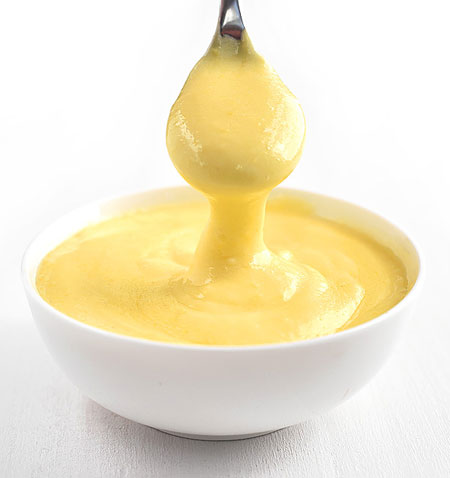
Hollandaise sauce is the traditional partner for asparagus, artichokes, Eggs Benedict and fish.
Hollandaise is notoriously difficult to make well and to hold. Properly made it should be smooth and creamy, and if beaten long enough will hold its shape as firmly as whipped cream. It tastes very rich and buttery, with a mild tanginess added by the lemon juice and seasonings. It must be made and served warm, but not hot. If the ingredients are not mixed properly, or if they are kept too cold or too hot, they will separate, resulting in an oily mess filled with particles of egg yolk. Hollandaise Sauce curdles at 180 degrees F. It should never be boiled after the eggs are added. The liquid should be heated to a sufficient point, however, to allow egg proteins to thicken it.
Some people like to make Hollandaise in a blender. Blender or processor hollandaise is a very thick, smooth sauce. Cooked hollandaise, on the other hand, is a fluffier, more delicate sauce.
I like this recipe for Hollandaise sauce because it uses a lot more water than other recipes, cutting down on the calories in the sauce. Some recipes even do not use any water. Adding some water definitely makes the sauce lighter.
Eggs Benedict: Recipe makes enough for 3 servings (1 serving = an English muffin split in half, each with Canadian bacon and a poached egg.)
1/2 c. butter (1 stick)
4 egg yolks, at room temperature
3/4 c. boiling water [use just 1/2 c. so the sauce is thicker, one chef uses 1/4 c. for every 2 egg yolks]
pinch cayenne pepper
1/4 tsp. salt (omit if using salted butter)
2 T. lemon juice
[My revised instructions from How to Make a Satiny, Full-Bodied Hollandaise Sauce:
Melt the butter and keep it warm.
Whisk the eggs in a double boiler over medium low heat, and slowly add the hot water, whisking the whole time. Off the heat, continue to whisk the eggs and water for 30 seconds, move your whisk laterally, just purely back and forth at fast speed, with the occasional mix to ensure homogeneity (an electric beater with a whisk attachment or whisking up and over in the sauce adds too much air making it foamy).
Cook the sabayon over very low heat, whisking constantly and scraping the bowl, until thick and voluminous. The whisk will leave tracks that hold for a few seconds. This will take some time, so do not rush it. After making this several times, you will get a feel for when it is ready.
Note: Cook the eggs too much and you get scrambled eggs. Don't cook them enough, and your sauce won't thicken. If it looks like the eggs are going to curdle, pull the top pan off the double boiler and whisk to cool, as in the next step.
At this point, take it off the heat and whisk rapidly for 30 seconds to cool it slightly. Add the melted butter a little at a time, whisking constantly. Be sure the butter isn't too hot or it will break the emulsion.
Add the cayenne pepper, the salt and lemon juice. Taste and adjust seasonings.]
Betty's instructions:
Beat eggs until very light and fluffy.
Melt butter in the top of a double boiler - be sure that the top pot does not touch the water in the bottom pot. Remove from the heat and slowly ladle small portions of the butter into the eggs, whisking all the time. This is called tempering the egg, which means that you slowly heat it so that you can add it to something hot without it immediately cooking and scrambling. Gradually stir the egg yolks into the butter, again whisking all the time, so that the eggs remain light and fluffy.
Slowly whisk in boiling water. Cook over very low heat until the sauce starts to thicken, whisking all the time, or let set over the hot water in the double boiler. Too much heat will break the sauce and the eggs will start to scramble. Remove from heat and add the last three ingredients. Keep warm in a thermos [or in a double boiler that has hot water in the bottom pan] until ready to serve.
Store covered in refrigerator. To serve refrigerated sauce, reheat over very low heat and stir in a small amount of water.
Blender Method: Hollandaise Sauce has a tendency to break. Try making the sauce in a blender. Put the beaten egg yolks and water in an electric blender. Flick on and off quickly; the mixture should be light and fluffy. Melt the butter and heat until bubbly but not boiling. Turn blender on high speed and dribble the hot butter slowly into the beaten yolks through the hole in the lid until the sauce thickens. The heat from the butter will start to cook the eggs. Add the last three ingredients. FMM: This did not work well for me. Did not thicken enough.
Susan Spungen uses 1 tsp. cornstarch to stabilize the emulsion helping to prevent the sauce from breaking:
Whisk 3 egg yolks in a small saucepan until smooth, about 1 minute. Add 1 tablespoon cold water, 1 tsp. cornstarch, 1 tsp. Dijon, 1 tablespoon lemon juice, and 1/2 teaspoon salt; whisk until thoroughly combined. Add 1 Tbsp. cold butter to egg yolk mixture; place over very low heat. Cook, whisking constantly, until thickened and bubbles have disappeared, 1 to 2 minutes, being careful not to curdle egg mixture. (If egg mixture looks anything but perfectly smooth, remove from heat, and cool briefly, whisking constantly.)
When butter is completely incorporated and mixture has thickened, immediately add remaining 1 tablespoon cold butter; remove from heat, and whisk until smooth. While whisking egg yolk mixture constantly, slowly add 2 tablespoons melted butter, 1/4 teaspoon at a time, until mixture begins to thicken, about 1 minute. Whisking constantly, add remaining 10 tablespoons melted butter, 1 tablespoon at a time, until sauce is smooth, about 2 minutes. Whisk in cayenne, remaining 1/2 tablespoons lemon juice, and remaining 1/2 teaspoon salt. Add warm water, 1 teaspoon at a time, as needed until sauce is thin enough to spread out on its own a bit but still thick and billowy. Cover pan, and move to back of stove, or set over another pan with hot water in it, to keep sauce warm. Add more warm water to thin if needed after resting.
https://www.foodandwine.com/recipes/eggs-benny-toast
Notes:
If the Hollandaise starts to curdle, beat in 1 tablespoon of cold water or add an ice cube and beat it in as it melts. This will bring the temperature of the sauce down. It is also a good idea to have a bowl of iced water by you when you make Hollandaise sauce. If the sauce begins to separate you can plunge the base of the pan in the water as well as adding the cold water or ice cube.
Whipped butter makes a very light and wonderful sauce. You can try whipping your own.
Variations:
Moutarde Hollandaise (good with fish, vegetables, and eggs): add 1 tbsp. dry mustard with the salt and pepper. Substitute 1 1/2 tbsp. tarragon vinegar for the lemon juice.
Mousseline Sauce (for fish, eggs, artichokes, broccoli, cauliflower): Make the Hollandaise sauce as above. When ready to serve, fold in 1/4 cup cream which has been beaten stiff. Serve warm with artichokes or artichoke hearts, eggs, fish or shellfish. Also known as Sauce Chantilly.
Madame Benoît's recipe for Mousseline uses whipped egg whites instead of whipped cream
Sauce Divine - - If reduced sherry is first folded into the whipped cream, the result is Sauce Divine.
Sauce Béarnaise: the sauce of choice for Chateaubriand and beef steaks. It is made by replacing the acidifying agent (lemon juice) with a strained reduction of vinegar, shallots, fresh chervil, fresh tarragon and (if to taste) crushed peppercorns. Good with green beans, salmon, beef, broiled chicken, lamb, and egg dishes.
Other Variations:
Sauce Aux Capres - add drained capers
Sauce Maltaise - - hollandaise to which blanched orange zest and the juice of blood orange is added. Commonly served with fish and asparagus
Sauce Noisette - - Hollandaise made with browned butter (beurre noisette). Good with vegetables, fish, eggs and meat
Sauce Bavaroise - - hollandaise with added cream, horseradish, and thyme.
Sauce Foyot - - add meat glaze (Glace de Viande) to Bearnaise; also known as Sauce Valoise. Grilled meats and offal
Sauce Choron - - Sauce Foyot plus tomato purée. Grilled meat and poultry
Sauce Colbert - - Sauce Foyot with addition of reduced white wine.
Sauce Paloise - - Sauce Bearnaise but substitute mint for tarragon (great with Lamb and grilled meats).
Sauce Creme Fleurette - - hollandaise with crème fraîche added
Sauce Dijon - - add Dijon mustard to hollandaise (also known as Sauce Moutarde or Sauce Girondine).
Sauce vin Blanc (for fish) - - add reduction white wine and fish stock to hollandaise
Bavaroise - - Flavor profile: Crayfish butter, whipped cream, and diced crayfish. Typically served with: Fish tail meat
