How to Make a Satiny, Full-Bodied Hollandaise Sauce
by James Peterson, From Fine Cooking, December 1, 1999
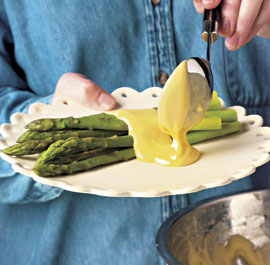
Clarified butter and vigilant whisking
are the keys to this thick, sumptuous
hollandaise sauce.
There's no denying the irresistibility of hollandaise sauce, especially one that's well made: thick yet airy, with a rich, buttery flavor brightened with a splash of lemon juice. Hollandaise, or its sister sauce Béarnaise, is wonderful at the holiday table, whether paired with poached eggs for a New Year's brunch or with beef tenderloin for Christmas dinner.
Making hollandaise can be tricky, however: it's easy to overcook, it can separate (break) for seemingly no reason, and it can turn out disappointingly thin or heavy and gluey. Knowing how to avoid these pitfalls—using the proper heat, getting the right ratio of eggs to butter, using clarified butter, and whisking to incorporate air—will go a long way toward making a successful sauce. It also helps to know that a broken sauce can be fixed.
Not one, but two emulsions
One reason hollandaise is challenging is that you're trying to coax together liquids that don't normally mix, making what's called an emulsion. First egg yolks and water are whisked together over heat to create a fluffy initial emulsion, which the French call a sabayon (not to be confused with a sauce sabayon, which is a dessert sauce). Butter is then slowly incorporated into the yolk-water emulsion, creating another emulsion.
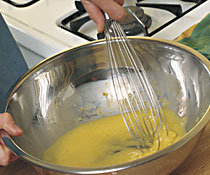
Whisk the eggs and water for 30
seconds off the heat. Lift the whisk
high in the bowl as you work
to whip lots of air into the eggs.
Cooking the sabayon can be tricky. Undercooking the sabayon results in a sauce that's too thin; overcooking it creates coagulated lumps. This kind of curdling can't be repaired. The good news is that if the sabayon does go awry, it's easy enough to start over with a few new egg yolks since you won't have wasted any butter yet.
Skip the double boiler for better heat control. Many hollandaise recipes suggest using a double boiler. I find that this offers a false sense of security since a double boiler offers no guarantee against overheating. Instead, I cook the sabayon directly over low heat.
A Windsor pan (a saucepan with sloped sides) works best for cooking the sabayon because the eggs aren't able to collect in the corner of the pan where, out of the reach of the whisk, they can easily overcook. A heavy-duty metal mixing bowl—you have to hold it on one edge with a kitchen towel—also works well.
Get ready to whisk a lot. A metal whisk is vital to making hollandaise sauce. Vigorous whisking, using a left and right motion in the sauce (not up and over which can incorporate too much air), protects the eggs from overcooking and incorporates a bit of air into the sabayon. Be sure to lift the whisk in the bowl to help accomplish the latter.
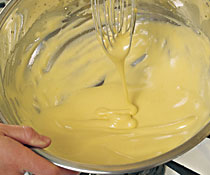
Cook the sabayon over very low heat,
whisking constantly and scraping the
bowl, until thick and voluminous.
The whisk will leave tracks that hold
for a few seconds.
Use clarified butter for a smooth sauce
Chefs differ on whether to use softened butter, melted butter, or clarified butter. Each has its merits and its flaws. Softened whole butter may have the most buttery flavor, but much of the airiness of the sauce will be lost because the butter will need more whisking as it's added to the sabayon. Melted butter also has a full flavor but will result in a thinner sauce because butter is about 25 percent water. If you want a thick sauce with the smoothest texture, clarified butter—butter with the water and milk solids removed—is your best bet.
After making the clarified butter, let it cool slightly before you add it to the sabayon. It should feel hot but not scalding; otherwise, it might break the sauce. Add the butter slowly and steadily, whisking all the while.
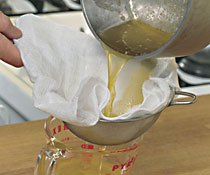
Clarified butter—which has the milk
solids strained out—makes the
thickest, smoothest sauce.
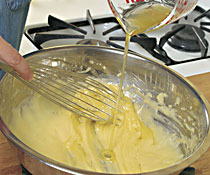
Add the butter a little at a time,
whisking constantly. Be sure the
butter isn't too hot or it will break
the emulsion.
How to fix a broken sauce
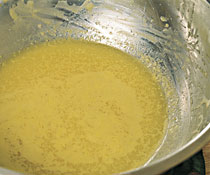
A broken sauce can be saved. Whisk
another yolk with a tablespoon
of water and then very gradually
whisk the broken sauce into the yolk.
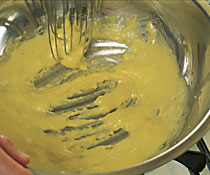
If you overcook the egg yolks—
essentially scrambling them—the
sauce is beyond repair. You will
have to start over again using lower heat.
A broken sauce is a sad sight: thin with a grainy appearance. The likely causes are overheating, adding the butter too quickly, or adding too much butter.
If a sauce seems too thick or on the verge of breaking—you'll see oily butter begin to accumulate on the edge of the sauce— you can often save it if you act fast. Take the sauce off the heat and slowly whisk in a tablespoon of cold water (some chefs add an ice cube) or heavy cream (which is cold and a great emulsifier besides).
If the sauce actually breaks, it can usually be repaired by very slowly beating the warm sauce into a yolk that has first been whisked vigorously with a tablespoon of cold water or heavy cream. (You're basically starting the emulsion process over.) A repaired sauce won't be as light, but it will be acceptable for most uses.
The Recipe: Hollandaise Sauce
10 oz. (2-1/2 sticks) good-quality unsalted butter
3 large egg yolks
3 Tbs. water
2 tsp. fresh lemon juice
Salt and freshly ground pepper to taste
In a heavy-based saucepan, melt the butter. Simmer it rapidly for at least 10 min.; the water will evaporate and the milk solids will coagulate on the bottom and sides of the pan. Let the melted butter sit for a few minutes so the solids will fall to the bottom. Skim off the foam on top and then either decant the golden liquid, leaving the solids behind, or pour the melted butter through a cheesecloth-lined strainer. Put the eggs and water in a Windsor pan (a saucepan with sloped sides) or in a heavy-duty metal mixing bowl (you'll have to hold it by one edge with a kitchen towel over the burner). Off the heat, whisk the eggs and water for 30 seconds, whipping in lots of air. Cook the sabayon over very low heat, whisking constantly and scraping the bowl, until thick and voluminous. The whisk will leave tracks that hold for a few seconds. At this point, take it off the heat and whisk rapidly for 30 seconds to cool it slightly. Add the clarified butter a little at a time, whisking constantly. Be sure the butter isn't too hot or it will break the emulsion.
Finish by whisking in the lemon juice and seasoning with salt and pepper.
Yields about 1-1/2 cups.
Her Sister: Béarnaise Sauce
To make béarnaise sauce, you use the same technique as for hollandaise sauce, replacing the lemon juice with a reduction of wine, vinegar, shallots, and tarragon.
For the reduction:
2 medium shallots, minced
1/4 cup dry white wine
1/4 cup white-wine vinegar
10 crushed black peppercorns
4 large sprigs fresh tarragon
Salt to taste
For the sauce:
10 oz. (2-1/2 sticks) good-quality unsalted butter
3 large egg yolks
3 Tbs. water
Salt and freshly ground pepper to taste
To make the reduction: Combine the shallots, wine, vinegar, peppercorns, and tarragon in a heavy-based saucepan and simmer over medium high until 2 Tbs. of liquid remains. Strain and discard the solids.
To make the sauce: In a heavy-based saucepan, melt the butter. Simmer it rapidly for at least 10 minutes.; the water will evaporate and the milk solids will coagulate on the bottom and sides of the pan. Let the melted butter sit for a few minutes so the solids will fall to the bottom. Skim off the foam on top and then either decant the golden liquid, leaving the solids behind, or pour the melted butter through a cheesecloth-lined strainer. Put the eggs and water in a Windsor pan (a saucepan with sloped sides) or in a heavy-duty metal mixing bowl (you'll have to hold it by one edge with a kitchen towel over the burner). Off the heat, whisk the eggs and water for 30 seconds, whipping in lots of air. Cook the sabayon over very low heat, whisking constantly and scraping the bowl, until thick and voluminous. The whisk will leave tracks that hold for a few seconds. At this point, take it off the heat and whisk rapidly for 30 seconds to cool it slightly. Add the clarified butter a little at a time, whisking constantly. Be sure the butter isn't too hot or it will break the emulsion.
To finish the sauce, whisk in 1 Tbs. of the reduction (or more to taste). Season with salt and pepper. Stir in finely chopped tarragon, if you like.
Yields about 1-1/2 cups.
Holding and storing
Hollandaise and its sister sauces are best made close to serving. They can be kept warm for an hour in a covered saucepan in a hot—but not too-hot—water bath. You can also store the sauce overnight in the refrigerator. To reconstitute it, melt the sauce gently. Meanwhile, whisk an egg yolk with a tablespoon of water over medium heat until the yolk begins to stiffen. Gradually beat the melted sauce—it will look severely broken—into the yolk. The sauce should come back together but it won't be as light as the original sauce.
