Velouté Sauce
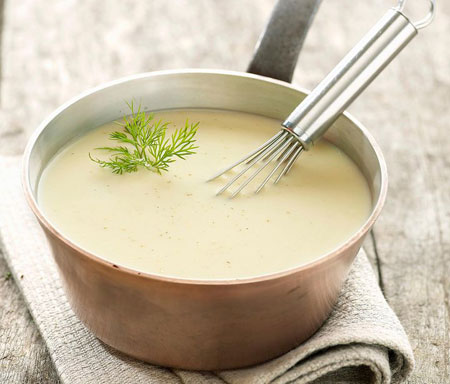
Chicken velouté
Velouté (pronounced "vuh-loo-TAY") translates to “velvety” in French, and that is exactly what this sauce is. It’s one of the five French mother sauces, and has a delicate, silky-smooth texture and mild, savory flavor. If you are familiar with Béchamel Sauce (also called White Sauce), it is made the same way except meat or fish broth is used in place of the milk.
In preparing a velouté sauce, a light stock (one in which the bones used have not been roasted), such as chicken, veal, shellfish, or fish stock, is thickened with a blond roux. Thus the ingredients of a velouté are butter and flour to form the roux, a light chicken, veal, fish stock, or shellfish stock, salt and pepper for seasoning. Commonly the sauce produced will be referred to by the type of stock used e.g. chicken velouté.
There is a huge difference between gravy made from pan drippings, as found in English style gravies, and a sauce. Gravies are made in the skillet or pan from the drippings of cooked meats, then thickened with flour, cornstarch or arrowroot. Whereas sauces, made with stock, have to stand on their own, not relying on the meat fat or meat tidbits for flavor, but the have to enhance the meat, fish, vegetables whatever on their own. Sauces do thicken and have body, but are not thick and heavy. Sauces can be bold, or subtle, but always lighter in taste and calories than gravies.
It is often served on poultry or seafood dishes, and is used as the base for other sauces. Sauces derived from a velouté sauce include Allemande sauce (by adding lemon juice, egg yolks, and cream), Suprême sauce (by adding mushrooms and cream to a chicken velouté), and Bercy sauce (by adding shallots and white wine to a fish velouté).
Velouté Sauce
1 1/2 cups white stock (veal, chicken, shellfish or fish) - white stock just means the bones were not roasted
2 tablespoons unsalted butter
3 tablespoons flour
Salt & Pepper, to taste
Bring the stock to a simmer in a large saucepan.
In a separate saucepan, melt the butter over low heat (don't let it burn) and add the flour. Raise the heat to medium and stir the butter and flour together for about 2 minutes. You are making the roux. Take a good whiff and it should have a pleasant toasted smell.
Whisk the simmering stock into the roux and keep heating and whisking. When the stock begins to simmer again, turn down the heat to low and cook until the sauce thickens. A thin skin may form, just skim it away with your spoon. Depending on your stovetop, the sauce may take 5 - 10 minutes to get to your desired consistency.
Season with salt and pepper. Strain if you have a fine mesh strainer or chinois.
Secondary Mother Sauces
Each of the veloutés forms the basis of its own respective secondary mother sauce.
For instance, chicken velouté fortified with cream becomes the Suprême Sauce (see recipe below). Veal velouté thickened with a liaison of egg yolks and cream becomes the Allemende Sauce (see recipe below). And the fish velouté plus white wine and heavy cream becomes the White Wine Sauce.
Allemande Sauce
The classical Allemande sauce is made with veal velouté, but you can use chicken veloute if that's all you have on hand. Allemande sauce is one of the secondary mother sauces, based on Veal velouté.
1 quart veal (or chicken) velouté
2 egg yolks
1/2 cup heavy cream
1-1/2 teaspoons lemon juice
Salt to taste
White pepper to tastePlace the veloute in a saucepan and bring to a simmer; reduce very slightly.
Beat the yolks and cream together in a stainless steel bowl. Temper the liaison by slowly adding a small amount of the hot veloute; repeat until you've incorporated about a third of the sauce into the liaison.
Slowly stir the liaison back into the pan.
Reheat to a very low simmer. Do not bring to a boil. Add the lemon juice, salt and pepper to taste. Strain through cheesecloth.
Supreme Sauce
Supreme sauce is one of the secondary mother sauces, based on Chicken velouté.
1 quart chicken veloute
1 cup heavy cream
2 tablespoons cold butter
Salt to taste
White pepper to taste
Lemon juice to tasteHeat the veloute in a medium saucepan and simmer until reduced by 1/4, stirring occasionally. Pour the cream into a metal bowl and temper by slowly incorporating a small amount of the hot veloute. Slowly stir this into the sauce, and return to a very low simmer. Swirl in the raw butter until melted, then season to taste with salt, pepper and lemon juice. Strain through cheesecloth.
Small Sauces
Small sauces from velouté can be derived from the velouté directly, or from each of the three secondary sauces. For example:
Bercy Sauce: Fish velouté with white wine and shallots finished with parsley, lemon juice, and butter. The Bercy sauce, named after a district in the east of Paris, is a finished sauce for fish and seafood dishes. It's made by reducing white wine and chopped shallots and then simmering in a basic fish velouté. It is finished with butter, chopped parsley, and lemon juice.
Normandy: Fish velouté with mushrooms and an egg yolk and heavy cream liaison. The Normandy Sauce is a classic sauce for fish and seafood. It's also called Normande sauce and sauce Normande. It is made by flavoring a fish velouté with chopped mushrooms and then thickening it with a mixture of egg yolks and heavy cream called a liaison. The Normandy Sauce can be served with fish, seafood, and with fettuccine dishes. It also is good served with vegetables. Escoffier has a recipe for the sauce to serve with Sole Normande and notes it is a perfect sauce for whitefish.
Herb Seafood Sauce: This creamy herb sauce can be served with fish and seafood dishes. It's made by adding fresh herbs to a basic White Wine Sauce. A White Wine Sauce is a finished sauce made by reducing white wine and then simmering in a basic fish velouté and some heavy cream. The White Wine Sauce is an ideal accompaniment for all kinds of fish and seafood dishes. It's also the base from which a number of other classical sauces are built — such as the Herb Seafood Sauce, the Shrimp Sauce or the Venetian Sauce.
Mushroom Sauce: Mushrooms finished with chopped parsley and lemon juice. This creamy mushroom sauce can be served with chicken and poultry dishes as well as veal. It's made by adding sautéed mushrooms to a basic Suprême Sauce (based on chicken velouté) or Allemande Sauce (based on veal velouté). Note: There is another version of the mushroom sauce in classical cuisine, but it is a demi-glace-based sauce that can be served with meat and pork dishes.
Poulette: The Poulette Sauce is a creamy, tangy mushroom sauce for chicken and poultry dishes. The word poulette comes from the French word for "pullet," which refers to a young hen. The Poulette Sauce is made by adding sautéed mushrooms, chopped parsley and lemon juice to a basic Allemande Sauce (based on veal velouté).
Aurora: Tomato puree. The Aurora Sauce is a creamy tomato sauce for eggs, vegetables and pasta dishes. It's made by adding tomato purée to a basic Suprême Sauce (based on chicken velouté) or Allemande Sauce (based on veal velouté).
Hungarian: Onion, paprika, white wine. The Hungarian Sauce is made by reducing white wine with sautéed onions and paprika, and then adding either chicken velouté or veal velouté sauce. The Hungarian Sauce is an ideal accompaniment for sautéed chicken.
Ivory/Albufera: Glace de viande
Venetian: Tarragon, shallots, chervil
