Snickerdoodles
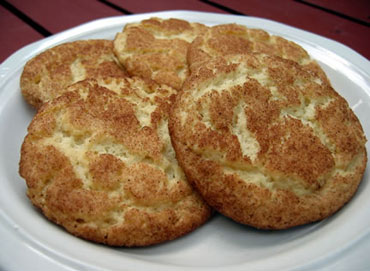
The Snickerdoodle is one of the older cookie recipes, dating to the late 1800s. It is believed to have originated in New England, among Dutch or German immigrants. A butter cookie ball is rolled in a cinnamon-sugar mixture before baking and bakes into a flat cookie with browned, crisp edges. It is crisp on the outside and chewy on the inside.
There are two things that can be attributed to the cream of tartar in snickerdoodles: the signature ‘tang,’ and the perfect chewiness. These characteristics are due specifically to the chemical makeup of the cream of tartar, which prevents the cookie from developing a sugar-crystal-induced crunch that sugar cookies have, instead giving it a soft and pillowy texture and their characteristic surface cracks. The cinnamon-sugar mixture coats the outside of the dough, providing this treat with several layers of different flavors; a spicy, yet sugary outer layer and a simple and sweet center. Though some prefer to omit the cream of tartar in snickerdoodles, purists will contest that it’s not the classic cookie without it — more like a plain cinnamon sugar cookie.
For true Snickerdoodles, don't skip that cream of tartar!
FMM: I added the baking soda to the recipe ingredients because I made this once and the cookies did not get their crackly crust. They puffed, but did not crackle. Almost all recipes on the Internet use baking soda. I made the dough one night and refrigerated it for several days. I'm not sure if this had something to do with it. I have since seen web sites say to not refrigerate the dough. (See Baking Better Cookies Through Chemistry). Susan said she believes her recipe only uses cream of tartar. She always bakes them right after mixing the dough and does not have this problem. The problem may be with using a convection oven setting which is always 25 degrees lower. See below.
Dough:
1 1/2 cups sugar
1 cup shortening [softened] = 2 sticks
2 eggs
2 3/4 cups flour
2 teaspoons cream of tartar
1 teaspoon baking soda (not in Mom's original recipe)
1 teaspoon salt
Coating:
2 tablespoons sugar [1/4 cup]
2 teaspoons cinnamon
In separate bowl, sift together flour, cream of tartar, and salt. In large bowl, beat together sugar and shortening. Blend in eggs. Slowly add flour mixture, beating on low speed until well mixed [until flour is just mixed in]. Chill dough for several hours or over-night. [Most recipes say to bake right away. It might be good to let the dough sit on the counter for 1/2 hour to hydrate.]
When ready to bake, roll dough into 1 inch balls then roll in mixture of sugar and cinnamon [completely coat].
Place 2 inches apart on ungreased baking sheets.
Bake at 350 degrees for about 10 minutes [8 - 10]. For the best results and the best texture, do not overbake. They will puff up and then flatten out with crinkled tops. Bake until lightly browned [around the edges], but not crisp. [The cookies should look a little underdone in the cracks when you take them out of the oven - they're best that way! The cookie edges should be set and just beginning to brown, with the middles still nice and puffy and soft.]
[Note: for cracks to appear, the outside of the cookie must dry out while the interior is still spreading and setting. Do not use a convection oven setting; you want the temperature at 350 degrees.]
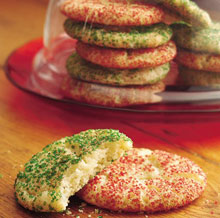
Holiday Snickerdoodles
Instead of the sugar cinnamon mixture used above, in a small bowl, mix 2 Tbsp. red decorator's sugar and 1 1/2 teaspoons of cinnamon; set aside.
In another small bowl, mix 2 Tbsp. green decorator's sugar and another 1 1/2 teaspoons cinnamon; set aside.
Before baking, roll half the dough balls in the red sugar and the other half in the green.
