Gingerbread Recipe over Time
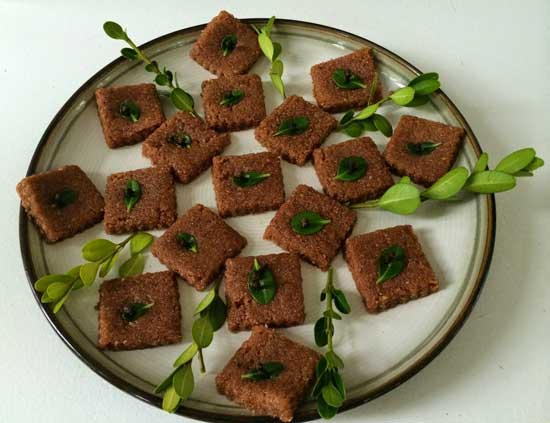
Medieval Gingerbread decorated with Boxwood leaves and clove (recipe from Two 15th c. Cookery-Books)
Gingerbread has been a revered food in Western Europe for almost one thousand years, thought to be introduced by the Crusaders. Originally made with breadcrumbs and honey, the dough ranged from intensely sweet to incredibly spicy, from light to dark. We think of gingerbread as containing sugar, ginger, cinnamon and cloves, at the very least. But medieval gingerbreads often included cardamom and anise from the Far East, as well as black or white pepper to add a savory, sharp spice. These were palate cleansers, usually served at the end of a meal (at the ‘Void’) with wine, or during the remove or entremet of each food course at a Banquet.
History
Gingerbread has been around, in one form or another, for longer than Christmas itself. There are records of its use in Greece, for ceremonial purposes, as early as 2000 BC (see Honey Nut Cake). Later, the ancient Romans made special, highly spiced honey cakes cooked in a clebanus (a type of portable oven) in their dining rooms. The cakes were taken straight from the clebanus and served directly to guests and visitors. The Romans also made their little honey cakes in the shape of hearts, associating them with weddings. They eventually became edible love tokens, similar to a box of chocolates on Valentine’s Day.
An Armenian monk called Gregory of Nicopolis (Gregory Makar, Grgoire de Nicopolis) supposedly brought honey cakes to Europe in 992. He left Nicopolis Pompeii for Bondaroy, France, where he spent seven years, teaching the art of gingerbread making to the French priests and Christians until he died in 999. At that time, the honey cakes didn’t include any ginger.
Accounts vary as to how it made its way to Europe but food historians note that, in the 11th century, ginger, almonds, and raisins were among many foodstuffs brought back to Europe by the Crusaders. Ginger, which is native to Malaysia, could be used medicinally for all type of things (flatulence, hangovers, stomach disorders) and quickly became a popular cure. The discovery that ginger could be used a preservative probably lead to the invention of new types of cakes, pastries, and breads, including the gingerbread. The center of the medieval ginger trade was in Nürnberg, Germany, a city that became famous for its gingerbread cakes and cookies
The term “gingerbread” was not the food’s originally name. In the 13th century, it was called “gingerbras,” the Old French word for “preserved ginger.” Gingerbras meant anything that had been cooked with ginger, and not specifically a cake type item. Gingerbras came from the Latin name for the spice, zingiber. In the middle of the 14th century, -bras was replaced with the more familiar word –bread and by the 15th century, gingerbread had replaced gingerbras altogether.
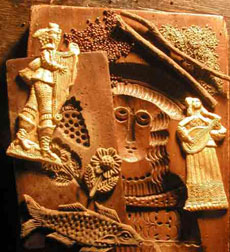
Catholic monks were the first to make honey cakes infused with ginger, and introduced them to Europe in the 1300’s. The monks designed the cakes to be theme “cakes” for Saint’s Days and festivals. The gingerbreads depicted saints and religious motifs, which were imprinted on the gingerbread by molds, called “cookie boards.” They were intricately carved slabs of wood that were pressed into the surface of stiff, rolled dough leaving a detailed image on the surface. Soon, gingerbreads were being made all over Europe, particularly in Germany, Scandinavia, England, and France.
By the 13th century, gingerbread was made throughout Europe, in a variety of forms. Many countries, most notably Germany and the Scandinavian states, made crisp, biscuit-like confections. Other countries, including England and Poland, evolved a dense, moist cake much like those prepared in the Middle East.
By the fifteenth century it was a “cake” made from a dense dough of breadcrumbs or ground almonds mixed with honey or spices. Often this dough was pressed into moulds with very intricate designs. There were many varieties of gingerbread in medieval times: ‘coarse’, ‘fine’, white, red (coloured with red wine or sandalwood), and gilded (with real gold).
The hard cookies, sometimes gilded with gold leaf and shaped like animals, kings and queens, were a staple at Medieval fairs in England, France, Holland and Germany. Queen Elizabeth I is credited with the idea of decorating the cookies in this fashion, after she had some made to resemble the dignitaries visiting her court. Over time some of these festivals came to be known as Gingerbread Fairs, and the gingerbread cookies served there were known as 'fairings.' A 'fairing' is basically any item bought as a gift at a fair. This could be an edible item or a more lasting memento. Every old town or country fair in England had a different food associated with it, often a type of gingerbread, a long-lasting heritage deriving from the Medieval love of spices. Then, gingerbread was not only sold around the Winter holidays as it is today, instead every holiday and season had its own shapes; buttons and flowers for the Spring, animals and birds for the Autumn.
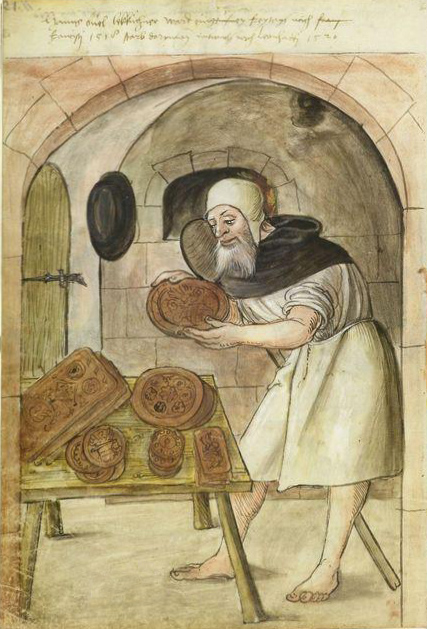
Lebküchner, Handschrift Stadtbibliothek Nürnberg Amb. 279.2°,
Folio 11 verso (Landauer I)
Association with Christmas
There are probably many reasons why gingerbread is associated with Christmas celebrations but the explanation encountered most often is this:
In the 11th century, ovens were not commonplace. It was not unusual for monasteries to own the only oven for miles around. The first recorded instances of gingerbread baking in Europe took place in monasteries and, as an act of charity honouring the gifts of the wise men, monks distributed food to the poor on St. Stephen’s Day (December 26).
Ginger and other spices were precious commodities, most originating far from Europe and imported by means of long, arduous journeys that put tradesmen at great risk. Because of their high monetary value, and because many spices originated in the east—in the same part of the world as frankincense and myrrh—a gift containing spices could be made analogous to the gifts the wise men brought to Bethlehem.
Most of the population at that time was illiterate. Religious teachings were shared verbally, through demonstration, and through art. In giving gingerbread on St. Stephen’s Day, the monks were not only ministering to the poor, but giving them a tangible reminder of the nativity story.
14th Century Recipes
Even though medieval recipes for Gyngerbrede (or gingerbrede) do include ‘breadcrumbs’ and ‘ginger’, it is nothing like a modern ‘gingerbread’, which is soft and cake like, with a hint of ginger warming the mouth. A medieval gingerbread is a hard honey paste cut into small squares, and flavoured with spices. It is far more like a traditional boiled sweet / toffee, or Tudor ‘comfit’, than a cake or bread. Peter Brears, in his work ‘Cooking and Dinning in Medieval England’, has this to say about them, “[they were] honey-sweetened and with the ability to release their flavour a few moments after they had been placed in the mouth. The simplest were made as a straightforward blend of honey, ginger and bread”. These were palate cleansers, usually served at the end of a meal (at the ‘Void’) with wine, or during the remove or entremet of each food course at a Banquet.
Honey, when boiled, will easily reach a hard-crack stage, (even easier than sugar) and when fully cools it sets into a brittle ‘toffee’; while boiled to the ‘soft-crack’ stage honey will remain soft and pliable, and be able to be moulded then cut as it continues to firm up. The harder you boil the honey the harder the set will be.
Source: Curye on Inglish, Constance B. Hieatt & Sharon Butler (eds.), c. 1390
To make gingerbrede.
Take goode honye & clarefie it on þe fere, & take fayre paynemayn or wastel brede & grate it, & caste it into þe boylenge hony, & stere it well togyder faste with a sklyse þat it bren not to þe vessell. & þanne take it doun and put þerin ginger, longe pepere & saundres, & tempere it vp with þin handes; & than put hem to a flatt boyste [box] & strawe þereon suger & pick þerin clowes rounde aboute by þe egge and in þe mydes yf it plece you &c
15th Century Recipes
Here is one such recipe (however, ironically, there is no ginger in this one!) from Two 15th c. Cookery-Books by Thomas Austin, 1888 which is based on several period English manuscripts, most notably Harleian MS. 279 and Harleian MS. 4016, both circa 1425-1450:
"Gyngerbrede.--Take a quart of hony, & sethe it, & skeme it clene; take Safroun, pouder Pepir, & throw ther-on; take grayted Bred, & make it so chargeaunt that it wol be y-lechyd; then take pouder Canelle, & straw ther-on y-now; then make yt square, lyke as thou wolt leche yt; take when thou lechyst hyt, an caste Box leves a-bouyn, y-stykyd ther-on, on clowys. And if thou wolt haue it Red, coloure it with Saunderys y-now."
Here is a translation by William Edward Mead in The English Medieval Feast:
"Take a quart of honey and seethe it and skim it clean. Take saffroun, powdered pepper, and throw thereon. Take grated bread and make it so stiff that it will be leched (cut in slices). Then take cinnamon powder and strew thereon enough. Then make it square as though thou wouldst slice it. Take, when thou slicest it, and cast box leaves above, stuck thereon in cloves. And if thou will have it red, color it with saunders (sandalwood) enough."
16th Century Recipes
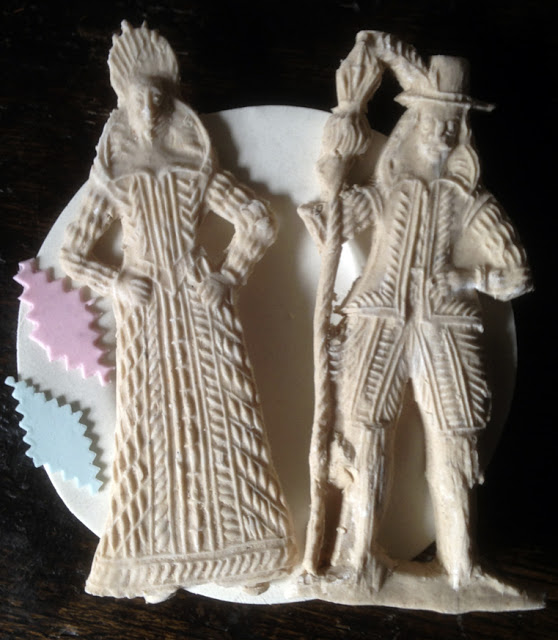
The white gingerbread figures were printed from an original early
Stuart mould in Ivan Day's collection and made from a recipe
in Lady Anne Clifford's receipt book in the BL. From Ivean Day
Probably the most famous country with a long history of making gingerbread is Germany. Lebkuchen, is a traditional soft gingerbread baked around the holidays, sweetened with honey, and flavored with spices like ginger, cloves allspice and anise seed. It was a cookie most resembling Lebkuchen that can be traced all the way back to the Egyptian, Greek, and Roman empires. At a time when sugar was extremely rare and very costly, honey was the primary way of sweetening any food. Considered to be a gift from the gods, honey cakes were sometimes worn as talismans for protection against evil.
Gingerbread houses originated in Germany during the 16th century. The elaborate cookie-walled houses, decorated with foil in addition to gold leaf, became associated with Christmas tradition. Their popularity rose when the Brothers Grimm wrote the story of Hansel and Gretel, in which the main characters stumble upon a house made entirely of treats deep in the forest. It is unclear whether or not gingerbread houses were a result of the popular fairy tale, or vice versa.
By the 16th century and into the 17th c. gingerbreads were transformed by replacing the breadcrumbs with flour and the honey with molasses. With time, butter and eggs were also added.
A book of cookrye Very necessary for all such as delight therin. Gathered by A.W. At London : Printed by Edward Allde, 1591
To make white Ginger bread.
Take Gumma Dragantis* half an once, and steep it in rosewater two daies, then put thereto a pound of sugar beaten and finely serced, and beat them well together, so that it may be wrought like paste, then role it thin into two Cakes, then take a fewe Jordain almonds and blaunch them in colde water, then dry them with a faire Cloth, and stampe them in a mortar very finelye, adding thereto a little rosewater, beat finely also the whitest Sugar you can get and searce it. Then take Ginger, pare it and beat it very small and serce it, them put in sugar to the almonds and beat them together very well, then take it out and work it at your pleasure, then lay it even upon one of your cakes, and cover it with an other and when you put it in the molde, strewe fine ginger both above and beneathe, if you have not great store of Sugar, then take Rice and beat it small and serce it, and put it into the Morter and beat them altogether.
*Gumma Dragantis = gum traganth.
The oldest remaining written gingerbread recipe (?) has been passed down from the sixteenth century and is kept at the German National Museum of Nuremberg. It reads (strange volumes included):
1 pound of sugar
500 drams or 1/8 of honey
4 ‘Loth’ (1 Loth = 16,67 g ) cinnamon
1 ½ nutmeg
2 ‘Loth’ ginger
1 ‘Loth’ cardamom
½ pinch pepper
1 kilo of flour – about 5 Loth
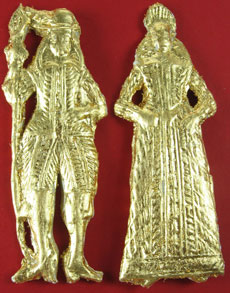
A pair of gilt gingerbreads made from an early
Stuart mould. These were printed from 'white
gingerbread', a spiced almond paste sandwiched
between two sheets of 'sugar plate', a thinly
rolled sheet of gum paste. They were then
painted with gum arabic and the gold leaf
applied when the gum had almost dried.
From Ivan Day
17th Century Rrecipes
Source: The English Housewife, by Gervase Markham, 1615, Michael R. Best (ed.):
To make gingerbread.
Take claret wine and colour it with turnsole, and put in sugar and set it to the fire; then take wheat bread finely grated and sifted, and liquorice, aniseeds, ginger, and cinnamon beaten very small and searced; and put your bread and your spice all together, and put them into the wine and boil it and stir it till it be thick; then mould it and print it at your pleasure, and let it stand neither too moist nor too warm.
How to make a coarse ginger bread.
To make a coarse ginger bread, take a quart of honey and set it on the coals and refine it: then take a pennyworth of ginger, as much pepper, as much liquorice; and a quarter of a pound of aniseeds, and a pennyworth of sanders: all these must be beaten and searced, and so put it into the honey: then put in a quarter of a pint of claret wine or old ale: then take three penny manchets finely grated and strew it amongst the rest, and stir it till it come to a stiff paste, and them make it into cakes and dry them gently.
Coarse gingerbread.
Take a quart of honey clarified, and seethe it till it be brown, and if it be thick put to it a dish of water: then take fine crumbs of white bread grated, and put to it, and stir it well, and when it is almost cold, put to it the powder of ginger, cloves, cinnamon, and a little liquorice and aniseeds; then knead it, and put it into moulds and print it: some use to put to it also a little pepper, but that is according unto taste and pleasure.
Delightful Daily Exercise for Ladies and Gentlewomen; John Murrell; 1621
To make white Gingerbread.
Take halfe a pound of marchpaine* past, a quarter of a pound of white Ginger beaten and cerst, halfe a pound of the powder of refined sugar, beate this to a very fine paste with dragagant** steept in rose-water, then roule it in round cakes and print it with your moulds: dry them in an oven when the bread is drawn foorth, upon white papers, & when they be very dry, box them, and keepe them all the yeare.
*marchpaine past = marzipan paste
** dragagant = gum traganth
The accomplisht cook, or, The art and mystery of cookery wherein the whole art is revealed in a more easie and perfect method than hath been publisht in any language … .Robert May; London : Printed by R.W. for Nath. Brooke ..., 1660
To make Ginger Bread.
Take a pound of jordan almonds, and a penny manchet grated and sifted and mingled amongst the almond paste very fine beaten, an ounce of slic’t ginger, two thimble fulls of liqouras and aniseed in powder finely searced, beat all in a mortar together, with two or three spoonfuls of rose water, beat them to a perfect past with half a pound of sugar, mould it and roul it thin, then print it and dry it in a stove, and gild it if you please.
Thus you may make ginger bread or sugar plate, putting sugar to it as abovesaid.
The queen-like closet; or, Rich cabinet stored with all manner of rare receipts for preserving, candying &c; cookery. Very pleasant and beneficial to all ingenious persons of the female sex. By Hannah Wolley; London : printed for R. Lowndes at the White Lion in Duck-Lane, near West-Smithfield; 1670
To make Ginger-bread.
Take three stale Manchets grated and sifted, then put to them half an Ounce of Cinnamon, as much Ginger, half an Ounce of Licoras and Aniseeds together, beat all these and searce [sift] them, and put them with half a Pound of fine Sugar, boil all these together with a quart of Claret, stirring them continually till it comes to a stiff Paste, then when it is almost cold, mould it on a Table with some searced Spice and Sugar, then bake it in what shape you please.
Lady Barbara Fleming's Manuscript Receipt Book (1673)
Gingerbread using Lady Fleming's recipes.
From Ivan Day
Lady Fleming's gingerbreads are very strong of spice and are extremely potent. Their original medicinal origin, to aid digestion and to ward off cold were probably foremost in her mind. In the North of England, particularly in the Lake Counties where Lady Fleming lived, a strong gingerbread tradition has survived. Since at least the early nineteenth century it has been customary to give children little gingerbreads at Rushbearing ceremonies in various Cumberland and Westmorland villages.
These recfipes are very old fashioned in that they use spices like liquorice, grains of paradise and sanders, which were popular in the medieval period, but unusual at this period. They are also based on breadcrumbs or almond paste rather than flour and are dried in front of the fire rather than being cooked. Gingerbreads of this kind lingered much longer in the North of England than in the South.
To make ginger bread of Almonds
Take a quarter of a pound of Almonds blanched, put them into a morter, put to them a quarter of a pound of sugar beaten, and halfe a score of dates cut small, beate all these together untill they be as small as for Marchpain, put thereto an ounce of cinamon, an ounce of ginger searced and a little sanders. beate all these together one houre after you make little cakes of it, and lay them upon your mould to print, and cast of the powder of cinamon and ginger between the mould and it so it doo not cleave, dry them before the fire till they be hard, and so lay them up in boxes and they will keep all the year.
Lady Barbara Fleming's Manuscript Receipt Book (1673)
To make another kind of gingerbread
Take a quart of honey, put it into a great skillet on the fire and when it begineth to seeth, put thereto a pint of strong ale, & scum it clear, then put soo much grated bread as will make it like unto dow and put thereto halfe a pound of Liquorish, as much Aniseeds, and a quarter of a pound of ginger being finely searced with two ounces of graines, then take it out of your skillet and worke it on a table as you doo flower to dough to make it stiffe, then make it in cakes, put powder of Liquorish and Aniseeds upon your moulds so it cleave not and so lay them upon a board till they be dry, then lay them up in boxes.
18th Century Recipes - American
Significantly, by the late 18th century, when the chemical leavening agents potash (potassium carbonate) and its refined cousin, pearlash (potassium bicarbonate), began to be used more widely in the culinary arena, many of the earliest baking recipes to use these leavening agents were for gingerbreads because the acidic molasses reacted well with the alkali potassium (bi)carbonate to produce the necessary aeration to lighten the end product.
Orange gingerbread was particularly favoured in the eighteenth century and is frequently advertised on confectioners' and gingerbread bakers' trade cards. Orange peel and ginger are a great combination and both harmonise well with the strong caramel flavour of treacle.
A collection of above three hundred receipts in cookery, physick and surgery; for the use of all good wives, tender mothers, and careful nurses. Kettilby, Mary; 1714
Thick Ginger-Bread
A pound and a half of Flower, takes up one pound of Treacle, almost as much Sugar, an ounce of beat Ginger, two ounces of Carraway-seeds, four ounces of Citron, and Lemon-peel Candy’d, the Yolks of four Eggs, cut your Sweet-meats, mix all, and bake it in large Cakes, on Tin-plates.
The cooks and confectioners dictionary: or, the accomplish’d housewives companion. ... The second edition with additions. Revised and recommended by John Nott; London : printed by H. P. for C. Rivington, 1724
To make an excellent sort of Ginger-Bread.
Take a quart of Damask-rose-water, and four pound of double refin’d Sugar; two Quarts of fine Flour, or as much as will make it up into a pretty stiff paste. Take Ginger, Carraway-seed, and Coriander-seed, of each two Ounces, finely powdered; Nutmets finely powdered one Ounce and a half; Anniseed, and Fennel-seed, powder’d, of each three quarters of an Ounce; of Cloves powdered, almost half an Ounce. Mix all these well together in a Mortar. Then reserve this powder for use. Put in two Ounces of it into a Quart of your Syrup made of Rose-water and Sugar to your two Quarts of Flour; make your Paste into thin square Cakes, and bake it.
Elizabeth Moxon, English Housewifery. Leeds: 1779
To make GINGER-BREAD another way Take three pounds of fine flour, and the rind of a lemon dried and beaten to powder, half a pound of sugar, or more if you like it, a little butter, and an ounce and a half of beaten ginger, mix all these together, and wet it pretty stiff with nothing but treacle, make it into rolls or cakes which you please; if you please you may add candy'd orange peel and citron; butter your paper to bake it on, and let it be baked hard.
Cookery and pastry. As taught and practised by Mrs. Maciver, ... A new edition. To which are added, for the first time, figures of dinner and supper courses, from five to fifteen dishes. Also, a correct list of everything in season ... . MacIver, Susanna; Edinburgh : printed for C. Elliot: and G. G. J. and J. Robinson, London, 1787
To make fine Gingerbread.
Take two pounds and a half of flour; mix an ounce of beat ginger with it, and half a pound of brown sugar; cut three quarters of a pound of orange-peel and citron not too small; mix all these together; take a mutchkin and a half of good treacle, and melt it on the fire; beat five eggs; wet the flour with the treacle and eggs; weight half a pound of fresh butter, Scots weight*; melt it and pour it in amongst your other materials; cast them all well together; butter a frame, and put it in the oven. This gingerbread wont fire without frames. If it rises in blisters when it is in the oven, run a fork through it. It makes very fine plain bread without the fruit, with a few caraway seeds. All these cakes must be fired in an oven neither too hot nor too cold. The way to know when the cakes are fired enough is to run a clean knife down the middle of them; if the knife comes out dry, they are enough; if the least of it sticks to the knife, put it in the oven again.NOTE: Mrs McIver specifies “Scots weight” because until 1824 when they were forced to change to Imperial measurements, Scottish measures were different. One Scottish pound weight was equivalent to one pound, six ounces and one dram in Imperial weight.
Here is a recipe for gingerbread with pearlash from American Cookery, the first cookbook published by an American, Amelia Simmons in 1796.
Gingerbread leavened with chemicals such as pearlash (potassium carbonate) were being made in late eighteenth century America, but do not seem to have been produced in Britain until the 1820s. Amelia Simmons, American Cookery (Hartford: 1798), adds pearlash to what was a fairly standard treacle gingerbread mix to get a lighter result. Pearlash and other alkaline leavening agents such as ammonium bicarbonate and sodium bicarbonate were probably used in Britain in the early nineteenth century, but do not appear in the cookery books until the 1820s and 30s when a few recipes are included in manuscript collections. However, the process of maturing the treacle for a long period to make a sponge, seems to have only been undertaken by professionals. In England, some domestic recipes call for the addition of gooseberry vinegar to react with the alkaline leavening agent and create carbon dioxide bubbles in the dough. The professionals realised that treacle itself is a mildly acidic material which also reacts with soda, Its highly viscous nature also allows the tiny bubbles of this gas to be trapped, especially when it is combined with some flour.
American Cookery, Amelia Simmons, 1796
Gingerbread Cakes, or butter and sugar Gingerbread.
No. 1. Three pounds of flour, a grated nutmeg, two ounces ginger, one pound sugar, three small spoons pearl ash dissolved in cream, one pound butter, four eggs, knead it stiff, shape it to your fancy, bake 15 minutes.
For more recipes from the 19th century: http://www.theoldfoodie.com/2006/12/through-ages-with-gingerbread.html
