Elaborate 17th Century Dessert Tables
Jacobean Banquet (early 17th century)
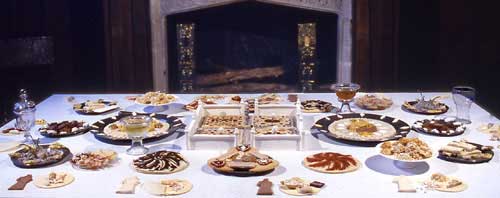
The predecessor of the French influenced baroque dessert was the cold collation, an arrangement of sweet luxury foods which had its origin in the ultimo servizio of the Italian Renaissance feast. In England this was known in the sixteenth and seventeenth century as the banquet. The table to the left is a recreation of a banquet of the early Stuart period. It is dominated by a marchpane in the form of a knot garden after designs in William Lawson's Country Housewife's Garden (London: 1628).
There is also a large range of other sweetmeats and preserves from other recipe texts of the period. They include cheesecakes, gilt gingerbreads, candied eringoes, diet bread (small sponge cake or biscuit), bane bread, Shrewsbury cakes, cotoniack, wet suckets, comfits, fruit pastes and marmalades.
Bean or Bane Bread - From the seventeenth century onwards English cookery and confectionery texts abound with recipes for a family of biscuits which contain no flour. The ingredients are held together with a simple mixture of powdered sugar and egg white. Base ingredients include everything from dried jasmine flowers, slivered almonds to slices of candied peel. One variant, known as bane bread or bean bread, consists of little piles of flaked almonds held together with an orange or rosewater icing and baked with a generous scattering of caraway comfits. These biscuits were usually baked on wafer paper. They blister a little while cooking and sometimes spread out a little beyond their brittle bounds, but they crisp-up once cold and hold their crispness for weeks. They were probably eaten with sweet dessert wines.
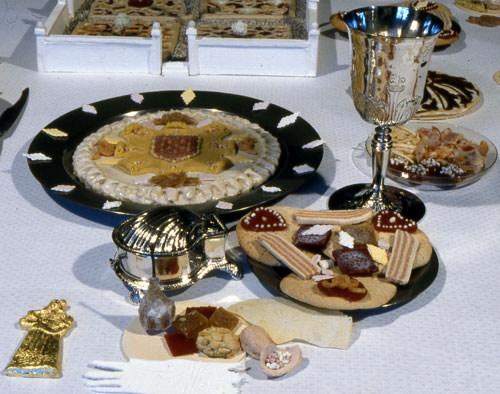
According to the Oxford English Dictionary, "Diet Bread" was consumed by sick people: "diet-bread n. special bread prepared for invalids or persons under dietetic regimen. 1617 S. Collins Epphata to F. T. ii. ix. 357. A late 19th century article suggests diet bread was sometimes pronounced as "dier" or "dyer." The OED defines the word "dier" is as someone who is dying. "Diet bread" is devoid of standard period culinary riches: spices, dried exotic fruits and rich cream.
[1736]
"XII. To make a Diet Loaf.
Take 9 Eggs, beat them with 3 Quarts of a lib. of Sugar, till they be thick and white, take 2 Drop of Cinnamon, 2 Drop of Nutmeg, 2 Drop of Cloves, a Quarter of an Ounce of Carvey-seed [caraway seed], 3 Quarts of a lb. of Flour, mix all together, and put it in your Frame, and send it to the Oven."
---Mrs. McLintock's Receitps for Cookery and Pastry-Work, facsimile 1736 edition [Aberdeen University Press:Glascow] 1986 (p. 5)
[1753]
"To Make Diet Bread. Dry and beat a Pound of Loaf-sugar; then take three Quarters of a Pound of Flour dried, seven Eggs, Yoks and Whites; whisk your Eggs with two Spoonfuls of Orange-flower-water, and two Spoonfuls of Water, Half an Hour; then shake in your Sugar, and beat them with a Spoon a Quarter of an Hour; and put in your Flour, and beat it another Quarter; bake them in Tin-pans, put Paper within your pans well floured; an Hour bakes them; put them into your Pans just as you put them into the Oven."
---The Lady's Companion, 6th edition, Volume II [J. Hodges:London] 1753 (p. 212-3)
Late Stuart Dessert Table in the 'baroque court style' (late 17th century)
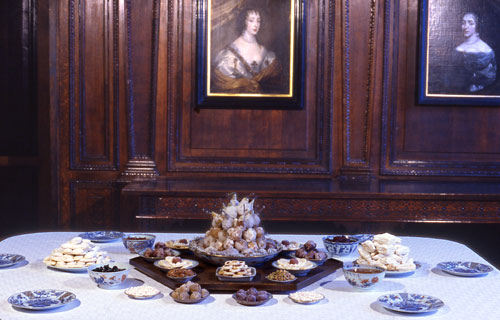
The table features a wooden dessert frame adorned with a pyramid of candied fruits. Both wet and dry sweetmeats are served on late seventeenth and early eighteenth century Chinese porcelain.
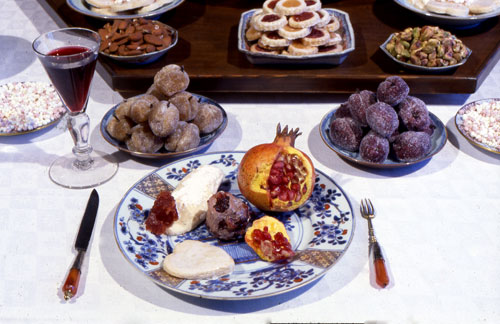
Typical sweetmeats of the period include quiddany of quinces, preserved cherries, artificial fruits made of apricot paste and royal marchpanes. Recipes from both Massialot and Nott were used to create the dishes.
