Lumber Pie
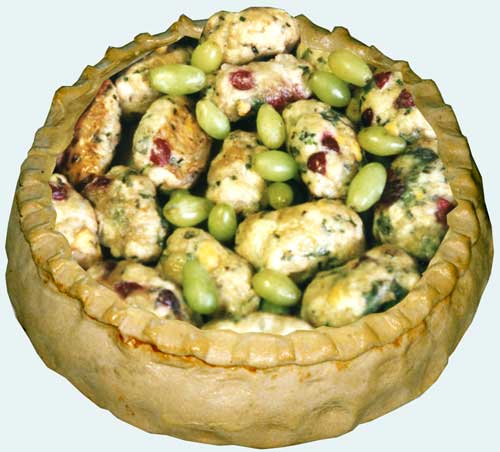
Robert May's Lumber-Pie of veal or capon before being covered with a 'cut lid'.
(from Ivan Day's web site, http://www.historicfood.com/)
This is one of the great 'sweet-sour' pies of the early modern period. The name is a corruption of Lombard Pie. The little balls of lumber meat, usually made from veal, sometimes enclosed a little nugget of bone marrow and would have had a soft centre like a Chicken Kiev. Other forgotten English pies in this ancient sweet-sour tradition were dowlett pie, spring pie and stump pie.
The concept of a lumber pie is unequivocally medieval. A great mix of ingredients, often including fruit, was placed in a large ‘coffin’ which was given a pastry lid and well-baked. When it came out of the oven, a thickening mixture (a ‘caudle’or 'lear') was poured in through a hole in the crust before it was served to table, where the lid was removed, as we would remove the lid of a casserole dish, and the guests would then help themselves to the contents. Most lumber pies contain eggs, and in many or most the meat or fish is made into forcemeat balls, but as with any recipe idea which has been around for centuries, there are many variations on the theme.
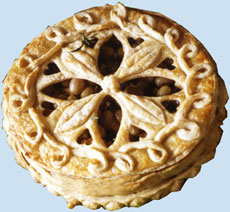
Robert May's recipe calls for an elaborate decorated lid. The great heyday of this kind of pastry trellis work lasted from the second half of the sixteenth century to the first half of the eighteenth. The practice almost certainly had its origins in a burgeoning fashion for knotted strapwork ornament inaugurated by Mannerist architects such as Sebastiano Serlio (1475-1554). Interlacing decorations like those published by Serlio found their best known expression in architectural detailing and garden design, but food ornamentation was strongly influenced by the same zeitgeist. The curious knotted biscuits or sweetmeats known as jumbals emerge at this period and elaborate tarts and pies in kaleidoscopic knot-garden form start to adorn the tables of the wealthy. Edible strap work was all the rage.
To make a Lumber-Pie
Take some grated bread, and beef-suet cut into bits like great dice, and some cloves and mace, then some veal or capon minced small with beef suet, sweet herbs, fair sugar, the yolks of six eggs boil’d hard and cut in quarters, put them to the other ingredients, with some barberries, some yolks of raw eggs, and a little cream, work up all together and put it in the caul of veal like little sausages; then bake them in a dish, and being half baked have a pie made and dried in the oven ; put these puddings into it with some butter, verjuyce sugar, some dates on them, large mace, grapes, or barberries, and marrow - being baked, serve it with a cut cover on it, and scrape sugar on it.
- From Robert May The Accomplisht Cook (London: 1660)To make a Lumber Pye of Salmon
Lumber Pie with it's "cut lid"Mince a rand, jole, or tail with a good fat fresh eel seasoned in all points as beforesaid [with pepper, salt, nutmeg cinamon, beaten ginger, caraway-seed, rose-water, butter, verjuyce, sugar, and orange-peel minced], put five or six yolks of eggs to it with one or two whites, make it into balls or rouls, with some hard eggs in quarters, put some butter in the pye, lay on the rouls, and on them large mace, dates in halves, slic’t lemon, grapes, or barberries, & butter, close it up, bake it, and ice it; being baked, cut up the cover, fry some sage-leaves in batter, in clarified butter, and stick them in the rouls, cut the cover, and lay it on the plate about the pie, or mingle it with an eel cut into dice work, liquor it with verjuyce, sugar, and butter.
- From Robert May The Accomplisht Cook (London: 1660)
Recipe from the 15th Century:
To mak custad lombard mak a large coffyn then tak dates from the stones tak gobettes of mary and smalle birdes and parboile them in salt brothe and couche ther in then tak clowes mace and raisins of corans and pynes fryed and strawe ther on and sett them in the oven to bak and luk ye haue a coup of cowes creme yolks of eggs good pouderes saffron sanderes and salt then fill the coffins ther with, and on fishe daies boille wardens or other peres paire them and hole them at the crown then fill them full of blaunche poudur and torn them in blaunche poudur and skoche them all about that the pouder may abid ther in then set the stalks upryght and ye may mak your coup of creme of almondes and shak up your custad as ye did of flesche and when they be bak gilt the stalkes of the peres and serue them.
- Original Receipt from A Noble boke off cookry ffor a prynce houssolde or eny other estately houssolde (Noble Boke 1480);
Recipe from the 18th Century:
Most of the printed cookery books and many manuscripts of the seventeenth and early eighteenth century give at least one recipe for lumber, lumbard or lombard pies.
To make a Lumber Pye.
Take a pound and a half of veal, parboil it, and when 'tis cold chop it very small, with two pound of beef-suet, and some candied orange-peel; some sweet-herbs, as thyme, sweet-marjoram, and an handful of spinage; mince the herbs small before you put them to the other; so chop all together, and a pippin or two; then add a handful or two of grated bread, a pound and a half of currants, washed and dried; some cloves, mace, nutmeg, a little salt, sugar and sack, and put to all these as many yolks of raw eggs, and whites of two, as will make it a moist forc'd-meat; work it with your hands into a body, and make it into balls as big as a turkey's egg; then having your coffin made put in your balls. Take the marrow out of three or four bones as whole as you can: let your marrow lie a little in water, to take out the blood and splinters; then dry it, and dip it in yolk of eggs; season it with a little salt, nutmeg grated, and grated bread; lay it on and between your forc'd-meat balls, and over that sliced citron, candied orange and lemon, eryngo-roots, preserved barberries; then lay on sliced lemon, and thin slices of butter over all; then lid your pye, and bake it; and when 'tis drawn, have in readiness a caudle made of white-wine and sugar, and thicken'd with butter and eggs, and pour it hot into your pye.
- Compleat Housewife (1736), by E. Smith
