Sally Lunn
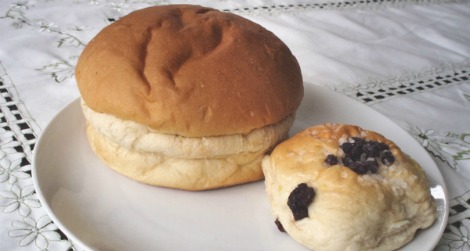
The Sally Lunn bun (left) and the Bath bun (right).
from http://www.smithsonianmag.com/
Sally Lunn is nearly six-inches in diameter with a soft, domed top, it is like
a brioche bun. Bath Buns, on the other hand, are smaller and sweeter than
Sally Lunn Buns, with a lump of sugar baked into the bottom, crushed sugar
sprinkled over the top and, often, currants or raisins swirled throughout.
A Sally Lunn is a large bun or teacake, a type of batter bread, made with a yeast dough including cream and eggs, similar to the sweet brioche breads of France. Served warm and sliced, with butter, it was first recorded in the spa town of Bath in southwest England in 1780. The same name has been applied to various unrelated breads in the US since the early 20th century.
Bath is also known for its Bath Buns. Both Sally Lunn and Bath Buns likely link to an 18th-century baking tradition of yeast-leavened rich breads, which were popular for breakfast. Sally Lunns are made from a soft dough that requires a hoop or round pan to hold its shape during rising and baking. Bath buns, made from a stiffer dough, are shaped by hand into rounds about three inches across, small enough to be eaten by hand.
History of Sally Lunn
The origins of the Sally Lunn are shrouded in myth - one theory is that it is an anglicisation of "Sol et lune" (French for "sun and moon"), representing the golden crust and white base/interior. The Sally Lunn Eating House in Bath, England, claims that the recipe was brought to Bath in the 1680s by a Huguenot refugee from France called Solange Luyon, who became known as Sally Lunn, but there is no evidence to support this theory.
There is little historical evidence for Sally Lunn as a person. The Gentleman's Magazine of 1798 uses Sally Lunn as an example during a discussion of foods named after people - 'a certain sort of hot rolls, now, or not long ago, in vogue at Bath, were gratefully and emphatically styled "Sally Lunns"'. But it is not until 1827 that a historical person is described by a correspondent of William Hone using the pseudonym "Jehoiada", who says she had sold the buns on the street "about thirty years ago". A baker called Dalmer had bought out her business and made it highly successful after he composed a special song for the vendors, who sold the buns from mobile ovens. The earliest evidence of commercial production is an 1819 advert for the Sally Lunn "cakes" sold by W. Needes of Bath, bread and biscuit maker to the Prince Regent.
According to http://www.foodsofengland.co.uk/: "The name appears to be simply a corruption of 'solilem', a brioche type of cake from Alsace. Indeed, Eliza Acton's 'Modern cookery for Private Families' (Acton 1845) refers to 'Solimemne - A rich French breakfast cake, or Sally Lunn'."
Some of the earliest name in print:
A song, published in 1778 in The Gentleman’s Magazine” has the opening lines of which read:
A general Invitation to Sally Lund at Spring Garden
Ye Beaux and ye Belles, who resort to the Wells,
Come to Bath, your loose guineas to fund;
One and all I invite, free from envy or spite,
To feast upon sweet Sally Lund.
Spring Gardens were the pleasure gardens set out across the River Avon, east of Bath, which held public breakfasts twice a week, with musical accompaniment, at sixpence a head.
Just to, if not rain, then certainly drizzle a little, on Bath’s bun parade claim to fame, in 1776, a (long and, to be honest, rather dreary) poem published in The Westminster Magazine contained the lines:
Where Donnybrook surveys her winding rills,
And Chapelizod rears her sunny hills
Thy sumptuous board the little loves prepare,
And Sally Lun and Saffron cake are there.
placing these teatime treats surprisingly, but very firmly, in the Dublin countryside.
The name is known at least since a poem, by the Irish poet William Preston, was printed in 'The Caledonian Mercury' on 9 August 1776 which says of Dublin; "Sally Lun and safron cake are there".
The first recorded mention of the bun in Somerset is as part of a detox regime in Philip Thicknesse's 1780 guidebook to taking the waters at Bath. Thicknesse describes how he would daily see visitors drinking 2-3 pints of Bath water and then "sit down to a meal of Sally Lunns or hot spungy rolls, made high by burnt butter!" He recommends against the practice as his brother died after this kind of breakfast - "Such a meal, few young men in full health can get over without feeling much inconvenience".
The Sally Lunn is mentioned alongside muffins and crumpets by Charles Dickens in The Chimes (1845). The same year Eliza Acton gave a recipe in Modern Cookery for Private Families, describing it as a version of "Solimemne - A rich French breakfast cake, or Sally Lunn". Solilemmes is a kind of brioche that is served warm and popularised by the great Parisian chef Marie-Antoine Carême in a book of 1815. Carême claimed the "solilem" originated in Alsace but there is no evidence to support that claim; he may have taken the idea from contacts in Bath and then tried to disguise the origins of a recipe that came from France's great enemy.
Sally Lunn in American Southern colonies
Whatever the origin, Sally Lunn traveled across the Atlantic to the Southern colonies. The Williamsburg Art of Cookery, published in 1742, contains a recipe for Sally Lunn muffins. Miss Parloa’s New Cook Book, published in Boston in 1888, doesn’t mention it.
In New Orleans, Creole Cookery, edited by the Christian Woman’s Exchange, and Lafcadio Hearn’s Creole Cook Book, both published in 1885, feature Sally Lunn. Hearn praises the bread: “This is a never-failing recipe and has been much liked.” He explains at some length that it must be started at night if it’s to be served for breakfast. “If you wish it for tea, make it up five hours beforehand, having set the yeast to rise after breakfast.”
Some years later, The Picayune’s Creole Cook Book (1901) suggested that the cook in a hurry could substitute three teaspoons of baking powder for the yeast, mix the dough and bake it immediately.
A soda-raised bread cake and a pudding of the same name are found in the French parts of the Southern United States.
Historic Recipes for Sally Lunn
While the origin of Sally Lunn Bread may continue to be an enigma, there is no doubt as to the deliciousness of the bread. Below are several examples of historic recipes for Sally Lunn. Both the c.1770 Virginia and the c.1824 Baltimore recipes use yeast as a leaven but there is no mention of any flavorings such as mace. Rutledge’s, The Carolina Housewife, (1847), includes chemical leavenings of tartaric acid and soda (either sodium bicarbonate or potassium bicarbonate) instead of yeast, and she also instructs cooks to flavor the bread with mace.
Mary Smith recipe, 1772
The only recipe one writer has been able to find that actually dates from the eighteenth century; a recipe which predates all other mentions by several years and comes, not from elegant, regency Bath, but from Newcastle in the north-east of England. Discovered in a book published in 1772 by Mary Smith, it admittedly doesn’t have the exact same name, but it is recognisably similar. In addition, the recipe itself does indeed make a bun that fits the description of a Sally Lunn, right down to the traditional serving suggestion.
Luns Cake
Rub four ounces of butter into one quart of fine flour; add a little yeast, three eggs, ans a much warm milk as will make it into a light paste; set it before the fire to rise for one hours; put it into an earthen pot to bake; when done, cut it in round slices, butter it, and serve it up hot for breakfast.
As well as the early date and surprising location of this recipe, there are two further interesting details: the single rise and the bakeware. When a dough is enriched with dairy and eggs, it lengthens the amount of time required for the yeast to do its work. This explains why, in old recipes, the dough is first set to rise, and only afterwards are the enriching ingredients kneaded in, just before the dough is shaped. Enriching dough can be something of a double-edged sword, because yes, the result is very delicious, but also, without the correct proportion of liquid, or time, it can turn out heavy. The single rise here means that the initial, exuberant frothiness of the yeast is tempered with the rich ingredients, ultimately producing the perfect balance of both richness and lightness.
Original Receipt from from 'The Monthly magazine' (v2, p5) of 1796
The first known published receipt is a delightful verse version.
RECEIPT TO MAKE A SALLY LUN
A well-known cake at Bath
Written by the late Major DREWE, of Exeter
NO more I heed the muffin zest
The Yorkshire cake or bun
Sweet Muse of Pastry teach me how
To make a Sally Lun.
Take thou of luscious wholesome cream
What the full pint contains
Warm as the native Mood which glows
In youthful virgin's veins
Hast thou not seen in olive rind
The wall-tree's rounded nut
Of juicy butter just its size
In thy clean pastry put
Hast thou not seen the golden yolk
In Chrystal shrine immur'd
Whence brooded o'er by sostring wing
Forth springs the warrior bird?
Oh save three birds from savage man
And combat's sanguine hour
Cush in three yolk, the seeds of life
And on the butter pour
Take then a cup that hold the juice
Fam'd China's fairest pride
Let foaming yeast its concave fill
And froth adown its side
But seek thou first for neatness sake
The Naiad's crystal stream
Swift let it round the concave play
And o'er the surface gleam
Of salt more keen than that of Greece
Which cooks not poets use
Sprinkle thou then with sparing hand
And thro the mass diffuse
Then let it rest disturb'd no more
Safe in its steady feat
Till thrice Time's warning bell hath struck
Nor yet the hour compleat
And now let Fancy revel free
By no stern rule confin'd
On glittr'ing tin in varied form
Each Sally-Lun be twin'd
But heed thou west to lift thy thought
To me thy power divine
Then to the oven's glowing mouth
The woud'rous work consign
Sally Lunn, c. 1770
Recipes from the Raleigh Tavern Bake Shop, Colonial Williamsburg Foundation Publication. Williamsburg, VA: 1984.
Beat four eggs well; then melt a large Tablespoonful of Butter, put it in a Teacup of warm Water, and pour it to the Eggs with a Teaspoon of Salt and a Teacup of Yeast (this means Potato Yeast); beat in a Quart of Flour making the Batter stiff enough for a Spoon to stand in. Put it to rise before the Fire the Night before. Beat it over in the Morning, grease your Cake-mould and put it in Time enough to rise before baking. Should you want it for Supper, make it up at 10:00 o'Clock in the Morning in the Winter and 12: o'Clock in the Summer.
A person's comment on the Williamsburg recipe: "Sally Lunn bread isn't the same as the Sally Lunn buns served at the Sally Lunn House in Bath, England. Sally Lunn buns are a sweet bread similar to French brioche festival bread. They are heavenly! You can eat them as toast, as bread, with toppings, with a sandwich, a hamburger, etc. The Sally Lunn bread is a yeast bread that's dark on top and light on the bottom. Williamsburg's recipe is delicious too but not the same thing."
Sally Lunn – Mrs. Merryman, c.1824
The Manuscript of Ann Maria Morris, Maryland Historical Society, Special Collections Library
Take about 3 pints of flour, rub in a quarter of a pound or less of Butter; a teacupful of good yeast, quarter of a lb. of sugar, two eggs, half a nutmeg & a little salt, make the dough, rather softer than for bread, set it to rise. butter the pan you bake in, and bake in a moderate oven – serve it hot for tea.
Original Receipt in The Cook's Oracle by William Kitchiner, 1830
Sally Lunn Tea Cakes
Take one pint of milk quite warm, a quarter of a pint of thick small-beer yeast; put them into a pan with flour sufficient to make it as thick as batter,-cover it over, and let it stand till it has risen as high as it will, i.e. about two hours: add two ounces of lump sugar, dissolved in a quarter of a pint of warm milk, a quarter of a pound of butter rubbed into your flour very fine; then make your dough the same as for French rolls, &c.; and let it stand half an hour; then make up your cakes, and put them on tins: when they have stood to rise, bake them in a quick oven.
Care should be taken never to put your yeast to water or milk too hot, or too cold, as either extreme will destroy the fermentation. In summer it should be lukewarm, in winter a little warmer, and in very cold weather, warmer still. When it has first risen, if you are not prepared, it will not hurt to stand an hour.
Sally Lunn, c.1847
The Caroline Housewife by Sarah Rutledge, 1847
This is a bread made with tartaric acid and baking soda. This is an American version that substitutes new chemical leaveners in place of the traditional yeast.
Two eggs, two small cups of cream, two cups of loaf sugar, one pint of flour, half a pound of butter, one tea-spoonful of mace; the cream and butter to be warmed together and when melted, to be poured into the eggs and sugar, which must be well beaten together; sift the flour into it gradually, add a tea-spoonful of tartaric acid, one and a half tea-spoonsful of soda; the soda must be dissolved in warm water, and mixed in well. Have the pans buttered and the oven ready; then stir the acid in quickly; put into the oven immediately, before the effevescence eases.
A Sally Lunn, c. 1851
Miss Leslie's Directions for Cookery by Eliza Leslie, Philadelphia, 1851 edition
This cake is called after the inventress. Sift into a pan pound and half of flour. Make a hole in the middle, and put in two ounces of butter warmed in a pint of milk, a salt-spoonful of salt, three well-beaten eggs, and two table-spoonsful of the best fresh yeast. Mix the flour well into the other ingredients, and put the whole into a square tin pan that has been greased with butter. Cover it, set it in a warm place, and when it is quite light, bake it in a moderate oven. Send it to table hot, and eat it with butter.
Or, you may bake it on a griddle, in small muffin rings, pulling the cakes open and buttering them when brought to table.
