Ancient Mesopotamia: History of a Civilization
from https://www.timemaps.com/
Origin
- The Rise of Farming in Mesopotamia (6000 BCE) Ubaid period, city of Eridu
- Early States (3500 BCE)
The Sumerians, world’s first civilization (Uruk, very first true city)
The First Empires
- Sargon of Akkad (Akkadian Empire)
- The Guti Interlude
- The Empire of Ur
Early Babylon
- Hammurabi
Babylonia in the first millennium
- the Assyrians
- King Nebuchadnezzar
The fall of the Babylonian empire
Also see Ancient Mesopotamia Timeline
The Rise of Farming in Mesopotamia
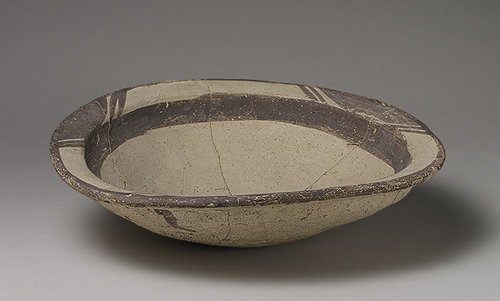
5th - 6th century BC Ubaid period (5500 to 3800 BC) in Mesopotamia
Roughly 10,000 years ago, villages started popping up across Mesopotamia. The people who lived in the region raised animals and grew grains, even as they continued to hunt and gather. Over time, those villages expanded and their people became increasingly dependent on farming. Archaeologists still aren’t sure exactly what life was like for these early cultures. However, similarities in pottery styles and stamp seals placed on a variety of containers suggests some level of administrative control emerged between 6,000 and 7,000 years ago.
By 6000 BCE, farming settlements dotted the Middle Eastern landscape from Egypt to Iran. Most of these were small villages, but some, like Jericho, were sizable towns. Jericho, situated in a large oasis, consisted of 8 to10 acres of mud-brick homes surrounded by substantial walls. Large water tanks were probably used for irrigation, and a massive stone tower for defense. It had a population of some 2,500 people.
The Fertile Crescent was inhabited by several distinct, flourishing cultures between the end of the last ice age (c. 10,000 BC) and the beginning of history. One of the oldest known Neolithic sites in Mesopotamia is Jarmo, settled around 7000 BC and broadly contemporary with Jericho (in the Levant) and Çatal Hüyük (in Anatolia). It as well as other early Neolithic sites, such as Samarra and Tell Halaf were in northern Mesopotamia; later settlements in southern Mesopotamia required complicated irrigation methods.
In about 6000 BCE, irrigation began to be practiced in the foothills of the Zagros mountains, very near southern Mesopotamia. Communities of farmers dug tanks and reservoirs to store water, and ditches to lead it to the fields throughout the growing season. In this way they were able to water their fields over a long period of time, increasing their yield of crops.
The techniques learnt here enabled farmers to settle in the dry southern Mesopotamian plains. By creating irrigation systems, they were able to feed their crops with water well beyond the brief rainy season.
The first of these was Eridu, settled during the Ubaid period culture by farmers who brought with them the Samarran culture from the north. The Samarran Culture was the precursor to the Mesopotamian culture of the Ubaid period. The city seems to have been founded around 5400 B.C. and it was occupied for thousands of years until it was finally abandoned for good around 600 B.C.
This early population—known as the Ubaid people—was notable for strides in the development of civilization such as farming and raising cattle, weaving textiles, working with carpentry and pottery and even enjoying beer. Villages and towns were built around Ubaid farming communities.
Ubaid culture is characterized by large unwalled village settlements, multi-roomed rectangular mud-brick houses and the appearance of the first temples of public architecture in Mesopotamia. Domestic equipment included a distinctive fine quality buff or greenish colored pottery decorated with geometric designs in brown or black paint. Tools such as sickles were often made of hard fired clay in the south, while in the north stone and sometimes metal were used. Villages thus contained specialised craftspeople, potters, weavers and metalworkers, although the bulk of the population were agricultural labourers, farmers and seasonal pastoralists.
Meanwhile, people started constructing a series of temples using mud bricks at Eridu. Eridu’s status was legendary even in ancient times. Babylonians actually believed that Eridu was the oldest city on Earth, having been created by the gods themselves. That kind of reverence attracted modern researchers, too. Even before archaeologists discovered Eridu, they had read about its existence in ancient texts.
"After kinship had descended from heaven, Eridu became (the seat) of kingship," one Sumerian tablet reads.
The area around Eridu was excavated a handful of times between the mid-19th century and the mid-20th century, turning up the remains of a once-sprawling metropolis that saw successive buildings constructed on the remains of temples and other structures that had come before. Those digs did confirm Eridu as a real and truly ancient metropolis. At around 7,400 years old, Eridu is among humanity’s oldest cities.
Trade
The farming villages faced a further challenge, however. This region has no mineral resources to speak of, so the new communities had to import all their stone – for tools, decorations and weapons – from elsewhere.
Trade networks can be traced far back into pre-history, before agriculture in fact. Hunter-gatherer sites 100 miles inland show stores of shellfish which must have come from the coast. The spread of agriculture, however, would have greatly stimulated trade.
One of the beneficial characteristics of cereal staples such as wheat and barley is that they can be stored for a long time before eating, unlike fruit, berries and meat. Buildings for communal grain storage are a universal feature of early farming villages, and they will have been able to build up food surpluses. This in turn will have allowed them to survive periods of drought as well as use grain for trade with neighboring peoples. Trade routes gradually developed over long distances. These would almost certainly not have been operated by long-distance traders, but rather have grown up through repeated local exchanges. Bladed tools of obsidian, a semi-precious stone found in Asia Minor, have been discovered in south western Iran dating from as early as 8000 BCE.
Sumerians
The period after 3500 BCE saw the world’s first civilization, that of the Sumerians, reach a peak of cultural dynamism as their small city-states competed with one another for dominance. Some scholars believe that the Sumerians migrated to the area as late as c. 3600 BC, whereas others believe that the Sumerian presence goes back to the early Ubaid period (c. 6500–3800 BC) or even prior to that. The name Ubaid derives from Tell al-'Ubaid where the earliest large excavation of Ubaid period material was conducted initially.
The first civilization in human history was that of the Sumerians. The city of Eridu was just the beginning of Sumer. The civilization quickly grew to include dozens of cities, like Ur, Kish and Uruk. As Sumerian cities exploded in size, Sumer emerged as one of the world’s first great agricultural societies. In time, Eridu would fade in influence and Uruk would take on an outsized role. At its height some 4,800 years ago, Uruk was the largest city in the world. Some estimates suggest the city held as many as 80,000 people at a time when the total human population was somewhere around 15 million.
Their homeland in Mesopotamia (meaning “between two rivers” in Greek), called Sumer, emerged roughly 6,000 years ago along the floodplains between the Tigris and Euphrates rivers in present-day Iraq and Syria. They called themselves the Sag-giga, the “black-headed ones.” The Sumerians learned to farm on a grand scale in the so-called Fertile Crescent, a thin, crescent-shaped sliver of Mesopotamia often tied to the dawn of farming, writing, mathematics and astronomy.
And while the arid, ancient landscapes of the Middle East may not seem like the most likely location for an agricultural breakthrough, Sumer actually had a massive advantage. By settling between two large rivers, the Sumerians benefited from rich floodplain soil and ample water to irrigate crops. Their success was accelerated by Sumerian technological innovations like canals and plows. With time, Sumer got so good at growing food that they started to have enough resources left over to focus on building the cities and temples.
Expansion
Returning to the period just after 6000 BCE, then, and to those new communities in the dry and mineral-poor plain of southern Mesopotamia, they were able to survive only by creating irrigation systems and tapping into the already-existing trade routes of the region. Having survived, however, they thrived. The plains of southern Mesopotamia have wonderfully rich soils, deposited by the rivers Tigris and Euphrates over thousands of years. Watered by means of irrigation, they turned into highly productive farm land, able to sustain large populations.
Archaeology traces the growth of these early southern Mesopotamian communities from just after 6000 BCE down to historic times, and witnesses their growth from farming villages into the first true cities in history, two and a half thousand years later.
This comparatively sudden growth of a dense new population in the Middle East must by itself have quickened trade in the region. The two thousand years between 6000 BCE and 4000 BCE saw a very large expansion of population in southern Mesopotamia. The pace of change quickened, with new inventions appearing. Most notable, the wheel had arrived by 4000 BCE, and a few hundred years later they were being fixed to ox carts.
They were also being used by pottery makers – and indeed the potter’s wheel is a pointer to the appearance of craftsmen making artifacts for a wide market. The artistic standard of pots in fact declines with the advent of this device, as for the first time potters churn out their wares quickly and cheaply. This is a clear sign of the increasing trade of the region.
Ancient Sumerians were among the first to start adding tin to copper to make bronze. Bronze was harder and more durable than copper, which made bronze a better metal for tools and weapons. Archaeological evidence suggests the transition from copper to bronze took place around 3300 B.C. in Sumer. (The Bronze Age ended around 1200 B.C. when humans began to forge an even stronger metal: iron.)
Sumerian Technological Innovations
Innovation was one of the key factors in the Sumerians’ efforts to turn the desert into an oasis. And one of their most beneficial innovations was also among the simplest: the plow.
The first plow appeared about 3500 B.C. And by 1500 B.C., the Sumerians had also invented a seeder plow, which let farmers use beasts of burden to till and plant at the same time. The devices even came with instructions, courtesy of the Sumerian Farmer’s Almanac, which told farmers how to boost their crop yields thanks to tilling and irrigation.
All the efficiencies helped support a growing population, as well as a growing system of rulers and religion. And as their cities grew, so did their efforts in writing, math and religion. As far back as 5,000 years ago, the Sumerians had developed cuneiform, one of the earliest forms of writing. Sumerian inscriptions on clay and stone tracked the trade and movement of grain and other goods, recorded Sumerian history, and even included cooking recipes and pornography. Thousands of Sumerian tablets still sit awaiting translation in museums around the world. The Sumerians also invented or utilized a wide-array of other more modern seeming innovations like wheeled chariots, the 60-minute hour, and even possibly the first written work of literature — The Epic of Gilgamesh. The 3,000-line poem, the Epic of Gilgamesh, follows the adventures of a Sumer king as he battles a forest monster and quests after the secrets of eternal life.
One clay tablet discovered at Eridu, as well as others found elsewhere in Sumer, also tells a flood story about a deluge that mirrors the one found in the Bible’s Old Testament. Biblical historians call it “The Eridu Genesis” story. According to the tablets, it was the gods who first told humans to take up living in cities in Sumer. But eventually, the gods decided to wipe out the human race with a deluge. According to the myth, one particular god, Enki, tipped off a Sumerian king named Ziusudra that he should build a boat to save his people.
The fascination with Sumerian society goes back much further in human history. Both the Babylonian and Assyrian empires, which rose to control parts of the Middle East as Sumer faded away, continued using the Sumerian language in their religious rituals for millennia. Excavations of Babylonian homes have uncovered tablets inscribed with the Sumerian language from long after the civilization itself was gone.
And the Babylonians, who created the first star maps, seem to have inherited some of their knowledge of astronomy from the Sumerians as well. The Babylonian people had two sets of constellations — one for tracking farming dates and another to recognize the gods. The latter was passed onto us today thanks to the Greeks and formed the foundations for the 12 zodiac constellations. And the star names that they used seem to date back to the Sumerian people, implying this ancient civilization had a seriously sophisticated knowledge of much more than the Earth below their feet.
Early States
Within southern Mesopotamia itself, the archaeological record indicates that over the course of hundreds of year, the Tigris and Euphrates plain became ever more thickly studded with farming villages. Some of these became religious centers, each home to a small temple of a local god which the people of the surrounding villages worshipped. It was these centers which later evolved into the Sumerian city-states of later centuries.
How exactly this happened is of course unknown. One likely scenario is that, as the population grew and the available land came under the plough, disputes arose between villages as to land- and water-rights. To resolve these disputes they turned more and more to the local temple, with its (at that time small) group of priests, whose religious prestige thus gradually evolved into a judicial authority covering a locality.
This authority was further augmented by the need to build large-scale dykes and canals to contain the flooding of the turbulent rivers; this would have involved the labor of men from a whole locality, not just one village, who would need to be controlled as a body. Furthermore, as groups of villages were co-ordinated into tighter co-operative, even “political”, units, conflict would now involve locality against locality. Individual villages would have been very vulnerable in these circumstances, and the trend would all have been towards greater power shifting to the temple priests, now transformed into something like a ruling class.
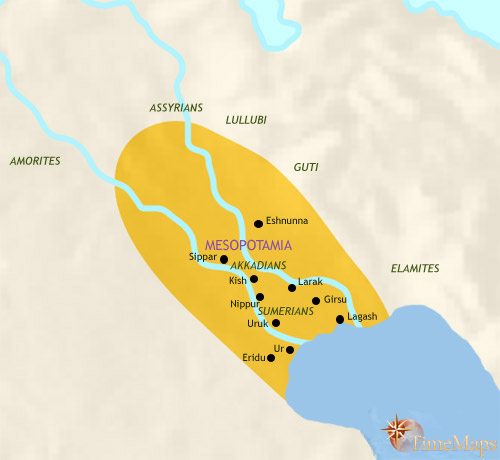
What is happening in Iraq in 3500BCE
One of the most important developments in world history is taking place in
Mesopotamia. Here, on the flood plains of the rivers Tigris and Euphrates, the fertile
soil brought down from the mountains by the great rivers has given rise to much
denser populations than anywhere else in the world. The arid climate, plus dangerous
spring floods, has called for the creation of large-scale irrigation systems, to channel
and store water for crops, and to protect communities from the raging waters.
Over the centuries, large communities with densely concentrated populations of many
thousands of people have grown up. These are the first true cities in human history.
To help them manage the economic life of these cities effectively, the priests who
control them are gradually perfecting the first known writing script and numeric
system – key developments in human progress. The civilization of Ancient
Mesopotamia is being built by a people known as the Sumerians. They are
constructing the first urban and literate culture in world history.
An Urban Revolution
The archaeological evidence would harmonize with this narrative, as it shows the gradual enlargement of these temple centers surrounded by many villages. This was the situation by about 4000 BCE. Over the following few centuries, however, the temple centers – and indeed the temples themselves – grew massively.
Sizable towns appear, and by 3500 BCE several are true cities with tens of thousands of inhabitants. The largest, Uruk, may have been home to 40,000 people. This development was accompanied by the decline in the number of small villages. Clearly a concentration of the population within the city precincts was taking place, very likely for protection.
This dramatic development has been called an “urban revolution”, and it reflects in physical settlement patterns the transformation of society into a much more complex organism than any up to this time. The large surpluses made possible by the rich soil of the plains had come under the control of religious and political elites, centered on the temples. By imposing tribute and taxes on the surrounding population, these had accumulated wealth on a scale undreamt of in previous times.
This they used to construct monumental public buildings – granaries, temples and palaces. These overawed the people and proclaimed their power, and indeed helped to reinforce it. The granaries were centers of a distributive system whereby the temple officials controlled much of the economic life of the people. The god (and therefore his temple) was held to own the land and people of the state (which the locality can now fairly be called); and this translated into the temple elite directly controlling much of the land and labor of the city and its surrounding area.
New Horizons
Much of this wealth was devoted to the decorative arts, and along with a ruling group a class of full-time professional craftsmen emerged. The standard of craftsmanship – indeed, of representational art – was raised to new heights. This was not only stimulated by the desire to decorate temples and other public spaces, but also to manufacture trade goods needed to keep the inward flow of raw materials, in which southern Mesopotamia was so sadly lacking, open. This in turn stimulated long-distance commerce.
A final development needs to be noted, perhaps the most important of all. The demands of administering land and wealth on a scale hitherto unknown presented significance challenges to the temple officials. To meet this challenge, they developed a system of symbols to record the huge number of economic transactions they were overseeing. From these early foundations writing scripts evolved, and the first literate societies appeared.
Early Sumerian Advances
The people known as Sumerians were in control of the area by 3000 B.C. Their culture was comprised of a group of city-states, including Eridu, Nippur, Lagash, Kish, Ur and the very first true city, Uruk. At its peak around 2800 BC, the city had a population between 40,000 and 80,000 people living between its six miles of defensive walls, making it a contender for the largest city in the world.
The period after 3500 BCE is known to historians as the Early Dynastic period of Mesopotamian history. It saw Sumerian civilization increase in complexity and sophistication. In particular, writing made important advances. From the early pictograms, the script gradually became more abstract and stylized. It also became more linear, reflecting the use of the wedge-shaped styluses used to inscribe the clay tablets. Writing remains one of the most important cultural achievements of the Sumerians.
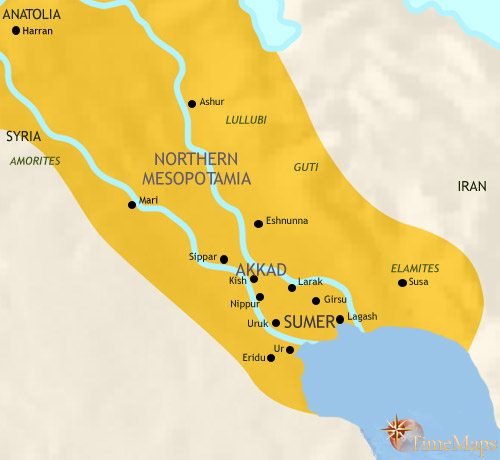
What is happening in Iraq in 2500BCE
The past millennia has seen the Sumerians bring the civilization of ancient Mesopotamia
to a high level. It has now expanded to the north, to what would later be the land of Assyria.
The Sumerians have now entered the Bronze Age. Bronze is used in the weapons and
decorations of the ruling classes; it is far too expensive to be used by farmers, and
agriculture basically remains at a stone-age level of technology. However, the demand
for copper and tin, the ingredients of bronze, means that the Mesopotamian city-states
now lie at the centre of an expanding network of long-distance trade routes.
Writing has reached a level of sophistication that makes it a vehicle, not only for
administration, but also for the hymns, prayers and myths of the world’s most
ancient literature.
The small Sumerian states are constantly at war with one another, and have developed
the first organised armies in history, together with the systematic taxation and
bureaucracies to support them. The economic life of these city-states is highly
centralized on the temples. These own much of the land (or rather, their gods do),
provide work for the craftsmen and labourers, administer the cities’ markets and
organize long-distance trade.
By around 2500 BCE the script had developed into classic Sumerian cuneiform writing, with which a subtle and varied literature, containing economic and administrative documents, letters, stories, prayers, hymns and so on was being committed to writing. The Sumerians were musically inclined and a Sumerian hymn, “Hurrian Hymn No. 6,” is considered the world’s oldest musically notated song.
One of the crowning achievements of Mesopotamian literature is the “Epic of Gilgamesh,” a 3,000-line poem that follows the adventures of a Sumerian king as he battles a forest monster and quests after the secret of eternal life. While the poem’s hero is a demigod with Hercules-like strength, most scholars believe he is based on an actual king who served as the fifth ruler of the city of Uruk. The historical Gilgamesh appears on the Sumerian “King List” and is thought to have lived sometime around 2700 B.C. Few contemporary accounts of his reign have survived to today, but archeologists have found inscriptions that credit him with building Uruk’s massive defensive walls and restoring a temple to the goddess Ninhil, which suggests he may have been a real ruler whose deeds were later repurposed as myth.
Elaborate construction, such as terra cotta ornamentation with bronze accents, complicated mosaics, imposing brick columns and sophisticated mural paintings all reveal the society’s technical sophistication.
Sculpture was used mainly to adorn temples and offer some of the earliest examples of human artists seeking to achieve some form of naturalism in their figures. Facing a scarcity of stone, Sumerians made leaps in metal-casting for their sculpture work, though relief carving in stone was a popular art form.
The urbanization process reached its peak in the early 3rd millennium, and spread throughout the whole of Mesopotamia and beyond. In northern Mesopotamia cities appeared at places like Mari and Assur, and other cities appeared in Elam, Syria and eastern Turkey. The people of these cities were influenced to a great extent by Sumerian art and architecture; colonies of Sumerian merchants were established in some centers, though more local influences were also apparent.
Sumerian Science
Sumerians had a system of medicine that was based in magic and herbalism, but they were also familiar with processes of removing chemical parts from natural substances. They are considered to have had an advanced knowledge of anatomy, and surgical instruments have been found in archeological sites.
One of the Sumerians greatest advances was in the area of hydraulic engineering. Early in their history they created a system of ditches to control flooding, and were also the inventors of irrigation, harnessing the power of the Tigris and Euphrates for farming. Canals were consistently maintained from dynasty to dynasty.
Their skill at engineering and architecture both point to the sophistication of their understanding of math. The structure of modern time keeping, with sixty seconds in a minute and sixty minutes in an hour, is attributed to the Sumerians.
Sumerian City-States
The eighteen recorded Sumerian cities of southern Mesopotamia remained concentrated along the branches and irrigation canals of the Euphrates in a narrow strip of land extending from south of present-day Baghdad to the marches bordering the Gulf.
This region was divided between people of two language groups: in the south, Sumerian-speakers, in the north, Semitic speakers, or Akkadians. The Sumerian language is the oldest linguistic record. It first appeared in archaeological records around 3100 B.C. and dominated Mesopotamia for the next thousand years. It was mostly replaced by Akkadian around 2000 B.C. but held on as a written language in cuneiform for another 2,000 years.
Each Sumerian city was the center of a small city-state, consisting of the city itself and its surrounding territory – farmlands, gardens and orchards in the irrigated land near the city, grazing land for herds of cattle and flocks of sheep and goats on the arid land further out, between the cities.
The city was surrounded by a wall. A large Sumerian city held between 30,000 and 40,000 inhabitants, and one of the largest, Lagash, had a territory of 2,880 square kilometers. At the heart of the city, both physically and metaphorically, stood the temple to its patron god.
The Sumerians regarded their city-god as the true owner of the city. This may originally have had its earthly expression in the temple owning all the land in the city-state, but by the Early Dynastic period this was no longer the case. The temple owned an estimated third of the arable land in each city-state, and was therefore a major economic unit. It used the revenue to maintain the priest, officials, craftsmen and other servants of the temple; to store as a provision against drought; and to exchange with goods from abroad – international trade was in the hands of the temple or palace.
Sumerian Rulers
By the mid-third millennium BCE secular rulers had usurped much of the political and economic power of the temple. The ruler of a city-state came to be viewed as chosen by the god of the city to be responsible for the safety and prosperity of the people. The earliest rulers were probably both the high priest and ruler, and Mesopotamian kings continued to have priestly functions throughout their history.
From an early date, however, there was a trend for temple and palace to become separate institutions. Even if the rulers started out as the high priests, it is easy to see how this development took place. It is easier for a community to identify with a personal leader rather than an institution, and the high priest of a town would have been invested with charismatic authority. The office would in all probability have been hereditary within a particular family, who would have taken on the attributes of a royal dynasty.
With increasing warfare between states the leader’s position would have become ever more crucial, and so more prestigious, and the ruler’s office would have outgrown the temple context in which it had its roots. In due course the Palace would have developed as a distinct institution within the state, and by the Early Dynastic period the royal palace was probably as wealthy and powerful as the temple.
Warfare
What we know of Sumerian history in the Early Dynastic period is one of warfare, between city-states and with foreign invaders. The cities strove to subdue one another, and one city-state after another – Kish, Uruk, Ur, Nipur, Lagash, Umma – achieved a position of dominance over some or all of the other cities of southern Mesopotamia, and beyond.
In this rather tedious power-struggle, certain issues seem to have been at stake. It is clear that some wars were a straightforward conflict over resources – land, water, trade routes. Over and above these, however, there seemed to be two goals that an ambitious king would aim for.
Firstly, domination of Nippur gave him control over the religious center of Sumer, because it was in this city that the temple of the chief Sumerian god, Enlil, was located. This seems to have been a center of pilgrimage, and possessing it gave a ruler enormous prestige. His patronage of the temple legitimized his status as overlord of other city-states.
Secondly, controlling Kish seems to have been key to controlling the Semitic lands of Akkad, just north of the Sumerian heartlands, which in turn gave a ruler a huge strategic advantage viz-a-viz the other rulers. These two cities therefore figure prominently in the power-struggles of the period.
The First Empires
Suddenly in the late 3rd millennium BCE there burst onto the scene the first of history’s great conquerors, Sargon of Akkad. His empire wrought great changes within Mesopotamia, and his career cast a long shadow over later history as ambitious kings strived to emulate his achievements. The Akkadian Empire takes its name from the region and the city of Akkad, both of which were localized in the general confluence area of the Tigris and Euphrates Rivers.
The Akkadian Empire was the first ancient empire of Mesopotamia after the long-lived civilization of Sumer. It was centered in the city of Akkad and its surrounding region. The empire united Akkadian and Sumerian speakers under one rule. The Akkadian Empire exercised influence across Mesopotamia, the Levant, and Anatolia, sending military expeditions as far south as Dilmun and Magan (modern Saudi Arabia, Bahrain, and Oman) in the Arabian Peninsula. The Akkadian Empire reached its political peak between the 24th and 22nd centuries BC, following the conquests by its founder Sargon of Akkad. Under Sargon and his successors, the Akkadian language was briefly imposed on neighboring conquered states such as Elam and Gutium. Akkad is sometimes regarded as the first empire in history, though the meaning of this term is not precise, and there are earlier Sumerian claimants. After the fall of the Akkadian Empire, the people of Mesopotamia eventually coalesced into two major Akkadian-speaking nations: Assyria in the north, and Babylonia in the south.
Sargon of Akkad (Akkadian Empire)
To the north-west of the Sumerian heartland lay the region later known as Akkad, inhabited by a Semitic people. The Semitic peoples of Akkad were by and large not nomads, and during the Early Dynastic period fully shared in the Sumerian civilization to their south. They lived in similar city-states, worshipped the same gods and goddesses, followed the same artistic and architectural styles, and used the same cuneiform script. The only difference was that they spoke a different language, later known as Akkadian.
In the center of this Semitic area stood the Sumerian city of Kish, and in c. 2334 BCE an official of humble origin, Sargon, seized control of the city and became its ruler. Being a Semite himself, he based his power on the local Semitic population, with whose help he defeated the Sumerians and became overlord of both Sumer and Akkad. Sargon then consolidated his power in a way no other king before him seems to have done. He founded a new capital, Agade (from which the term “Akkad” comes – but we do not yet know the exact location of the city); he placed his own officials as governors of the defeated Sumerian city-states; he confiscated large tracts of land in the old city-states, probably from both the palaces and temples, and turned them into royal domains under his own officials to support his personal wealth and power; and he made Akkadian the language for official business.
Having thus secured his power in southern Mesopotamia, he expanded it on a scale never before attempted. He subjected Elam in the east, Mari in northern Mesopotamia, Ebla and other cities in Syria, and carried his power as far as the Mediterranean Sea and the Taurus mountains. He probably even led an expedition into Asia Minor.
Sargon’s Successors
On his death in 2279 BCE there were widespread revolts, which his son, Rimush, dealt with vigorously. Even so, it appears that areas of northern Mesopotamia and Syria temporarily fell away from Akkadian rule, and it was not until Sargon’s grandson, Naram-Sin (2254-2218 BCE) came to the throne that Akkadian power revived.
Naram-Sin reclaimed all the lost territory and expanded the Akkadian empire still further. He spent almost his entire reign on campaign, re-imposing his family’s rule in northern Mesopotamia and Syria (sacking Mari and Ebla in the process), and extending Akkadian power into eastern Turkey. He departed from Mesopotamian tradition when he became the first Mesopotamian ruler to claim the status of a god within his own lifetime.
Decline
Naram-Sin was the last great king in Sargon’s line. With his death revolts and invasions occurred throughout the empire. Elam was lost, and several Sumerian cities revolted. Northern Mesopotamia, Syria and the Anatolian regions fell away from the empire. Finally the Guti, a barbarian hill people from the Zagros mountains, invaded Mesopotamia, put an end to Akkadian power once and for all, and installed themselves as the new rulers of Sumer and Akkad.
Thus ended the first real empire in world history. Sargon and his successors made an immense impression of the ancient Middle Eastern imagination. The memory of Sargon himself became surrounded by legend, and an example to ambitious rulers in the region for centuries after his death.
The Legacy of Sargon and his Empire
The geographical horizons of the people of southern Mesopotamia were vastly enlarged, and the influence of their civilization greatly enhanced in the surrounding regions. Northern Mesopotamia was brought fully within the fold of Sumerian/Akkadian civilization, as were other peoples further afield such as the Hurrians, Lullubi and Elamites. In southern Mesopotamia, Semites and Sumerians had become so intermingled that the region should hereafter be called “Sumer and Akkad”. Akkadian was established as the language of government alongside Sumerian.
The period of Akkadian rule had worked other changes in Sumerian civilization. For more than a century the main city-states of Sumer had been ruled by Akkadian governors. The old Sumerian rulers had not been displaced, however; they just answered to a higher (earthly) power. To support the Sargonid regime, large portions of the old temple and palace estates had been confiscated and handed over to the newcomers. With the passing of Akkadian rule the new rulers of the cities took over the land and brought it under their direct ownership, thus greatly expanding the wealth and power of the Palace at the expense of the Temple. The rulers now dominated their city-states in a new and more complete way.
On the other hand, one of the more lasting changes brought about by Sargon and his successors was that after their time Sumer and Akkad became more of an integrated political unit. The rulers of individual city-states were henceforth no longer as independent as they had once been, and were now usually vassals of an overlord, who called himself the king of Sumer and Akkad.
The Guti Interlude
The first of these overlords were the Guti kings. In the closing chapter of the Akkadian story the Guti invaded southern Mesopotamia, ravaged the country, sacked the capital and then occupied Sumer and Akkad as the ruling group. However, they were few in number and apparently only able to occupy a few strategic locations such as Nippur and probably Ur. Most of the city-states were left to their own devices so long (presumably) as they continued to send tribute to the Gutian kings, and some, notably Lagash, thrived economically and culturally.
After almost a hundred years of dominance, the Guti were driven out in 2120 BCE. Within a few years, the ruler of Ur, called Ur-Nammu, had establishing himself as king of Sumer and Akkad.
The Empire of Ur
Ur-Nammu (2112-2095 BCE) founded the 3rd dynasty of Ur, under whom southern Mesopotamia knew almost a century of peace and prosperity. He promoted agricultural expansion by enlarging the system of canals, and he carried out a spectacular building program in the cities of his kingdom.
Most famously, Ur-Nammu built a series of ziqqurats, pyramid-like structures which soared over the cities that housed them (indeed, some scholars believe they were inspired by the great Pyramids of Egypt, though they were not royal tombs but the final stage in a long history of Sumerian temple architecture going back thousands of years). The greatest of these was at Ur itself, at 40 meters or more in height the most magnificent example of Sumerian architecture remaining today.
A Centralized State
Ur-Nammu died in battle and was succeeded by his son, Shulgi, who in his long reign (2094-2047 BCE) carried out a thoroughgoing reform of his kingdom, breathtaking in its scope. A law code was drawn up for the entire kingdom, weights and measures standardized, and a uniform tax system imposed across the land. The tribute raised (grain, sheep, cattle and so on) was sent to a central storehouse near Nippur to be distributed to where the government ordered it: to feed the labor digging and maintaining canals and roads, building temples; or to support the lavish court at the capital.
Manufacturing centers were set up throughout the kingdom to produce a wide range of goods – leathers, textiles, flour, beer, pottery, cooking utensils and so on. International commerce was in the hands of state officials, in line with a long Sumerian tradition, but conducted on a much larger scale than hitherto.
To administer this highly centralized system an enlarged bureaucracy was built up, and the cuneiform script improved to help officials cope with the increased work load. The previous rulers of the different city-states of Sumer and Akkad were kept in their positions, but were now treated as subordinate officials within a national structure, their loyalty and efficiency inspected by royal officials.
The kings of Ur expanded their territories by conquest, and built up a network of allied states. The lands of northern Mesopotamia were turned into provinces, and beyond these lands, Elam, Mari and other states were drawn into a network of marriage alliances with the royal family of Ur. A network of roads knitted this geo-political structure together. Standing head and shoulders above all other kings, Shulgi, following in the steps of Naram-Sin, proclaimed himself a god in his own lifetime.
Decline and Fall
The empire of Ur lasted for around twenty years after Shulgi’s death before unravelling. One by one the eastern provinces seceded from the empire, and in the west Semitic nomads new to history, the Amorites, exerted pressure and then broke through the defenses, penetrating into the heart of the kingdom. Then the heartland of Akkad and Sumer itself began to break away, with the rulers of the city-states proclaiming their independence. Finally, in 2004 BCE, the Elamites invaded, took Ur, sacked the city and led the last king of Ur away captive.
The centuries after the empires of Akkad and Ur were ones of division and invasion. In due course another great conqueror emerged, who briefly held the Mesopotamian world together. But by now new centers of power and civilization were emerging, and the days of southern Mesopotamian dominance were nearing an end.
After the Elamites stormed Ur and took control, Amorites had begun overtaking the Sumerian population. The ruling Elamites were eventually absorbed into Amorite culture, becoming the Babylonians and marking the end of the Sumerians as a distinct body from the rest of Mesopotamia.
Early Babylon
After the fall of Ur, southern Mesopotamia remained fragmented amongst a multitude of kingdoms for more than two centuries. There was constant war as the kings struggled to dominate each other, aiming to become the next overlord of Sumer and Akkad. The most important states were Isin and Larsa, with Isin predominating for the first century or so, and Larsa in the next.
The kings of both these states, although of foreign origin (Isin’s royal family came originally from Mari, Larsa’s were of, first Amorite, then Elamite stock), saw themselves as the natural heirs of the old Sumerian rulers. They patronized Sumerian art and literature, embellished the great city of Ur with many new temples, and had their official inscriptions written in the Sumerian language – even though by now Akkadian was the everyday language of government and administration.
The Amorites
While Isin, Larsa and other kingdoms were thus competing with one another, the region was being settled by clans from the desert. These were the Amorites, who arrived as barbarian semi-nomads but soon adopted the civilization of Sumer and Akkad.
The Amorites founded many small kingdoms, and had a lasting impact upon the social and economic life of the region. The independence of the old city states, and the political and administrative structures that they embodied, were finally ended. The new kings took large pieces of the land for themselves, and, keeping some to be worked by tied peasants for the maintenance of the Palace, distributed the rest of it amongst their families, friends and followers. A new landowning class thus arose.
Temples lost their economic privileges and became landowners like many others; and like all, subject to royal taxes. The large temple and palace workshops, let alone the enormous factories of the kings of Ur, were a thing of the past, with small private workshops now proliferating. Even international trade, hitherto a jealously guarded monopoly of temple or palace, was now more in private hands.
Finally, the religious sphere was not untouched. The new Amorite kings were more taken up with local concerns, and the local gods became more important to them. The old national shrine of Nippur declined in importance, and with it the great god Enlil. This in due course created a vacuum for a new chief god to fill.
Hammurabi of Babylon
One of the Amorite chiefs settling in the region founded a small kingdom based on the hitherto unimportant town of Babylon (1894 BCE). Over the next sixty years or so he and his successors gradually expanded their power, so that by the end of this period they ruled almost all the land of Akkad. Hammurabi ascended the throne of Babylon in 1792, and over the course of a long reign (1792-49 BCE) turned his territory into a large empire covering the whole of Mesopotamia and beyond.
Throughout his disparate domains Hammurabi pursued a centralizing policy. Local government remained in the hands of local leaders, but above this a hierarchy of royal officials governed the empire, with the king taking a direct and active interest in the detailed affairs of his kingdom.
In many ways Hammurabi acted in the time-honored fashion of a conscientious Sumerian ruler: rebuilding and repairing the ancient temples, digging new canals and maintaining old ones, seeing justice done – with a view to which he issued his famous Law Code towards the end of his reign, following the example of previous Mesopotamian rulers.
In other ways he was a genuine innovator. For the first time a new socio-political institution appears in Mesopotamia, the fief, given to soldiers and others in return for military and other service. This was perhaps an attempt to create a class of followers distributed throughout the empire whose loyalty could be counted on to bolster the power of Hammurabi and his dynasty.
Decline
Hammurabi’s death was followed by mass revolts. Hammurabi’s son, Samsu-iluna (1749-1712 BCE), fought valiantly to keep his father’s political creation together, but without success. Southern Mesopotamia, ancient Sumer, fell under the control of the Sea-land dynasty – not before the historic centers of Ur and Uruk had been put to the torch – and northern Mesopotamia fell under the control of Assyria.
Hammurabi’s successors were henceforth confined to the old region of Akkad. They preserved the Babylonian kingdom for another century. However, in 1595 BCE a large raid conducted by the king of the Hittites sacked Babylon, and the king of Babylon was deposed, and probably killed. The Hittites withdrew almost immediately, as their king had pressing matters at home to deal with, and into the political vacuum they left behind stepped the ruler of the Kassites, Agur II, taking the throne of Babylon and founding a dynasty which would last 438 years – the longest in Mesopotamia’s history.
The Kassites
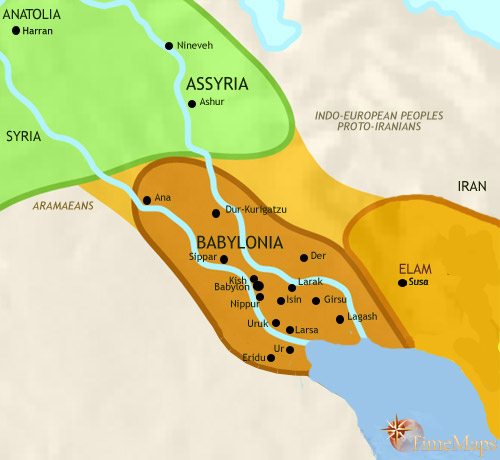
What is happening in Iraq in 1500BCE
Over the past thousand years, kingdoms and empires have come and gone in
Mesopotamia. The first recorded empire in world history appeared briefly under the
fierce Sargon and his descendants (c. 2334 to 2218 BCE), and the powerful
states of Ur (2112 to 2004 BCE) followed.
The civilization of Ancient Mesopotamia entered a new phase with the reign of
Hammurabi, king of Babylon (1792-49E). He conquered a large empire covering
most of Mesopotamia and parts of Syria. He is also famous as history’s first great
law-giver. Although his empire did not endure after his death, the city of Babylon
remained the primary city of ancient Mesopotamia, with the Sumerian cities
being eclipsed.
The history of Mesopotamian has been disrupted by periods of outside invasion and
internal fragmentation. Despite these upheavals, however, styles of art, architecture
and literature derived from the old Sumerian cities have retain a powerful grip on the
region’s culture.
By 1500 BCE new invaders divide the ancient lands of Mesopotamia between them.
The Kassites rule Babylonia in the south, while Assyria is now part of the
extensive (but short-lived) kingdom of the Mitanni. The powerful and warlike kingdom
of Elam lies to the east. Despite the recent origins of these powerful states, this
period represents the high point of Bronze Age civilization in Mesopotamia. The
next few centuries will see great upheavals hit this brilliant world.
The Kassites were a people who had lived in the central Zagros region for millennia, although since around 2000 BCE they had come under the rule of an Indo-European speaking ruling class, giving them a warlike streak which they do not appear to have had before.
Although foreigners in Babylon, they provided their new kingdom with much needed peace, stability and economic revival. Apart from a war in which they conquered the Sea-Land kingdom and so reunited southern Mesopotamia – which from this date is known to scholars as Babylonia – they indulged neither in foreign adventures not domestic strife for many long years. With Assyria they signed a treaty dividing Mesopotamia between the two powers. At home they ruled within the hallowed traditions of Mesopotamian monarchs – worshipping the ancient gods, digging canals and above all rebuilding the old temples.
Fortunately for generations of scholars thousands of years in the future, they also patronized Mesopotamian literature by overseeing the collecting, organizing, editing and storage of thousands of cuneiform tablets in the royal libraries.
The Kassites continued to rule Mesopotamia for several centuries. In 1235 BCE, however, a dual invasion of Babylonia by Assyria and Elam led to the Assyrians installing their own governors as rulers of Babylon. Assyria immediately entered a period of political instability, with a series of palace coups, and the Kassite-Babylonians soon revolted (1227) and restored their independence. Elam remained a threat, however, and in 1160 BCE invaded Babylonia again. They did so with a huge army, and plundered southern Mesopotamia mercilessly. Many Mesopotamian masterpieces, including the great statue of Marduk, were taken away to Susa, the capital of Elam. The last Kassite king was ousted from his throne in 1157 BCE, and Babylon occupied by Elam.
Decline, again
The Elamites soon evacuated Babylonia, probably because they were coming under pressure on their northern and eastern flanks from new groups of peoples moving into Iran. Babylon again had a native dynasty on her throne, and the most famous of these kings was Nebuchadnezzar I (c. 1124-1103 BCE), who gained lasting fame for a highly successful campaign into Elam which resulted in the return of the statue of Marduk to Babylon.
By this date, the ancient countries of Mesopotamia were all under threat from large-scale migrations of Aramaean tribes; and indeed the whole history of the region now takes on a new character, as the Middle East enters a phase of barbarian invasion and the eclipse of the ancient centers of civilization. This period lasts for several centuries, and is followed by one which sees the rise of a series of enormous empires in the region. The future of Mesopotamia is as one region amongst many others.
c. 1500: The Mitanni, an Indo-European people, conquer northern Mesopotamia, plus areas of Syria and Asia Minor. After 200 years the kingdom of Assyria conquers northern Mesopotamia from the Mitanni
From 1100: Nomadic peoples such as the Aramaeans and the Chaldeans overrun much of Mesopotamia. The kingdoms of Babylon and Assyria go into temporary decline.
Babylonia in the first millennium
Southern Mesopotamia – Babylonia – suffered even more than Assyria during the “Age of Confusion”, as Babylonian scribes called the centuries around 1000 BCE. From the west, large numbers of Aramaean peoples invaded, and from the south, a nomadic people called the Kaldu moved in to the coastal area of Babylonia. These people are known to history as the Chaldeans.
In this dark period of Babylonia’s history, a social revolution seems to have taken place. For centuries, the temples had been gradually losing wealth and influence, as powerful kings kept them in their place and large royal estates had come to overshadow the temples’ land holdings. A class of private merchants and landowners had risen in numbers, wealth and influence, rivaling the temple’s economic position.
With the chaos of the centuries on either side of 1000 BCE, however, the peasants of Mesopotamia, with the royal authorities in disarray, seem to have turned to the temples for protection. By the time southern Mesopotamia re-emerges into the light of history, the temples have regained a degree of power and wealth they had not known for more than a thousand years.
The Chaldeans in particular represented a continual threat to the cities of Babylonia. They established their base in the coastal area of Mesopotamia, from where they emerged to raid neighboring territory. The extensive marshes of the area provided an ideal shelter from reprisals.
Despite the fact that Mesopotamian civilization experienced chaos and decline in the centuries either side of 1000 BCE, it did not vanish. Indeed, the cities of Mesopotamia, above all Babylon, carefully fostered their ancient heritage. The culture of the Assyrians, who came to dominate Mesopotamia after about 800 BCE, owed a huge amount to the ancient Mesopotamians, and they treated Babylon and other Mesopotamian cities with great respect.
The Assyrian domination
From the 9th century BCE the Assyrians of northern Mesopotamia posed as protectors of Babylon, for which they had an enduring and genuine reverence as the cultural and spiritual center of Mesopotamian civilization. They mostly treated the Babylonian kings with great respect and campaigned against their enemies, principally the Chaldeans and the kingdom of Elam. Even so, on at least two occasions the Chaldeans were able to capture Babylon itself, and hold it for years at a time.
In return for their aid the Assyrian kings expected the allegiance of the king of Babylon and his subjects, which was usually forthcoming as the urban populations of Babylonia saw the Assyrians as their best protection against raiders and invaders. However, they did occasionally rebel. Once, in the early 7th century, this led to the destruction of the city of Babylon by an Assyrian army. The city was soon rebuilt, however, and the general Assyrian policy towards Babylonia was resumed. This involved the Assyrian kings confirming the temples in their predominant position, showering them with favors, not only from feelings of religious deference, but also as a way of keeping the local population happy. Nevertheless, these monarchs also kept the temples firmly in their place, and when need arose they had not hesitation in levying tribute (or forced loans) on them.
The Assyrian kings also regularly followed the practice of installing one of their sons as king of Babylon, subordinate to the king of Assyria.
The rise of the Babylonian empire
In the late 7th century, events began to unfold which would lead to the collapse of the Assyrian empire. The death of the last of the great Assyrian kings, Ashurbanipal, in 627 BCE, was shortly followed by civil war between two of his sons, the king of Assyria and the king of Babylon. The king of Babylon was victorious, but by then the Chaldeans had taken Babylon again (626 BCE). They were led by one of their chiefs called Nabopolassar, who now became one of the key players in the great events which now took place.
With the Assyrians’ civil war over and the former king of Babylon now king of Assyria, Nabopolassar now faced a strenuous Assyrian attempt to regain control of Babylonia. The war raged on for seven years, but the Assyrians had also to deal with events on their northern frontier, where Scythian and Cimmerian raiders from the steppes north of the Black Sea mounted devastating raids through Assyrian territory. By 616 BCE the Chaldeans had repelled the Assyrians and were in full control of Babylonia.
The end of Assyria
In 616 BCE the Chaldeans under Nabopolassar, who had styled himself king of Babylon for the past 10 years, invaded Assyria itself. In the following year, the Medes also invaded Assyria, and captured the Assyrian holy city of Ashur. Here, the Medes (who had be now united much of Iran under their king, Cyaxes) and the Babylonians agreed to act in unison (614 BCE), and, after a year’s slow campaigning, they besieged the Assyrian capital, Nineveh (612 BCE). After three months, the great city fell, and was utterly destroyed. All the other cities of Assyria were also taken and raised to the ground. Only Harran remained, and it fell in 610 BCE. Only villages were left in the land. Two hundred years later a Greek army would march through Assyria and have no idea that the heaps of rubble they saw had once been the greatest cities in the world.
The huge Assyrian empire was shared out amongst its victorious enemies, the Babylonians and Medes. The Medes took Iran, from where they would later expand into Armenia and Cappadocia. Nabopolassar held all Mesopotamia – that is, Babylonia and Assyria – and claimed Syria and Palestine. These were under Egyptian control, and in 607 BCE, Nabopolassar sent his crown prince, Nebuchadnezzar, to drive them out. After two years of hard campaigning he was able to dislodge the Egyptians from the strategic city of Carchemish, in northern Syria. This opened the way for the Babylonians to swiftly take the whole of Syria and Palestine from the Egyptians. Nebuchadnezzar may well have been planning on invading Egypt itself but just at that point he heard of his father’s death. He therefore hurried back to Babylon to claim the throne (605 BCE).
King Nebuchadnezzar
This was the opportunity for the peoples of Syria and Palestine to rebel against their new masters. All the cities of the Philistines joined in this rebellion, and Nebuchadnezzar made an example of Ascelon by raising it to the ground and exiling all its people. As an exemplary punishment, this clearly did not work: Nebuchadnezzar had to send armies to put down rebellions in his western provinces virtually every year, at least until 573 BCE. The Egyptians were of course keen to stir up trouble and on two occasions the Babylonians had again to drive Egyptian armies back to their borders.
In one of these campaigns, in 597, he had to put down a rebellion in the kingdom of Judaea. he captured Jerusalem, deporting 3000 of its leading citizens to Babylon. In 589 the people of Jerusalem rebelled again, and Nebuchadnezzar visited his full fury on that city. After an 18 month siege the city was sacked, its walls pulled down and its temple burnt. The last king of Judah, Zedekiah, was blinded and taken prisoner, and many thousands more people deported. Others took refuge in Egypt.
In 586 Nebuchadnezzar laid siege to Tyre, which had refused to pay tribute to him. This siege would last thirteen years. Finally, in 573, Tyre agreed to submit to Babylonian rule and pay tribute; and this seems to have brought peace to Nebuchadnezzar’s western provinces.
Nebuchadnezzar and Babylonia
At home, Nebuchadnezzar lavished attention on Babylonia. He paid close attention to the economic welfare of the people, taking seriously the traditional duty of Mesopotamian kings to repair and maintain the canals, dykes and pools on which their wellbeing depended. Indeed, he expanded the irrigation system of southern Mesopotamia as never before, bringing much new land under cultivation.
Babylon was rebuilt, enlarged and beautified, becoming the largest and most magnificent city in the world at that time. Other cities in southern Mesopotamia also received great attention, with all the ancient Sumerian cities having their temples restored and enlarged. By some interpretations, it was under Nebuchadnezzar that ancient Mesopotamia reached its peak. It had never been wealthier, its capital, Babylon, had never been more magnificent, and it had certainly never been more politically powerful. This is all reflected in its art and architecture. The ruins of Babylon which can be seen today mostly date from this phase in its history, and show what a splendid city it was at that time.
More striking still is the fact that this art and architecture stood in an unbroken tradition stretching back to early Sumerian times. There had been some evolution in style, but this had been within quite narrow limits. For example, the temples which Nebuchadnezzar built were in Ziggurat form, just as had been the temples of the Sumerians in the 3rd millennium BC. Also, the writing that was used by the priests of the temples was in the cuneiform developed by the priests in two and half thousand years before. It was in this script that the fiendishly exact observations of the stars which brought ancient Mesopotamian astronomy to the height of its achievement were note down by Babylonian scribes.
The countryside was covered by large estates, owned by kings, nobles, officials and, above all, temples. These were partly let out to tenants, free and, more often, unfree; serfdom seems to have been more widespread at this time than previously, probably a result of the age of chaos of the 11th and 10th centuries BCE when farmers put themselves under the protection of priests and other powerful figures to escape marauding raiders. Partly the estates were farmed directly, with the aid of slaves and hired labour, under the management of land stewards.
This period, indeed, marked the high point of the temples’ wealth and influence in Babylonian society; they were the predominant social and economic institutions of the time. The Chaldean kings, being of foreign descent and having no deep roots in the sympathies of the native population, were critically dependent upon the support of the immensely powerful Babylonian priesthood. When this support was withdrawn, then the foundations of their rule were undermined.
The temples of the late Babylonian period formed social and economic units almost independent of the royal government. They owned large estates, carried out extensive trade, both within and outside Mesopotamia, and controlled many production units, ranging from numerous small craft workshops to major industrial workplaces such as shipyards and warehouses. Their economic activities were directed by senior temple employees who commanded the labour of thousands of workers, including officials, overseers, scribes, accountants, business agents, ship crews, artisans, builders, peasants, hired laborers and slaves. The major temples were enormously wealthy, enjoying the produce of their estates, the profits from their trade, the temple taxes levied on the wider community, and their share in the sacrifices offered in the sanctuaries.
One of the features which shows clearly that the late Babylonians were heirs and continuators of the ancient Mesopotamian civilization is that the laws of Hammurabi, embodied in his famous code but probably dating to much earlier, were still in force in Nebuchadnezzar’s time. Although no law code survives from the sixth century BCE, and indeed may well not have been written, the ancient laws being deemed sufficient, the legal cases of which we have records show exactly the same principles in the way they are handled, with the same logic and judgements.
Nebuchadnezzar died in 562 BCE. Three obscure kings then followed one another in quick succession, each brought down by palace coups. Then, in 556 BCE, a man called Nabonidus came to the throne (reigned 556-539 BCE).
Babylon, the great city
Resources on a vast scale were devoted to rebuilding and beautifying what was already one of the greatest cities of Antiquity. By the end of the late Babylonian period it was probably the most magnificent city on earth. It had over 100,000 inhabitants living in it (at a time when 20,000 was a substantial city), and its great ziggurat, temples, palaces, ceremonial way and city gates caused Herodotus, the widely-travelled Greek geographer and historian, to exclaim, “it surpasses any city in the known world”.
The city was roughly square shaped, bisected by the river Euphrates. It was surrounded by two sets of walls, an inner wall and an outer wall. Each of these was in fact a double wall, the first with the gap between filled with earth and rubble and a road built on top, on which chariots could ride; the second with a military road between the walls, along which troops could be quickly deployed. The inner wall was punctuated by eight great gates, one of which, the Ishtar gate, functioned as the ceremonial entrance to the city and led on to the wide royal avenue down which the great processions of the city were held.
At the center of the city stood a colossal ziggurat, 90-meter high. A little distance from this was the temple of Marduk, the chief of the gods and patron-deity of Babylon, a massive complex of imposing buildings and spacious courtyards. Adjacent to this was the royal palace. In contrast to Assyrian palaces, the buildings here, though very large, aimed for beauty, not fear; the walls decorated with floral patterns and bright colors were designed to please the eye not to inspire awe.
Even by Nebuchadnezzar’s time, however, processes were at work which were weakening the vitality of ancient Mesopotamian culture. Under the Assyrian empire, Aramaic had spread as the common language of the Middle East. With its easy-to-learn alphabet, the old languages of Mesopotamia, Sumerian and Akkadian (or Old Babylonian), with their complex cuneiform script, had fallen out of everyday use. Indeed, under the Assyrians, Aramaic became the official language of government. It would remain so under the Babylonian and Persians empires. It was really only the wealth and power of the Babylonian temples that kept the old languages and their cuneiform script alive.
The fall of the Babylonian empire
Nabonidus was not of royal birth, and he was over sixty years old when he came to the throne. His mother (who, remarkably for that time, was still alive at the time of his accession) had been a priestess of the god Sin, in the city of Harran in northern Mesopotamia, which had been under the control of the Medes since the fall of Assyria, and Nabonidus himself was a devotee of the god Sin. From the outset of his reign he harbored an ambition to regain Harran and rebuild the sanctuary of Sin there.
Sin was not widely worshipped amongst the Babylonians, who were loyal to their national god, Marduk; however, the god’s cult was widespread amongst both the Arameans and Chaldeans. Given the wealth and influence of the Babylonian temples and their priesthoods, and given too the central role played by the kings in the religious life of the Babylonians, Nabonidus’ devotion to the god Sin was likely to give rise to religious and political tensions.
The monarch was certainly in need of resources. As his reign progressed the international situation deteriorated rapidly for the Babylonian empire. To some extent this may have been instigated by Nabonidus himself. As we have seen he had a burning wish to restore the temple to Sin in Harran, which was in the hands of the Medes. He may well have had strategic reasons as well. A struggle with the Medes, the other great power in the region, was bound to come sooner or later, and Harran was very strategically situated astride the major routes leading into Syria, Iran and Asia Minor. Its possession would have given Nabonidus a military advantage in any conflict with the Medes.
The rise of Cyrus
Whatever Nabonidus’ motives, he plotted with one of the vassals of the Mede king to rebel against him. This vassal was Cyrus, king of the Persians. By 550 BCE, Cyrus had emerged victorious against his Mede master. Over the next ten years he consolidated his hold over the Mede empire and carried out swift conquests of neighboring regions – all of Asia Minor in the west, and the regions eastwards into India.
For most of this time, Nabonidus was absent from Babylon. This may have been due to tensions with the temple priesthoods, especially of the chief god, Marduk. This, plus the fact that he had imposed stricter controls over the temples to try and extract more wealth from them, had aroused their bitter hostility. When a famine struck the city, open insurrection flared up, and, leaving Babylon, Nabonidus went to Arabia, where he based himself for almost ten years.
Again, there may have been strategic reasons for Nabonidus’ actions. With hostilities with the Medes growing, and then with the rise of the Persian threat, Babylon’s trade with the east – a source of immense wealth, especially for the royal treasury – was under pressure. Nabonidus’ expedition to Arabia may have been an attempt to win control of new trade routes, the valuable incense routes from Arabia. This idea is supported by his campaigns there, when he penetrated south down into the region of Medina and Mecca.
The final act
In 539 Cyrus turned his attentions on Babylon. He marched into Mesopotamia and down the Euphrates. Nabonidus was now back in his capital, and he and his son, Belshazzar, drew up their army north of Babylon. Just before the impending battle a large contingent of their already outnumbered army went over to the Persians. Unsurprisingly they were decisively defeated; Belshazzar was killed and Nabonidus probably withdrew to Babylon.
Here, the final act of the long history of Babylon as an independent power was played out. The gates were opened to Cyrus, who was able to enter the great city almost unopposed. This was only able to happen because, in his career as a conqueror, Cyrus had won for himself a reputation as one who respected the national gods of his various subjects. This was in stark contrast to Nabonidus, who had won the hostility of the priests and people of his capital. He vanishes from view at this moment, probably dying as the Persians entered, and Cyrus the Persian was welcomed as a liberator.
The fall of the Babylonian empire to the Persians 539 BC brought Mesopotamia under foreign rule, and it was to remain so for more than a thousand years. In that time, the culture of the people of Mesopotamia was transformed.
The Persian ruling class had no high culture of its own – not many centuries before their ancestors had been nomadic wanderers on the central Asian steppes. Settling in southwest Iran, they had been influenced by the culture of the ancient kingdom of Elam, very similar to that of the Mesopotamians. The Persian kings chose the old Elamite city of Susa as their chief administrative capital, and this thus became one of the great cities of the world at that time – but it must have looked very much like any Mesopotamian city.
Under the Persians, Mesopotamia was ruled by foreign officials, appointed from Persian capitals located beyond Mesopotamia’s borders. The later Persian kings, moreover, neglected the Mesopotamian cities. Wealth was drained away from Mesopotamia in the form of heavy taxes to fill the king of Persia’s coffers, rather than being reinvested in monuments or irrigation. No new temples or public buildings were erected, and existing ones were not maintained properly.
Under the Persians, a long-term trend set in which foreign rulers did not give the irrigation systems of Mesopotamia priority; some neglected it entirely. Little by little, living standards of the farming population declined, and the economies of the cities came under increasing pressure. The area of cultivation shrank, and herding became more and more important. In places the desert encroached. Population levels declined.
To make matters worse, heavy rents were paid by Mesopotamian farmers to support the lavish lifestyle of absentee Persian landowners, who had been granted extensive estates in Mesopotamia. Discontent spread. Babylon was the center of the revolt in 452 BC, and in the aftermath it was sacked by Persian forces. Its main temple destroyed, and never repaired. Even so, Babylon probably remained the largest city in the huge Persian empire.
The Persian empire was conquered by Alexander the Great, who occupied Babylon and Mesopotamia in 331 BCE.
Passing on a legacy
Ancient Mesopotamia must surely be the most influential civilization in world history. For a start, it was the first. The Mesopotamians were the first to build cities, use the potter’s wheel, develop writing, use bronze in large quantities, evolve complex bureaucracies, organize proper armies, and so on.
All subsequent Western civilizations were ultimately built largely upon foundations laid here. Mesopotamian civilization deeply influenced societies in Syria, Palestine and Egypt. These in turn, especially via the Phoenicians and the Israelites, would provide the material, religious and cultural models on which the Greek, Roman and Islamic civilizations would later be constructed. A whole range of technologies and scientific advances were thus made in ancient Mesopotamia which eventually found their way to Medieval and Modern European civilization.
It is important to note, however, that the late Babylonian period was not exclusively one of defending the past against encroachments from more recent developments. The late Babylonians preserved ancient Mesopotamian knowledge, but they also advanced it. This can be seen most clearly in the sciences, notably astronomy. Astronomical observations continued to be made, (even though recorded in a by-now archaic cuneiform script), a process which did not stop with the loss of independence under the Persians. In fact, Babylonian astronomical knowledge continued being refined under the Persians and then the Seleucids. It then merged with Greek scientific knowledge to provide the basis of the works of such great scholars as Ptolemy (c. 100-170 CE).
The origins of the sixty-second minute and sixty-minute hour can be traced all the way back to ancient Mesopotamia. In the same way that modern mathematics is a decimal system based on the number ten, the Sumerians mainly used a sexigesimal structure that was based around groupings of 60. This easily divisible number system was later adopted by the ancient Babylonians, who used it make astronomical calculations on the lengths of the months and the year. Base-60 eventually fell out of use, but its legacy still lives on in the measurements of the both hour and the minute. Other remnants of the Sumerian sexigesimal system have survived in the form of spatial measurements such as the 360 degrees in a circle and the 12 inches in a foot.
The Achaemenid Dynasty of Persia
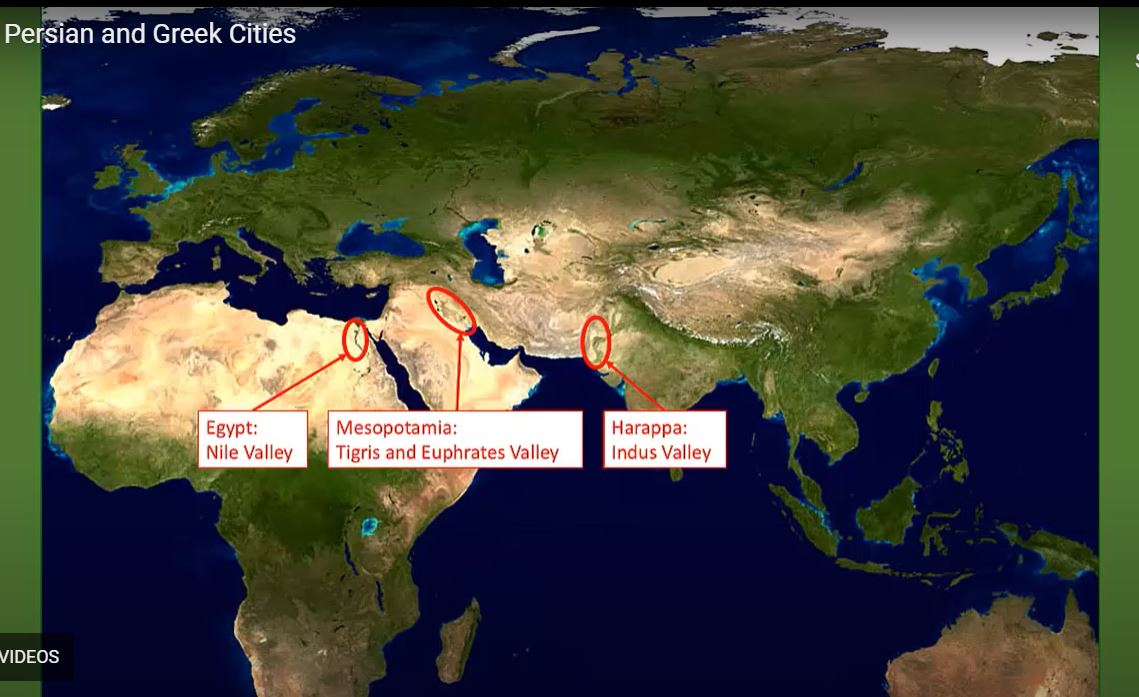
The Achaemenid Dynasty of Persia (the First Persian Empire) united these lands when they created the first world’s first great empire, an ancient Iranian empire that was based in Western Asia and founded by Cyrus the Great in 550 BC. The empire had its beginnings in the 7th century BC, when the Persians settled in the southwestern portion of the Iranian Plateau, in the region of Persis. From this region, Cyrus rose and defeated the Median Empire (another group of Iranian peoples) —of which he had previously been king (the Medes inhabited an area known as Media between western and northern Iran)—as well as Lydia and the Neo-Babylonian Empire (the last of the Mesopotamian empires to be ruled by monarchs native to Mesopotamia), following which he formally established the Achaemenid Empire. It reached its greatest extent under Xerxes I (fourth King of Kings of the Achaemenid Empire, ruling from 486 to 465 BC).
Out on the margins, the Greeks were developing their own urban traditions. Eventually these two states would come into conflict. It was Xerxes I who conquered most of northern and central ancient Greece. Xerxes I is notable in Western history for his invasion of Greece in 480 BC.
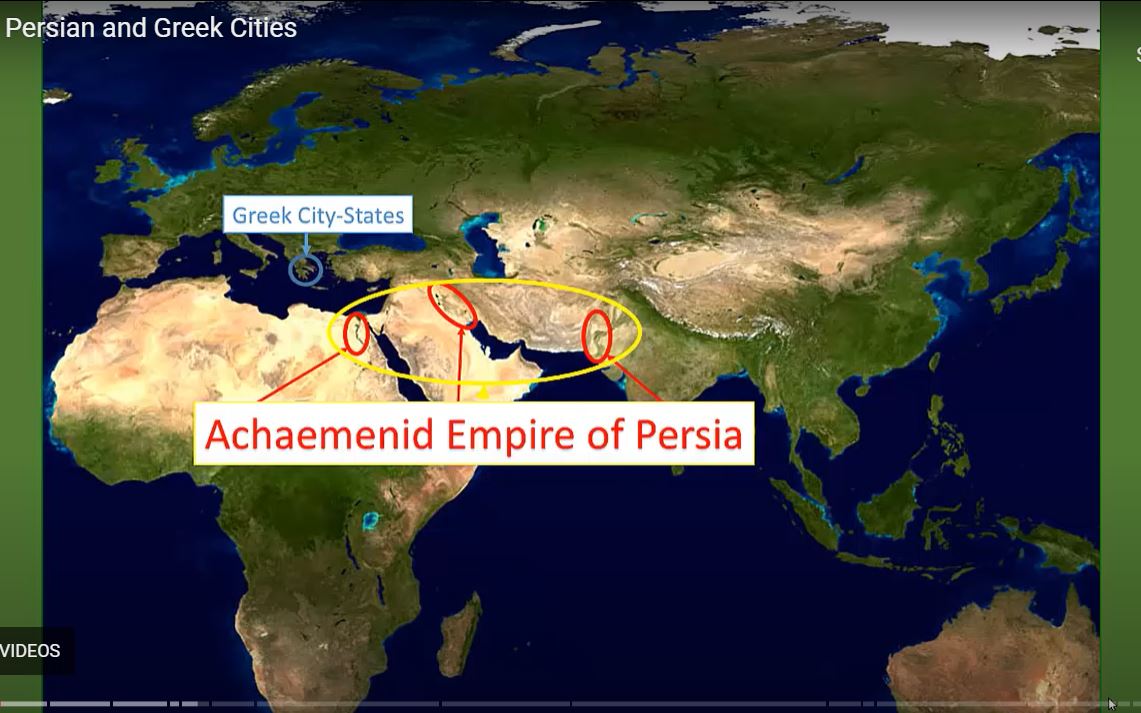
Alexander the Great, an ardent admirer of Cyrus the Great, conquered most of the Achaemenid Empire by 330 BC. Upon Alexander's death, most of the former territory of the empire fell to the rule of the Ptolemaic Kingdom and the Seleucid Empire. The Iranian elites of the central plateau reclaimed power by the 2nd century BC under the Parthian Empire.
