Staitites – Ancient Greek Sweet
from https://historicalitaliancooking.home.blog/
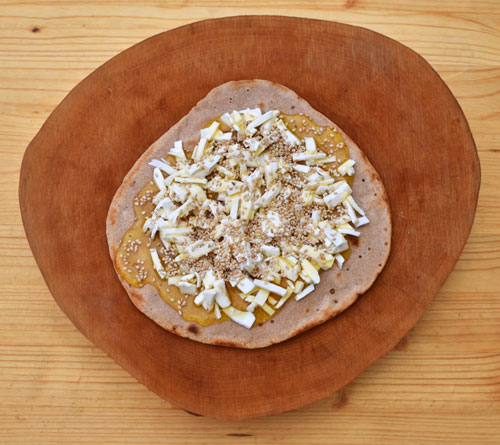
Pancakes have been around for centuries and were written about by Greek poets in the fifth century B.C. The Greeks had four kinds, one called teganites made with olive oil, honey and curdled milk and another kind, staitites, made into dough and topped with honey, sesame and cheese.
55. Then there is the staitites; and this, too, is a species of cheesecake made of wheaten-flour [spelt] and honey. Epicharmus mentions it in his Hebe's Wedding; but the wheaten-flour is wetted, and then put into a frying-pan; and after that honey is sprinkled over it, and sesame, and cheese; as Iatrocles tells us.
(Athenaeus)
In the 14th book of the Deipnosophists by Athenaeus, we find several recipes for plakountai (a term that we met in the past preparing Cato’s placenta. Actually, according to the classification that we find in this book, all the recipes for sweets present in Cato’s book can be called plakountai, despite the fact that placenta, in ancient Rome, is a very specific kind of cake.
This week, we present the staitites, a very simple Greek sweet mentioned in the Deipnosophists. The recipe is not written by Athenaeus, who just analyzes the uses of this term made by other authors, in this case Epicharmus, a Greek comedy writer who lived in Sicily during the 6th century BCE, and Iatrocles, author of a treatise about the plakountai.
The word staitites comes from stais, which means spelt flour. As it frequently happens in Athenaeus’ book, the recipe is just a list of ingredients, with scarce information about how to use them. However, we have a series of clues that help us to interpret the passages: first, the flour is moistened enough to become almost liquid, since the directions are to pour (epicheo) it in the teganon, a frying pan.
The author does not mention yeast, but this dish is among the sweets, not the breads, as a consequence we can guess it is unleavened, and not a sort of pancake. In addition, spelt flour mixed with water makes a batter that cooks very well in the pan, with no need to add eggs (which, otherwise, would be probably mentioned among the ingredients) or yeast.
The last part of the recipe does not present difficulties of interpretation: the verb epiballo, in this case, means to put on; in this recipe, cheese, honey, and sesame seeds. We roasted the sesame seeds because they are frequently used in this way in the ancient recipes, but there are no directions about it, in the same way as the author writes nothing about the kind of cheese, which is probably fresh. We used a sheep primosale.
Staitites
Original text
σταιτίτας πλακοῦς ποιὸς ἐκ σταιτὸς καὶ μέλιτος, μνημονεύει Ἐπίχαρμος ἐν Ἥβας Γάμῳ. σταῖς δ᾽ ἐστὶν ὑγρὸν εἰς τήγανον ἐπιχεόμενον, μέλιτος ἐπιβαλλομένου καὶ σησάμης καὶ τυροῦ, ὡς Ἰατροκλῆς φησίν.Translation
The staitites is a cake made with spelt flour and honey, as Epicharmus recalls in his Hebe’s Wedding. However, Iatrocles says that the spelt flour is moistened and poured in the pan, then spread with honey, sesame seeds, and cheese.
spelt flour
honey
sesame seeds
fresh cheese
Roast the sesame seeds and mince the cheese. Prepare a quite-liquid batter with the flour and warm water. Pour a bit of olive oil into the pan and add a ladle of the batter. Cook the staitites for a few minutes on both sides.
Plate each staitites in a plate, adding the cheese, pouring over the honey, and sprinkling on top with the sesame seeds.
