Tracta (dried pastry)
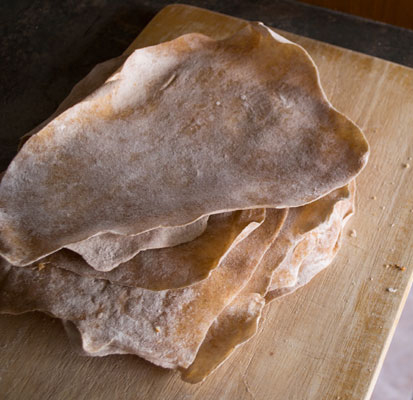
Dried Tracta
The majority of grains consumed by the Romans were milled into flours for baking. However there are several products mentioned that were commonly used in daily cooking. These products were made from unmilled grains. They are known as tractum and amulum and were generally used as thickeners for sauces and soups and as base ingredients in recipes requiring breads. These two products became an essential part of Roman cuisine throughout the ages. Recipes are available today in most extant transcripts and books on Roman culture and dining.
Tractum formed the basis of several sweet pastries, particularly the oldest kinds, from an era when Roman cookery was still simple and rather course. We have only the recipes from Cato the elder for placenta and libum.
Tractum from Sally Granger, Cooking Apicius
"A further item for the store cupboard you will find useful to make in advance is the dried pastry sheets known as tracta. These are not pasta – there is no evidence that they were cooked in water or that they held their shape when they were used in stews. Rather they are sheets of dried pastry similar in appearance to a coarse filo. The only Roman recipe for tracta is found in Cato's farming manual De agricultura (76), dating from the second century BC. Here the sheets of pastry are layered with goat's cheese and honey to make a baked cake called placenta. We don't find these cakes or tracta used this way in Apicius. Here we find them dried, crumbled and used to thicken meat stews. The dough is made with alica; a fine semolina soaked with water and kneaded with flour into a dough which is rolled out into discs and dried. The discs are friable and easily crumbled into very small pieces. In this state they act as a very efficient thickener."
100 g fine semolina
200 ml water
150 g plain flour
Make these tracta when you are cooking other things such as bread or when the oven is in constant use, so that you can keep the kitchen
warm while they are drying.
Pour the water over the semolina and allow to stand for 30 minutes. Tip the mixture into a fine sieve and allow the water to drain away. Stir it a little to ensure most has passed through, but do not push the softened semolina through the sieve. Tip into the bowl and add 100 g of the flour and mix until a soft dough is formed.
Turn on to a table and continue to knead while adding finger-fulls of flour each time the dough becomes sticky again. You may use more or less than the stated amount. Knead until the dough is firm and smooth. Cover with cling-film or a damp cloth and leave to stand for 1 hour. Divide the dough into two and return one half to the bowl. Roll the other into a sausage and cut into 8 pieces. Return all the pieces to the bowl and sprinkle with flour so they don't stick together. At all times the raw dough needs to be kept under cover so that it doesn't dry out.
Take one ball and pat it into the flour all over and roll it out to a disc. Roll a few times and then turn it over, roll a few times more and turn again and repeat constantly so that it never sticks to the table. Do not push from the centre but use a brisk back-and-forth motion at the edges and use plenty of flour to stop it sticking. When a large rolling pin ceases to work, switch to a small one (used for cake decorating) and continue to roll and then stretch the dough into a fine sheet. The shape doesn't matter, all that does is that the disc is as thin as possible. Eventually you will not be able to get it any thinner without it beginning to pull apart and sticking so completely to the table that you won't be able to release it. ;at is the time to stop.
As long as the edges are all equally thin, place the sheet to one side on a floured tray and begin the next one. You will make 16 in total and it will be difficult to keep them all separate while they dry. It may take some time to dry the sheets fully, but once a skin or crust has formed they can be stacked a little closer together. It may take overnight or even longer, depending on the temperature and the weather. You may wish to put them in a warm but cooling oven after it has been used for another purpose. Do not use direct heat. The texture should be very friable and easily crumbled. When you are sure they are fully dry, store in an air-tight tin until you need them. If you have failed to dry them fully, they will go mouldy in the tin so be careful. It is a lot of labour to repeat.
Tractum - translation from Patrick Fass, Around the Roman Table: Food and Feasting in Ancient Rome, p.182
Tractum “Take 4 pounds of flour and 2 pounds of alica. Soak the alica in water. When it has become soft, pour off the water and place the alica in a clean mortar. Then knead it with the hands. When it has been well kneaded, add the flour bit by bit. The tracta are shaped from this dough. Put them on a basket to dry. When they have dried they can be placed side by side. Treat each tractum as follows. After they have been kneaded, brush with a cloth that has been soaked in olive oil. Brush both sides like this. These are tracta. Heat the oven in which, and the lid beneath which, the tracta are to be baked to a high temperature”.
(Cato, R.R. LXXVI)
Spelt grains were most often polished into pearls known as alica. They could be either left whole or broken into pieces. Broken spelt, rolled spelt, or ground kernels were all available as different kinds of alica. To produce this product, the spelt kernels were rubbed with sand or chalk until they turned white. The abrasives were then sieved and washed away. An acceptable modern day substitution for alica would be bulgur, which is made from whole-wheat kernels.
From Wikipedia:
Tracta, tractum (Ancient Greek: τρακτὸς, τρακτόν), also called laganon, laganum, or lagana (Greek: λάγανον) was a kind of drawn out or rolled-out pastry dough in Roman and Greek cuisines.
What exactly it was is unclear: "Latin tracta... appears to be a kind of pastry. It is hard to be sure, because its making is never described fully"; and it may have meant different things at different periods. Laganon/laganum was at different periods an unleavened bread, a pancake, or later, perhaps a sort of pasta.
Tracta is mentioned in the Apicius as a thickener for liquids. Vehling's translation of Apicius glosses it as "a piece of pastry, a round bread or roll in this case, stale, best suited for this purpose." Perry compares it to a "ship's biscuit".
It is also mentioned in Cato the Elder's recipe for placenta cake, layered with cheese.
Athenaeus's Deipnosophistae mentions a kind of cake called καπυρίδια, "known as τράκτα", which uses a bread dough, but is baked differently.
