Ancient Roman Bread
add photo of bread from pompeii
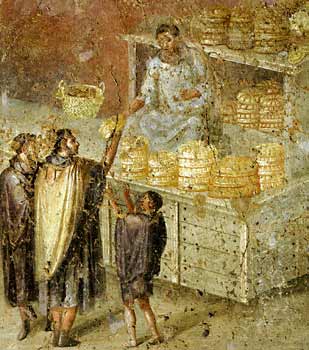
add photo of painting bread selling
Text:
photo - Ancient bakery and flour mill of the year A.D. 79. Four grain grinders to the right. The method of operating these mills is shown in the sketch of the slaves operating a hand-mill. These mills were larger and were driven by donkeys attached to beams stuck in the square holes. The bake house is to the left, with running water to the right of the entrance to the oven. The oven itself was constructed ingeniously with a view of saving fuel and greatest efficiency.
House of the Baker, Pompeii
This wall-painting depicts the sale of bread - loaves of bread are
stacked on the shop counter, and the vendor can be seen handing
them to customers.
It is thought that the inhabitants of Pompeii bought their daily bread
from bakeries rather than baked it themselves at home, since ovens
rarely are found in the houses of the town. The number of bakeries
that have so far been excavated (33) tends to support this belief.
Bakeries are identified by the presence of stone mills to grind grain,
and large wood-burning ovens for baking.
Bread may have been bought directly from the bakery, but it is likely
that it was also sold from temporary stalls set up at different parts
of the town. Two graffiti discovered on the precinct wall of the
Temple of Apollo are an indication of this. They read Verecunnus
libarius hic and Pudens libarius, which can be roughly translated
as 'Verecunnus and Pudens sell sacrificial bread here'.
Pompeii - Bakeries
Pompeii had 31 bakeries. Grain was brought to the bakery for refining using mills made out of volcanic rock. Grain was fed into the top and then ground using mules to rotate the grinder. Bread was baked in the ovens alongside the mills. These were heated by burning vine faggots. Loaves were then transported to separate shops and stalls.The cultivation and use of barley (hordeum) by the Romans was learned from the Greeks, and it was preferred ground into a product known as polenta. This was generally used for pulses or coarser less desirable breads. These loaves were commonly referred to as panis plebeius or panis rusticus.
Oats (avena) were generally considered a weed even though they had been cultivated for many thousands of years. Although favored by the Celts, oats were commonly grown as a fodder crop for livestock, especially in the British Isles by the time of Roman occupation.
Early on in the evolution of bread making, milled wheat was often sieved and re-milled several times to create a fine white flour know as siligo. This siligo flour was generally preferred for bread and it was thought to be the finest most expensive flour available.
Grain milling became simplified in Rome in about 500 BC with the introduction of a rotary quern in which a circular stone wheel turns against a fixed stone wheel (this was the basis of milling up until the nineteenth century). The top stone was turned by animals or domestic slaves, later by waterwheels. This process enabled the Romans to mill four or five grades of flour, reserving the finest and whitest for the wealthy. Coarse wholemeal, which also contained other grains such as millet, was favoured by wrestlers and gladiators to build up their strength, so the Romans were aware of the nutritive value of wholemeal flour but chose to use refined white flour.
In the days of the early Republic (according to Patrick Fass in Around the Roman Table: Food and Feasting in Ancient Rome), bread was rather bland and nondescript. Cato refers to this particular baked good as panis strepticius, or kneaded bread. This was a quick bread which was rolled into wafer-thin sheets then baked quickly, probably on hot stone or against the wall of the oven.
From his writings, the following recipe is derived. These hard baked loaves, prepared under a dome-shaped cover known as a testa, soon became the primary staple of the Roman’s diet. This common staple changed what Plautus of Sarsina referred to as a nation of ‘porridge eaters’ into a nation dependant on bread as a mainstay.
Kneaded bread is made as follows: the flour is placed in a baking trough, and some water is poured over it. Knead. When the dough has been kneaded, roll it out and bake it under a cover. (Cato, R. R. LXXIV)
- translation from Patrick Fass, Around the Roman Table: Food and Feasting in Ancient Rome, p.189
Yeast, as a leavener for bread, made its way into Rome at the height of the Republic during the outbreak of the third Macedonian War (171-168. BCE.). Many of the more conservative citizens resisted the temptation to indulge in the light or raised loaves, thinking them unhealthy.
Early Egyptian sun bread was made from a thick batter which was left in the sun to dry and leaven before it was baked. Bread was a staple in ancient Egypt too: the daily average wage was three loaves of bread and two jugs of beer. Leaving dough for several days to sour became a common method of leavening bread. The science behind yeast, which transforms sugars and uses bread gluten to make holes and to make it softer wasn't fully understood until thousands of years later. Nevertheless, its ability to make bread rise was probably known. A more reliable method, common in both Babylonian and Roman times, was to soak bran in sweet wine for several days to make a leaven.
Pliny describes six different ways to make and maintain yeast cultures (for the full text, see Pliny on Bread):
I: “Millet kneaded with wine must*. It should keep for a year”.
II: ”Wheat bran soaked for three days in the must of white wine*, then kneaded into rolls, soaked in water, heated and kneaded again with flour.” (This sort of yeast was thought to make high quality bread but did not keep well. It was made in autumn when fresh wine must was plentiful.)
III: “Dough balls of barley and water baked brown in the ashes then kept until they fermented. They were dissolved in water
before use.”IV: “Barley bread required a yeast culture made from chickpea, flour, or from vetch.”
V: “The commonest yeast was a sourdough variety prepared by boiling unsalted flour with water to a porridge consistency and leaving it to ferment. This was used as yeast.”
VI: “Another common form of leavening was to simply keep part of the previous day’s dough and mix with fresh ingredients.” (Pliny, N.H. XVIII-xxvi.)xiv
*Wine must is the product from the second stage of wine making where the majority of the raw pulp has been filtered off. It contains sediment, active yeast for fermentation, and grape juice.
- translation from Patrick Fass, Around the Roman Table: Food and Feasting in Ancient Rome, p.189
It was not long before bread production was begun on a large and public scale. The introduction of a yeast product into Roman culture is in almost direct correlation to the formation of bread baking as a specialty profession. In the year 168 B.C.E., the Roman citizens legislated and formed the first baker’s guild. It was known as the Collegium Pistorum.xv The word pistorum translates into the phrase, to grind, which is associated with the grinding of grains into flour. The bakers not only cooked but also milled grains professionally as well. The guild was of so high repute in the affairs of the state that one of its representatives had a seat in the Senate, and soon after the formation of the Pistorum, the government took control of the guild and bread became a regulated public commodity.
As was the case with many other cultures, Roman bread was made with all types of cereals. Sometimes loaves were made from ground pulses like chickpeas and other less common grains such as rice. Many times, bread dough was mixed with oils or fat from bacon to improve flavor. Other common flavor enhancers included grape and other fruit juices, wine, eggs, milk, and dried fruits or honey. Spices such as cumin, pepper, sesame, and poppy seed were often added. In fact, the Romans favored a type of bread known in the first century as Alexandrian bread. Apicius and the other popular scholars tell us very little of this delicacy except that the main spice used in its flavoring was cumin. Apicius recommends its use in several of his recipes, including Sala Cattabia. This is a bread-based salad that was generally served covered with snow so that it would be cold. Considered a rarity, Sala Cattabia was usually served at very special occasions or high-ranking state dinners.
In the days of the late Republic, Romans generally preferred their bread white and one of the tests of the quality of bread was the color. This white bread was usually made with the finest siligo wheat flour and it was quite pricey. As with most purchased goods, the price of flour was regulated by the amount of processing it needed as well as the size of the stones and sieves used to refine it. It was baked into loaves commonly known as panis siligineus. Dioscorides describes this bread as a fine and light with a dry and springy texture. With the growth of the population in Rome and its provinces and the state support of baking as a trade, time and money were both allotted so that the baker could experiment with different ingredients and perfect specialty recipes.
Given the sheer amount of bread baked in Rome and the varying styles brought into Rome through the diverse cultures of the people that made up the Republic and the Empire, it would be virtually impossible for us to list all of the baked goods and types of bread with which the Roman’s were familiar. But from the writings of Apicius, Cato, and Pliny, we can glean enough information to put together a substantial list that gives us some insight into the scope of the Roman’s baking abilities and some of their common recipes through description and ingredients.
Excerpts:
Dieuches (4th century BC Greek physician) states: "Wheaten bread should be prepared from the least glutinous ordinary wheat as possible, and this gently fermented with sweet leaven, such as is made from the very hardest spelt flour. Dough made from spelt is better, provided that it is made from the finest wheat flour and is thoroughly milled and one must have more softness to the dough than is the case with bread baked in a covered earthenware vessel."
Mark Grant. Dieting for an Emperor: A Translation of Books 1 and 4 of Oribasius' Medical Compilations with Introduction and Commentary. (New York: Brill, 1997), p227
Galen (129 – c. 200/c. 216 AD Greek Physicain) also gives some examples of wheaten bread and bran loaves: "white breads want more leaven and require rather to have been kneaded and to be baked not straightaway but after leaving or kneading; for bran-loaves on the other hand a little yeast and gentle kneading and a short space of time suffice."
Mark Grant. Galen of Food and Diet. (London: Routledge, 2000)
Galen also states that some bread had sesame seeds or poppy seeds spread on top of the loaves. Pliny in the first century CE also "noted that wholemeal flour was flavored with coriander and sprinkled with poppy seeds on the top crust of country loaves. The seeds had been mixed with egg to make them stick…. Pliny suggested that celery should be placed under bread."
Joan P. Alcock. Food in Roman Britain. (Charleston: Tempus, 2001), p29
Common Breads of Rome
from Around the Roman Table: Food and Feasting in Ancient Rome by Patrick Faas
Bread was baked in a stone oven (fornax), or in a small bronze oven (clibanus). Flat bread was baked over hot coals, in hot ashes or on a spit (Ath. 113).
Panis mustaceus— Bread commonly baked in a ring with a laurel wreath on top. Cato gives us a list of ingredients: 660g. fat, 330g. fresh cheese, 8.7 liters farina, anis, cumin, and must, which gives the bread its name. (CAT. R.R. CXXI) this bread was commonly eaten at wedding feasts, hence the larger quantities of ingredients.
Pane Cibarium — Bread with bran, from a list outside a restaurant in Pompeii
Panis farreus— Bread made of coarse spelt flour to be broken and shared by a bride and groom on their wedding night.
Panis adipatus— A flat bread resembling pizza that contained a good quantity of bacon and bacon fat.
Panis militaris— Soldier’s bread. It commonly came in two varieties. Both were a type of hard dry biscuit that had to be soaked before eaten. (Pliny. N.H. XVIII-68)
Casternsis: camp bread
Mundus: marching bread
Panis nauticus— Much like soldier’s bread. Known as ship’s biscuits. (Pliny. N.H. XXII- 138)
Panis picentino— Another hard bread that required soaking, generally in milk or mulsum* before eating. Picentino was luxury bread made from alica, which was soaked for nine days and then kneaded with uvae passae suco (the sweet juice of dried grapes or raisin juice). It was shaped into a long roll, placed in a clay pot and baked in the oven until the pot burst. (Pliny. N.H. XVIII-106)
*Mulsum was an aperitif beverage common in Republic and Imperial Rome. It was basically dry wine to which honey was added. It was consumed either during the blending process or thirty-one days later. (Pliny. N.H. XXII-24, 53)
Panis quadratus— Despite its name this bread is not square but circular. It owes its name to the slashes on the top of the loaf that divides it into quarters. (Ath. 114e)
Panis boletus — Bread that has risen in the shape of a mushroom. It was covered with poppy seeds and placed in a glass mold. The poppy seeds ensured that the bread did not stick. It was the color of smoked cheese. (Ath. 113c)
Panis alexandrinus — popular bread that is frequently mentioned in recipes and texts. We do not know the exact ingredients or recipe for this bread, other than the fact that it contained Egyptian cumin and was imported from Alexandria, hence the name.
Panis cappadocianus— A ‘Turkish’ style bread that was produced by making very wet dough out of flour and milk. To it was added large quantities of salt. It was baked in a very hot oven for a short period of time and had a soft crust. (Ath. 113b)
Panis secundarius— A common type of white bread. During the days of the Republic, eating white bread was considered very much a luxury and a costly venture. By the time the Empire was in its heyday, white bread was considered a commonality and thus known as a second choice or secundus. With the Emperor Augustus, came the popularity of brown bread or less refined products, thus reintroducing recipes that had long been forgotten; heavier breads were back in vogue once again. (Suet. Aug. 76)
Orindes—Bread made from rice flour (Ath. 110c)
Cybus—Cube shaped bread with anis, fresh sheep’s cheese and olive oil.(Ath. 114a)
Mazas—Barley biscuits (Ath. 114e)
Cribana- Bread made with curd cheese. Shaped to resemble a woman’s breast. (Ath. 114f)
While the government of ancient Rome controlled the import and export of wheat and the common trade of baking, it is noted from the list above that the baker still controlled the artistic avenue in which the recipes were developed. From the evolution of Cato’s unleavened loaves to untold varieties of the artisan bakers of Rome and her provinces, the freemen of the Republic and the Empire enjoyed a multitude of fresh baked goods and unlimited flavors. It is the whole of these products, and the conglomeration of so many different cultures that helped entitle Rome as the ’melting pot’ and urban center of the ancient world.
Barley and bread wheat (Triticum Aestivum) were the two most frequently used grains in Greek and Roman cooking with barley yielding almost 9 times more supply than wheat itself making wheat somewhat of a luxury grain. While the Roman province of Egypt was the prime supplier of wheat to the Empire for many years, wheat was also being shipped in to Rome and its surrounding settlements from Pontus and Sicily.
Professional bakers in Rome, and in Pompeii, did not exist until the 2nd century BC and it is suggested that this advancement in specialized crafts has everything to do with the appropriation of Macedonia for the Republic by Aemilius Paulus. It is also suggested that Pliny the Elder’s reference to Greek knowledge of leaven indicates that yeast likely became a component of Roman bread-making during this time as Greek bakers were employed in Roman settings: “The Greeks have established a rule that for a modius of meal eight ounces of leaven is enough.” (Pliny the Elder, Historia Naturalis – Book XVIII-26(11)). This also suggests that the advent of leavened bread-making by the Romans in the 2nd century, despite the feelings of disgust or impurity that ‘putrefied and rotten dough’ invoked in many, brought bread to a whole new level of social and dietary significance.
At this critical point in Roman history, bread was the backbone of the Roman daily diet. Commercial bread-baking began to emerge and the role of baking meager flat-breads on the home hearth moved from the hands of women in the household into the hands of the men who ran commercial bakeries. These commercial bread bakers (pistores) were powerful men in Roman society; and the bakeries themselves are incredibly telling and sensory environments. Bread required massive quantities of wheat, fire-wood, and slave and animal labour to produce a daily supply to feed approximately 12,000 people. Donkeys walked in circles tirelessly, for hours on end, rotating the industrial sized quern-stones (grain-mills) that ground the wheat; slaves did the same if animal labour was not possible. A kneading apparatus was also employed that featured rotated wooden bars that paddled dough just like our modern Kitchen-Aid mixers do only with human or animal strength to power it. The ovens were fired from dusk until dawn and enough grain had to be imported from within the region or from provincially confiscated territories to supply the Roman people with their daily bread. Bread was prepared daily, in high volume, sometimes in the home but mostly in commercial bakeries run by a Corpus Pistorum (or Collegium Pistorum): a veritable trade-union of powerful bakers who were likely looked upon as a Roman version of the ‘Hoffa teamsters’ of the day. The men who controlled the bread and the commercial ovens often ran for office or influenced civic elections themselves. A common saying of the day was to say that a baker ‘gave good bread’, ‘bonum panem fert’, which meant that he could be a trusted community member or a potential civic official.
