Cappadocian Bread (Hapalos Artos)
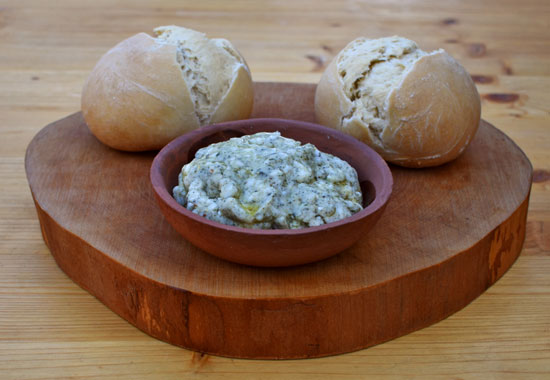
Hapalos Artos bread with Moretum
Some people call this bread hapalos artos, which means
soft bread, from a fragment by Chrysippus of Tyana, a famous ancient baker whose work is lost.
Athenaeus’ “Cappadocian” Bread From Deipnosophistae Book III circa 300 CE
At the end of this recital93 one of the learned men present, Arrian by name, spoke up: "all this 'breadstuff,' comrades, is getting stale. For we have no interest either in barley (since the town is full of wheat bread), or in the list of these kinds of bread. For I have come across another treatise, beside those cited, by Chrysippus of Tyana, entitled Bread-making, and have made the acquaintance of all the terms here mentioned by many of our friends, and so I shall proceed to say something on my own account about bread. The bread called artopticeus94 differs from that baked in ovens and furnaces. If now, you make it with hard yeast, it will be white and good to eat dry; but if with dissolved yeast, it will be light but not so white. Bread baked in the oven and furnace requires a softer yeast. The Greeks have a bread called 'soft,' which is made with a little milk and oil and sufficient salt;95 the dough must be quite soft. This bread is called Cappadocian, since it is chiefly in Cappadocia that 'soft' bread is made. Such bread is called lachma by the Syrians and is found to be very serviceable in Syria, because it may be eaten when very warm and is . . . resembling a flower. (The dots cover a problem with the text.)
93 By Pontianus.
94 Pliny XVIII.105.
95 For leaven; cf. American "salt-rising bread."
96 See critical note. Thayer's Note: the critical note to the Greek (διὰ τὸ θερμότατος τρώγεσθαι καί ἐστιν . . . ἄνθει παραπλήσιος) reads: Much has been lost, including the name of some flower.
Hapalos Artos (Syrian Lachma Bread)
from https://historicalitaliancooking.home.blog/
For this bread, we chose the hapalos artos, which means soft bread, from a fragment by Chrysippus of Tyana, a famous ancient baker whose work is lost.
Original text
παρὰ δὲ τοῖς Ἕλλησι καλεῖταί τις ἄρτος ἁπαλὸς ἀρτυόμενος γάλακτι ὀλίγῳ καὶ ἐλαίῳ καὶ ἁλσὶν ἀρκετοῖς. δεῖ δὲ τὴν ματερίαν ἀνειμένην ποιεῖν. οὗτος δὲ ὁ ἄρτος λέγεται Καππαδόκιος, ἐπειδὴ ἐν Καππαδοκίᾳ κατὰ τὸ πλεῖστον ἁπαλὸς ἄρτος γίνεται, τὸν δὲ τοιοῦτον ἄρτον οἱ Σύροι λαχμὰν προσαγορεύουσι, καί ἐστιν οὗτος ἐν Συρίᾳ χρηστότατος γινόμενος διὰ τὸ θερμότατος τρώγεσθαι.Translation
Among the Greeks, there is a bread called hapalos artos, made with a bit of milk and a sufficient quantity of oil and salt. The dough must be made soft. This kind of bread is called Cappadocian, since in Cappadocia it is prepared in huge quantities. The same bread is called by Syrians lachma and it is the best kind of bread in Syria, since it is eaten hot.Note: This translation differs from that above?
For the bread, we used a dry yeast called musteus and described by Pliny and Palladius. We showed the method in the past preparing a poppy-seed bread from the Naturalis Historia. As described in the same passage of the Deipnosophists, however, Greeks (as well as Romans) had at disposal both dry and fresh yeast. To prepare ancient Roman sourdough, as Pliny describes thoroughly, check on the recipe for artolaganon.
300 gr white wheat flour
1 musteus or one tablespoon of sourdough (see recipe for poppy-seed bread)
100 ml milk
30 ml olive oil
salt
Knead the flour with the milk and oil, adding two pinches of salt and breaking the musteus. Add the quantity of water necessary to obtain a quite soft consistency. Let the dough rest overnight. The following day, shape three bread rolls and bake them in the oven for about 40 minutes. Serve them still hot.
