Delian Sweets
See Apicius on Dulcia Domestica (homemade sweets)
Delian refers to Delos, a small (350.64 ha), rocky island in the centre of the Aegean Sea, which was considered “the most sacred of all islands” (Callimachus, 3rd century BC) in ancient Greek culture. According to the legend, it was there that Apollo-Sun, god of daylight, and his twin sister Artemis-Moon, goddess of night light, were born. According to Greek mythology, Apollo was born on this tiny island in the Cyclades archipelago. Apollo's sanctuary attracted pilgrims from all over Greece and Delos was a prosperous trading port. The island was first settled in the third millennium BC.
Delian sweets were first written about by historian Athenaeus, who mentions them in a description of the people of Delos. Later historian Apicius wrote down a similar recipe.
'On Hecate's Island,' says Semus in Deliad II, 'the Delians sacrifice what they call basyniai to Iris, goddess of the dawn. It is wheat dough, boiled, with honey and the so-called kokkora (which are a dried fig and three walnuts).' – Athenaeus 645.
Original text from Apicius
Aliter dulcia: accipies similam, coques in aqua calida, ita ut durissimam pultem facias, deinde in patellam expandis. Cum refrixerit, concidis quasi ad dulcia et frigis in oleo optimo. Levas, perfundis mel, piper aspergis et inferes. Melius feceris, si lac pro aqua miseris.
Translation
Other sweets: take durum wheat flour, cook it in hot water until you obtain a very hard puls, then spread it on a plate. When it is cooled down, cut it as to make sweets and fry in excellent oil. Remove them from the pan, pour over honey, dust with pepper, and serve. It will be better if you use milk instead of water.
Delian Sweets
from The Classical Cookbook by Andrew Dalby and Sally Grainger, 1996
Reference: Athenaeus 645b, Apicius 7, II, 6
Another sweet: Take durum wheat flour and cook it in hot water so that it forms a very hard paste, then spread it on a plate. When cold cut it up in lozenges, and fry in best oil. Lift out, pour honey over, sprinkle with pepper and serve.
To be served with dried figs and walnuts on the side, as the Delians seemed to have them accompanying the sweets as separate offerings to Iris, goddess of Dawn.
See Sally Granger’s revised recipe below.
3/4 cup water
1/2 cup plain all-purpose flour
Olive oil for deep-frying
2 tablespoons (60 g) honey
Poppy seeds or freshly ground black pepper
Bring the water to a boil and add the sifted flour. Beat vigorously as if you were making choux paste. Cook out for a few minutes and turn out onto a large plate, or a marble slab if you have one. Allow to cool completely. Heat the olive oil in a deep-fryer. Cut the paste into cubes: it will be firm but still a little sticky. Test the oil for temperature with a little of the mixture: if it rises and colors, the oil is ready.
Drop the cubes into the oil two or three at a time. Cook for three to four minutes until golden-brown and lift out on to the kitchen paper. While they are still warm, dribble warmed honey over the fritters and sprinkle them with either poppy seeds or freshly ground pepper.
Makes about fifteen.
Deep-fried honey fritters, Apicius 7.11.6
from Cooking Apicius:
Roman Recipes for Today by
Sally Grainger, 2006
These are quite delicious but it took a little adaptation to make the recipe work. In Apicius we are told to make a thick porridge with water or milk and flour, then allow it to go cold, cut it into sweets and deep-fry them in oil with honey and pepper. Couldn’t be simpler, but a thick porridge of flour and milk clumps into a thick glue and doesn’t set sufficiently well to be cut cleanly.
The recipe is in fact reminiscent of choux pastry without the egg. With this in mind, I considered adding a little oil to the milk to correspond to the margarine or butter used for choux pastry. This allows the flour and milk to form a roux rather than a glue! The thick porridge now sets into a firm paste that can be cut into cubes. The resulting crisp texture is quite amazing and it holds its crispness even as the fritters cool in the honey.
400 ml goats’ or sheep’s milk
2 tbsp olive oil
100 g plain white flour
100 g wholemeal flour (sieved to remove the largest flakes)
250 ml olive oil for frying
100 g runny honey
generous freshly ground black pepper
Put the milk and oil in a pan to heat. Sieve the two flours together and add all together to the milk and begin to beat briskly until it forms a mass. Beat continuously and cook out for a few minutes. Turn out onto a plate, spread it out into a disc and allow to cool completely. Cut into approximately 2 cm squares. Put the frying oil in a small pan and heat gently. Put one square fritter into the oil and when it takes on colour, the oil is ready. Keep the flame or temperature medium to low at all times. Put in a few fritters at a time, depending on the size of the pan. When they have acquired the right colour – golden brown – release them from the bottom of the pan (they will stick) and allow a minute or two for them to cook further before taking them out with a slotted spoon. Drain on kitchen paper and then put in a serving bowl. Pour honey on them while they are still hot and stir them into the honey so they are well covered. Season with black pepper and serve immediately.
Ancient Roman Sweet Fritters – Dulcia Domestica
from https://historicalitaliancooking.home.blog/
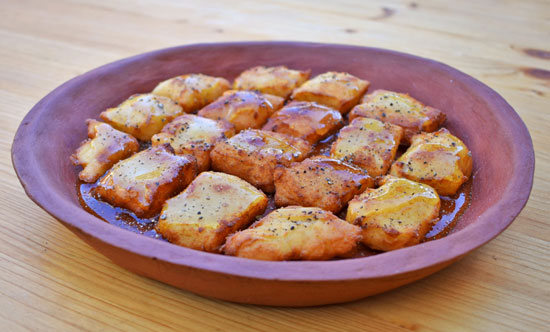
The sweet we are preparing today is part of the chapter of De Re Coquinaria dedicated to the dulcia domestica, which means homemade sweets, probably to distinguish them from others made, instead, by specialized bakers. The dulcia domestica are, indeed, very easy and quick to make, differently from others more complex that we know thanks to Cato’s De Agri Cultura, such as placenta. We prepared some recipes for dulcia domestica in the past, for example stuffed dates and ova spongia, a very simple omelette.
This sweet is based on a puls prepared with durum wheat flour and milk (or water, as the recipe specifies, but the author recommends milk), then fried and covered with honey and pepper, a very common ingredient in the ancient Greek and Roman desserts. We met the word puls in the past, preparing the puls Punica and granea triticea from Cato’s recipes and, more recently, an ancient German meal. Actually, the one we are making today is more similar to a polenta than a puls, since puls is usually made with overcooked cereals, then pounded to make a thick cream. The author specifies that we have to make a durissima puls with the flour and milk, which means a very hard puls. Despite its simplicity, this recipe is incredibly good, but the secret is the choice of the ingredients: excellent honey and pepper. We used black pepper, the most common in ancient Rome, but if you prefer a note more intensely aromatic, you can try to add long pepper.
Original text
Aliter dulcia: accipies similam, coques in aqua calida, ita ut durissimam pultem facias, deinde in patellam expandis. Cum refrixerit, concidis quasi ad dulcia et frigis in oleo optimo. Levas, perfundis mel, piper aspergis et inferes. Melius feceris, si lac pro aqua miseris.
Translation
Other sweets: take durum wheat flour, cook it in hot water until you obtain a very hard puls, then spread it on a plate. When it is cooled down, cut it as to make sweets and fry in excellent oil. Remove them from the pan, pour over honey, dust with pepper, and serve. It will be better if you use milk instead of water.
150 gr durum wheat flour
1 liter milk
olive oil
honey
pepper
Mix the flour and milk, cooking at low heat for about 15 minutes. If it hardens too much, add a bit of milk, but the final outcome must be very hard.
Let the puls cool, then spread it on a plate and cut it into small squares. Warm the oil and fry the sweets for about 5 minutes.
Grind the black pepper in the mortar. Plate the sweets dusting with pepper and pouring over honey.
