Recipe for Placenta: from Marcus Cato on Agriculture
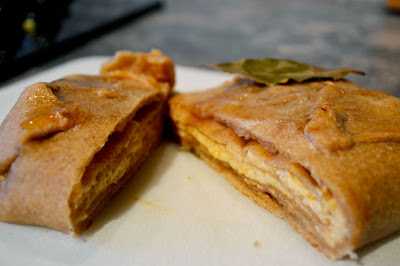
Placenta
Pronounced Pla-kenta, its closest modern relative is the Romanian Plăcintă, which is a 'dessert' made from layered cheese, honey, and pastry. The word plăcintă comes from Latin placenta which means cake. As shown by the etymology of the word, the plăcintă has a Roman origin, and dates from when Romania was a part of the Roman Empire.
Latin text:
'Placentum sic facito. Farinae siligineae L. II, unde solum facias, in tracta farinae L. IIII et alicae primae L. II. Alicam in aquam infundito. Ubi bene mollis erit, in mortarium purum indito siccatoque bene. Deinde manibus depsito. Ubi bene subactum erit, farinae L. IIII paulatim addito. It utrumque tracta facito. In qualo, ubi arescant, conponito. Ubi arebunt, conponito pariter. Cum facies singula tracta, ubi depsueris, panno oleo uncto tangito et circum tergeto unguitoque. Ubi tracta erunt, focum, ubi cocas, calfacito bene et testum. Postea farinae L. II conspargito condepsitoque. Inde facito solum tenue. Casei ovilli P. XIIII ne acidum et bene recens in aquam indito. Ibi macerato, aquam ter mutato. Inde eximito siccatoque bene paulatim manibus, siccum bene in mortarium inponito. Ubi omne caseum bene siccaveris, in mortarium purum manibus condepsito conminuitoque quam maxime. Deinde cribrum farinarium purum sumito caseumque per cribrum facito transeat in mortarium. Postea indito mellis boni P. IIII S. Id una bene conmisceto cum caseo. Postea in tabula pura, quae pateat P. I, ibi balteum ponito, folia laurea uncta supponito, placentam fingito. Tracta singula in totum solum primum ponito, deinde de mortario tract linito, tracta addito singulatim, item linito usque adeo, donec omne caseum cum melle abusus eris. In summum tracta singula indito, postea solum contrahito ornatoque focum deverrito temperatoque, tunc placentam inponito, testo caldo operito, pruna insuper et circum operito. Videto ut bene et otiose percoquas. Aperito, dum inspicias, bis aut ter. Ubi cocta erit, eximito et melle unguito. Haec erit placenta semodialis.'
76 Recipe for placenta: (see note 73)
Materials, 2 pounds of wheat flour for the crust, 4 pounds of flour and 2 pounds of prime groats [alicae primae] for the tracta. (see note 74) Soak the groats in water, and when it becomes quite soft pour into a clean bowl, drain well, and knead with the hand; when it is thoroughly kneaded, work in the 4 pounds of flour gradually.
From this dough make the tracta, and spread them out in a basket where they can dry; and when they are dry arrange them evenly. Treat each tractum as follows: After kneading, brush them with an oiled cloth, wipe them all over and coat with oil. When the tracta are moulded, heat thoroughly the hearth where you are to bake, and the crock.
Then moisten the 2 pounds of flour, knead, and make of it a thin lower crust. Soak 14 pounds of sheep's cheese (sweet and quite fresh) in water and macerate, changing the water three times. Take out a small quantity at a time, squeeze out the water thoroughly with the hands, and when it is quite dry place it in a bowl. When you have dried out the cheese completely, knead it in a clean bowl by hand, and make it as smooth as possible. Then take a clean flour sifter and force the cheese through it into the bowl. Add 4 1/2 pounds of fine honey, and mix it thoroughly with the cheese.
Spread the crust (see note 75) on a clean board, one foot wide, on oiled bay leaves, and form the placenta as follows: Place a first layer of separate tracta over the whole crust, (see note 75) cover it with the mixture from the bowl, add the tracta one by one, covering each layer until you have used up all the cheese and honey. On the top place single tracta, and then fold over the crust (see note 75) and prepare the hearth . . . then place the placenta, cover with a hot crock, and heap coals on top and around. See that it bakes thoroughly and slowly, uncovering two or three times to examine it. When it is done, remove and spread with honey. This will make a half-modius cake.
Notes:
73 The libum and the placenta, especially, are important, as these cakes are employed in religious services. Horace, Epistles, I, 10, 10‑11, compares himself to the runaway slave of the priest, who refuses liba, as he needs plain bread, which is better than mellitis placentis. Varro, I.2.28, is amused at the idea of treating such subjects in a work on agriculture. It should, of course, be remembered that honey took the place of our sugar. But even so, these recipes cannot be considered alluring.
74 Seemingly bits of pastry.
75 The word solum seems to be used of the bottom crust, (p85) while the balteus (belt) is used of the crust folded over; but the directions are vague.
Also see Tracta (dried pastry), Recipe from Sally Granger, Cooking Apicius.
Eat Like A Roman, Part 4: Baking Placenta
from Robert Sietsema, http://www.gourmet.com/food/2008/10/eat-like-a-roman-pastry
No, dear readers, the subject for this edition of Eat Like a Roman is the ancient pie-like pastry called placenta. (The culinary definition of this term preceded and inspired the meaning with which we commonly associate it.) A somewhat amorphous oblong shape, the placenta sports an outer layer of wheat-flour pastry and its interior is constructed of tracta, pastry layers that resemble Moroccan warka, a paper-thin dough that is twice as thick as Greek phyllo. Strips of tracta separate a simple filling of smooth, fresh ricotta cheese mixed with flavorful honey into horizontal layers. Fresh bay leaves are placed between the bottom layer of filling and the crust, increasing the sweetness and fragrance of the pie.
While most of our Roman recipes come to us from Apicius, who wrote a comprehensive cookbook around 400 A.D., the go-to guy for ancient bread and pastry recipes—indeed, anything made with grain—is Cato. Known popularly as Cato the Elder, Marcus Porcius Cato penned a farming manual called De Agri Cultura in 160 B.C., and it is from that source that our recipe derives. His recipe would have fed a big gang of farmworkers, calling for six pounds of flour, two pounds of faro (not the grain we now call farro, but a Roman grain now commonly known as spelt), fourteen pounds of fresh sheep’s cheese, and four and a half pounds of “good honey.” (Is there any other kind?)
There is reason to believe that placentas were sometimes intended as sacrifices to the god Jupiter, though the pastry may have been eaten after its religious function was fulfilled. The importance of placenta is also suggested by the fact that Cato gives variations of the recipe: scriblitam is the same pie minus the honey; in erneum, the dough and cheese are mixed together, put into a mold, and then steamed like a giant dumpling.
Some say Roman placenta is the forerunner of modern lasagna, which it resembles structurally. It’s also similar to many modern baklava-like Mediterranean pastries. But as a couple of friends and I cut up the still-warm placenta and began to eat it, we realized it tasted a lot more like modern Italian cheesecake—slightly sweet, with a crunchy crust. And treating it like a good cheesecake, we eagerly ate leftovers for breakfast the next day.
I’ve adapted Cato’s recipe for placenta, using cow’s milk ricotta instead of sheep’s milk, and making a pie that serves only eight people, but I imagine it’s still as delicious as his.
Serves 8
Roman Placenta
Serves 8
For encompassing pastry:
1 cup all-purpose flour, plus more for rolling
Olive oil, for brushing
For tracta:
1/2 cup all-purpose flour, plus more for rolling
1/2 cup spelt flour
Olive oil, for brushing
For filling:
1 pound fresh ricotta
1/2 cup honey
6 fresh or dried bay leaves, plus 1 for garnish
Preheat oven to 250ºF.
Make the encompassing dough: Place flour in a mixing bowl. Dribble in water (about 1/2 cup), mixing as you go, until a stiff ball of dough is formed. Knead dough for two minutes, then shape into a ball. On a flat surface, roll the ball into a thin circle, approximately 13 inches in diameter, dusting with flour as necessary to keep the dough from sticking. Brush both sides with oil, and set aside.
Make the tracta: Combine the wheat and spelt flours in a mixing bowl, and repeat the process above, rolling the dough into a rectangle. Brush both sides with oil, and cut into three pieces. Set aside.
Make the filling: Put the ricotta in a bowl. Pour in the honey. (Strong-tasting honey like buckwheat or chestnut will make a more perfumey placenta.) Whisk the ricotta mixture until smooth and fluffy.
Assemble the placenta: Place the encompassing pastry on a baking sheet. Evenly space the bay leaves over the center of the circle, so when the sides are folded up the leaves will be on the bottom. Spoon 1/4 of the filling evenly over the bay leaves. Put one of the tracta on top, and then cover it with another 1/4 of the filling. Continue layering until the last 1/4 of the filling is on top. Fold the encompassing pastry over so that it completely covers the top. The pastry should overlap. Bake for two hours, or until the placenta is light brown. Garnish with the remaining bay leaf, and cut into squares. Serve warm.
Placenta
from Tasting History with Max Miller video on youtube
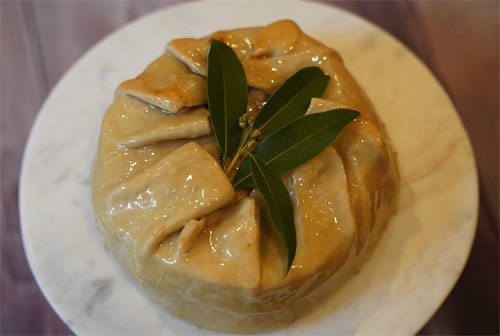
To Make the Tracta:
2/3 cup groats (spelt or emmer) [Cato names alicia here]
2 cups wheat flour
3/4 cup water
1 Tbsp. olive oil
Crust:
1 cup flour
1/4 cup water
Cheese Filling:
1 3/4 pound sheep cheese (should be crumbly)
3/4 cup honey
Plus bay leaves
To make the tracta, grind the groats in a mortar and pestle. Leave them somewhat coarse. Add the water and let them soak for about a day. Should be nice and soft.
Incorporate them with the flour. Add water if necessary, but you want the dough to be fairly dry. Knead for about 10 minutes until it is nice and smooth. Divide into 4 - 6 pieces and roll into discs. They should be fairly thin, like a flour tortilla. They should be as big as the cake will be. You will be layering them with the cheese mixture. Then lay them out to dry, but not as dry as hardtack.
For the crust, mix the flour and the water until it forms a dough. You may not need to use all the water. Add just enough for the dough to come together. Then roll it out to be a wide disc about twice as big as you want your cake to be. Make it as big as you can because you are going to be wrapping the cake with it.
To make the filling, wash the cheese if it is very salty. Washing will also make the cheese soft, which you want. Drain the cheese as much as possible, then mash it until nice and smooth. Mix in the honey until well incorporated.
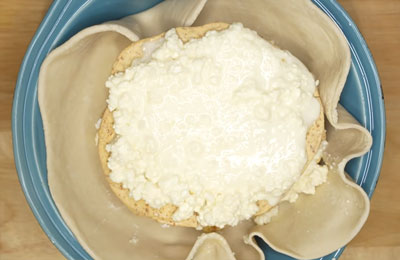
Assemble the placenta.
Line your dish with oil and bay leaves. This should help flavor the cake as well as keep the cake from sticking. Set your crust in over the leaves. Brush one of the tracta with the oil and set it in the middle of the dish. Spread some of the cheese and honey mixture on top. Cover that with another oiled tracta and repeat until you have used up all of the filling, finishing with an oiled tracta.
Then fold over the crust to enclose the cake as much as you can. Then cover the dish and set it in the oven, set at 300 degrees F, for about 70 minutes. Take off the top and bake it for another 10 minutes to darken it a bit. The original recipes calls for putting coals on top which also would brown it on the top.
Take it out of the oven and slather it with honey, and it is ready to eat.
