Laganon (Fried Flatbread)U
from https://historicalitaliancooking.home.blog/
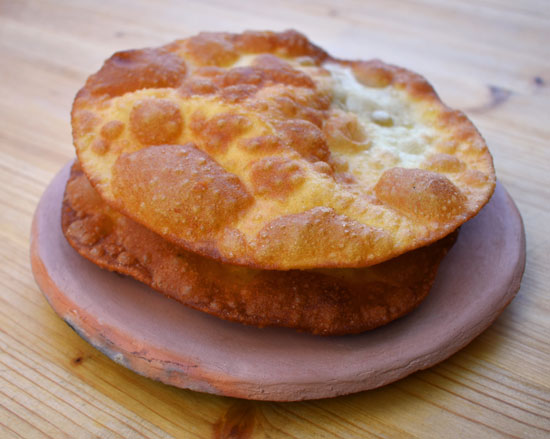
Fried Flatbread
Laganum appears to be the ancient precursor of pasta, and sometimes used in a similar manner as lasagna. However, the descriptions all confirm that it is a light thin fried dough product, similar to our modern crispbreads. Horace tells us that he ate leeks and chickpeas with laganum. This indicates that they were used as a scoop for these types of foods, as the Romans do not seem to have had many cutleries beyond spoons and knives.
In Hesychius’ book, we find a complete description of the laganon, a fried flatbread mentioned also by Athenaeus. It is interesting that the author writes that the laganon is a kind of cake similar to kapyria, according to Athenaeus a word equivalent to Roman tracta.
"Twist bread is prepared with the admixture of a little milk; there is added also a little pepper and oil or lard. But in making the so‑called artolaganon ('wheat-wafer'),97 a little wine, pepper, and milk are introduced, along with a small quantity of oil or lard. Similarly into kapyria, called by the Romans tracta, are put mixtures as into the wheat-wafer."
(Athenaeus)from Lexicon by Hesychius, a 5th-century Greek grammarian
Eidos plakountariou, hos kapyrode, apò semidaleos en elaiph teganizomenon.Translation
It is a kind of cake, as kapyria, made with durum wheat flour, fried in oil.
Laganon (Fried Flatbread)
300 gr durum wheat flour (for 10 lagana)
salt
warm water
Knead the flour with a pinch of sea salt and warm water until the dough reaches a smooth consistency, then divide it into ten pieces.
Roll thin, circular sheets of dough.
Warm a couple of fingers of olive oil in a pan (in the video there was quite a bit of oil, 1/2 inch or so) and fry a sheet at a time. It will need about 30 seconds for one side and 20 seconds for the other side.
