Columella’s Fresh Cheese and Herb Moretum
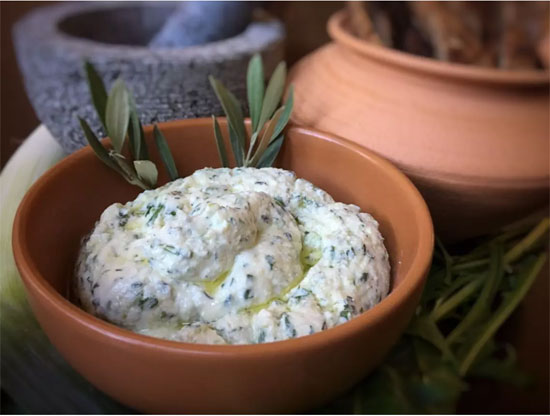
So, what is Moretum? The word ‘moretum’ roughly translates to ‘salad’ in latin and the dish is represented in the Roman written record, in the Late Republican and Early Imperial periods, as being a simple, vegetarian meal that is made with a base of cheese, additions of herbs and other greens, and condiments like olive oil or vinegar. Moretum is made using a common kitchen implement found throughout the Classical Mediterranean: a mortarium, or a mortar. The ingredients are added into the mortar, one by one, pulverized and minced together with a pestle, and formed into a spread or a dip which can then be consumed with bread.
Instructions how to prepare five different varieties of moretum are provided in the treatise on agriculture De re rustica libri duodecim, which was written by Columella in the Early Imperial Period (1st half of 1st cent. A.D.) and is thus roughly contemporary with the Virgil’s Moretum. Also see Virgil's Moretum (herb cheese spread for bread)
Early recipes for salad are rare and in fact this might be considered more of a sauce than (as the anonymous translator has it) salad and more of a seasoning than a single dish. Silphium had already became extinct under the Romans and was replaced then, as it typically is today, with asafeotida.
In his writings, De Re Rustica (60/65 AD), Columella tells us to prepare Moretum like so:
“An easily digested salad”
Moretum Oxyporum (or, How to make up a Salad of easy and quick Digestion; or as others will have it, a Salad or Sauce with a Mixture of Garum and Vinegar.)
[1] Put into a mortar savory, mint, rue, coriander, parsley, the festive leek, or, if you have none, a green onion, the leaves of lettuce and of rocket, green thyme, or cat-mint, as also green pennyroyal, and salted new-cheese; bruise all these equally together, and mix a little peppered vinegar with them: when you have made up all this mixture together, in a small dish, pour oil upon it.
[2] When you have bruised the above greens all together, join with them as many well-cleansed walnuts as you shall think sufficient; and mix a little peppered vinegar thoroughly with them, and pour oil upon them:
[3] bruise sesame, slightly parched, with the greens above also mix a little peppered vinegar with them, upon which pour a little oil.
[4] Cut Gallican cheese, or of any other sort whatsoever, very small, and bruise it, and the kernels of pine-apples [that is, pine-nuts], if you have plenty of them, if not, toasted filberts, after you have taken off their skin, or almonds; and mix them in equal quantities upon the said seasoning herbs; and add a little peppered vinegar to them, and mix them thoroughly; and pour oil upon the whole composition,
[5] If you have none of these green seasoning- or salad-herbs, bruise dry pennyroyal, or thyme, or marjoram, or dry savory, with cheese, all together, and put peppered vinegar and oil to them. Nevertheless, any one of these herbs, when they are dry, if you have not the rest, may also by itself be mixed with cheese.—Take of white pepper, if you have any, if not, of black pepper, three ounces; of parsley seed, two ounces; of laser-root, which the Greeks call Silphium, an ounce and a half; of cheese, two ounces; after you have bruised and sifted them, mix them with honey, and keep them in a new pot: then, when you shall have occasion to use them, dilute what quantity you shall think proper with vinegar, and garum. Take an ounce of lovage, two ounces of raisins [dried in] the Sun, after you have taken out their seeds; three ounces of black or white pepper: these, if you are avoiding greater expenses, you may mix thoroughly with honey, and so keep them. But, if you have a mind to make a more costly and valuable salad, for easy and quick digestion, you shall mix these same things with the composition above-described, and so lay it up for use. But also, if you have no laser, instead of the silphium, you shall put half an ounce of honey to it.
Columella’s Fresh Cheese and Herb Moretum
from https://tavolamediterranea.com/
This post’s moretum recipe comes from our good friend Columella and his aforementioned writings entitled De Re Rustica (On Agriculture) written in circa 60/65 AD. It’s a great place to start on the moretum scale of complexity as this recipe is the most basic version documented. It’s mild, creamy and the herbs give it a fresh, summery flavour.
De Re Rustica, Book XII, LIX: “Quemadmodum Moretum Facias: Addito in mortarium satureiam, mentam, rutam, coriandrum, apium, porrum sectivum aut, si id non erit, viridem cepam, folia lactucae, folia erucae, thymum viride, [vel] nepetam, tum etiam viride puleium et caseum recent<em> et salsum. Ea omnia pariter conterito acetique piperati exiguum permisceto; hanc mixturam cum in catillo composueris, oleum superfundito.”
From this passage we can read the following when translated into English:
“Put into a mortar savory, mint, rue, coriander, parsley, chives or green onion, leaves of lettuce, rocket, thyme and catmint, and fresh (new) cheese and salt. Mix thoroughly and mix in a little pepper. All these measures were ground in a like manner; this mixture is served with a little oil on the top.”
1 lb (450 gr) of fresh ricotta (goat’s or cow’s milk)
½ tsp dried mint (or 10 leaves if fresh)
½ tsp dried coriander (or 10 leaves if fresh)
½ tsp dried savory (or 10 leaves if fresh)
1 tsp dried or a few sprigs of fresh thyme (remove twigs)
A few leaves of edible rue (or a handful of cicoria/dandelion greens)
Handful of fresh parsley
2 chives or green onions
Handful of curly endive leaves/tops
Handful of arugula (rocket)
Fresh cracked pepper
Salt to taste
Olive oil
1. To begin, we want to get all of our ingredients trimmed, washed and ready. If you would like to make your own fresh cheese you can try one of these two recipes: Homemade ricotta using lemon, or Columella’s cheese made using fig rennet. Try this if you can as the consistency of the cheese is drier and denser. You can also buy a tub of ricotta, fresh goat cheese, or feta to use in this recipe although I would use feta as a last resort as Columella specifies fresh (recentem) cheese not aged, salted or brined cheese. If you do not have a mortar and pestle, do not fret. They can be found at every cooking supply shop nowadays and can also be ordered online at Amazon. You can opt to use a mixer to make this recipe but you’ll miss out on all of the fun and the general understanding of the labour and ancient food preparation technology involved in this recipe if you do.
2. I am using a modern household mortar for my recipe as I do not have a larger mortarium bowl. Given that the receptacle of most modern mortars are quite small it’s best to work with the ingredients in batches. Once the mortar is full, dump the pulverized herbs in a bowl on the side and keep going. Start processing all of your herbs and greens by loading the bowl of the mortar to capacity. Press your pestle into the herbs/greens and mince them by moving the pestle in a circular motion around the inner edge of the mortar. You’ll be shocked as to how much you can reduce the greens and herbs in a very short amount of time.
3. Once you’ve reduced all of your herbs and greens, you’ll want to add in the cheese, salt and pepper. You can mix everything together in a large bowl or in the mortar bowl if you are using one with a larger basin. Mix the cheese, salt and pepper in to suit your tastes as I am sure our friend Columella did as well. Free free to use some or all of the cheese called for in this recipe. Texture can be thick or creamy; I prefer mine to be on the thicker side so I can scoop it up with flatbread.
4. Once you’ve achieved the texture that you like, transfer the moretum into a serving bowl and drizzle it with some peppery, fresh olive oil. Note: I piped my moretum into the serving bowl for clean presentation. Serve with fresh-baked Panis Quadratus or Tracta and enjoy!
What stood out for me the most in tasting my first attempt at Columella’s basic Moretum recipe is how fresh and summery the flavours were. This recipe is simple but the flavours are bold and bright. The mint is very pleasant in the mix and the olive oil seems to open everything up a bit more and lend an overall peppery flavour to everything. The best part of the recipe is, however, the cheese; it’s very comforting, pleasing and filling. Coupled with fresh baked bread, it is easy to understand why Moretum was a favoured and regular Roman meal.
