Virgil's Moretum (herb cheese spread for bread)
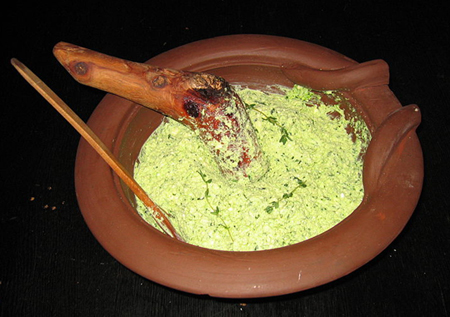
Moretum is a type of cheese, garlic, and herb spread that the Ancient Romans ate with bread. A typical moretum was made of herbs, fresh cheese, salt, oil and some vinegar. Optionally, different kinds of nuts could be added. The contents were crushed together in a mortar, hence the name.
Moretum is mentioned in a wonderful little poem, also called Moretum, by the poet Virgil. The poem tells us about the farmer Symilus and his morning meal. Waking up early he lights his lamp and works his way to his grain stores. He gathers his grain, mills it down into flour, and makes a bread. The farmer notices that he has no meat, and worries that the bread might not be tasty enough on its own, so he sets about making some moretum to go with it.
Symilus gathers four heads of garlic, celery, parsley, rue, and coriander seeds. He grinds the garlic in his mortar and pestle, and adds salt and cheese. He then adds the celery, rue, parsley, and coriander seeds. The smell is so strong that it makes his eyes water! He adds some olive oil, finishes off the mixture, and slaps some on his freshly baked bread.
Also see Columella’s Fresh Cheese & Herb Moretum
Original recipe
from A Taste of Ancient Rome by Ilaria Giacosa, p. 54:
Quattuor alia, apius, ruta, coriandrum, salis micas, caseus.
Modern recipe: Garlic and Herb Cheese Paté
from http://www.godecookery.com/
These ingredients in the original recipe can be translated as:
Four garlic cloves
celery
rue
coriander
salt grains
cheese
Some ingredients require careful handling. Safety Information: Rue (Ruta graveolens) contains a volatile oil and alkaloids, both known to be responsible for this plant having been used to treat indigestion, among other ailments, during our researched time period. However, because of its ability to strongly influence the female menstrual cycle, consumption of Rue by pregnant women or women trying to conceive should be avoided even in the smallest amounts. Consider omitting the Rue altogether.
No instructions are given for what to do with these ingredients, though it is easy to surmise from the name that they were combined in such a way as to make a spoonable sauce. Some debate exists over the exact translation of "quattuor" in that scholars disagree strongly on exactly how much garlic is meant: four cloves or four heads of garlic. We have chosen to accept the four clove translation rather than the four head translation because garlic heads were smaller in during the time period and because four heads of modern garlic would completely overpower the dish so that only the truly intrepid garlic fiend would brave it. Also note, the cook seems free to choose exactly which type of cheese to use and whether or not to use fresh coriander (cilantro) or dried.
Modern Recipe
from http://pass-the-garum.blogspot.com/
1 Clove of Garlic
1/2 of a Celery Stick (with its leaves)
A Small Bunch of Flat-Leaf Parsley
1 tbsp of Coriander Seeds
A Pinch of Salt
Some Cheese (I used Feta as it was easy to work with. With the benefit of hindsight, I would choose a milder cheese)
1 tsp Extra Virgin Olive Oil
A Splash of Vinegar
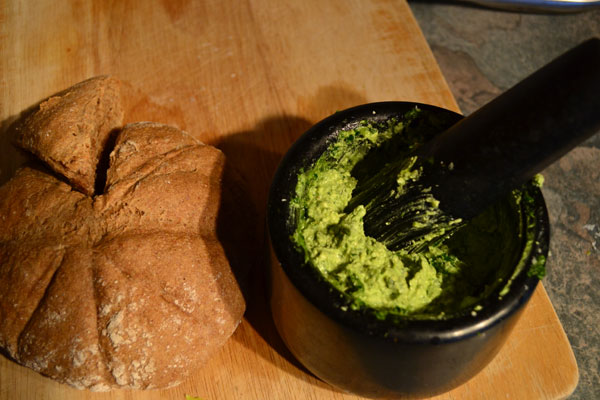
Peel the garlic, add to the mortar, and give it hell.
Add the salt, the cheese, and the celery to the mortar and mash them up too. Really make sure to mix them well with the garlic from earlier.
To this paste, add the coriander seeds, parsley, oil, and vinegar. I find that it is helpful to add the parsley in batches and break it down bit by bit rather than trying to do it all at once and making a mess. Test for flavour - if it is too garlicky, add more parsley.
Break off a lump of bread, spread some of the moretum on, and enjoy!
Results
Moretum was a great accompaniment for my Roman bread - its creaminess complimented the 'rough' texture of the bread, and the strong flavours drew attention away from the overly wheaty taste of the bread. In fact I'd go so far as to say that the wheaty after-taste provided by the bread was the perfect follow-on flavour for this cheese spread. However, even though I used just one garlic clove, this spread was verging on being too strong, something not helped by the saltiness of the feta either. Thankfully, a bit of extra parsley stopped that being so. Despite the inadequacies of this first attempt at moretum, it is a spread which I recommend you try, and one which I am looking forward to making again.
