Savillum
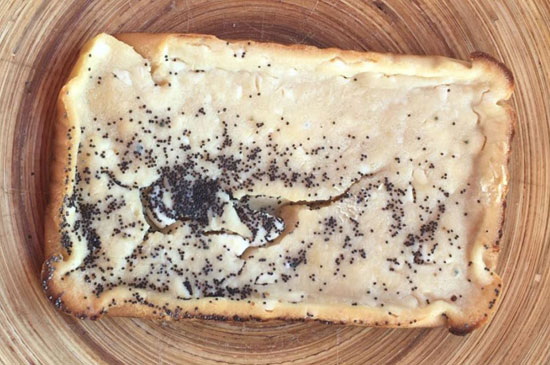
This is one of several Roman dishes that could be called “cheesecake”, although it lacks a crust on the bottom. After baking, the savillum is topped with a spice that was as well-known to the Romans as it is to us: poppy seeds (papaver). Savillum would have been served at the end of a Roman meal, in keeping with the Roman dining customs that we follow to this day: appetizer, main course and dessert, called gustatio (tasting), prima mensa (first plate) and secunda mensa (second plate). Like many Roman desserts, this recipe makes extensive use of honey (mel), the favorite Roman sweetener.
Original text
Savillum hoc modo facito. Farinae selibram, casei P. II S una conmisceto quasi libum, mellis P. * et ovum unum. Catinum fictile oleo unguito. Ubi omnia bene conmiscueris, in catinum indito, catinum testo operito. Videto ut bene percoquas medium, ubi altissimum erit. Ubi coctum erit, catinum eximito, melle unguito, papaver infriato, sub testum subde paulisper, postea eximito. Ita pone cum catillo et lingula.
from Cato, On AgricultureTranslation
Prepare the savillum in this way. Mix half a pound of flour and two and a half pounds of cheese to obtain a consistency similar to libum, then one-fourth pound of honey and one egg. Grease a clay cooking vessel with oil. When you have kneaded well the ingredients, place the cake in the vessel and cover with the testum. Pay attention that it cooks well in the middle, where is it thickest. Once it is cooked, remove the vessel, coat the cake with honey, sprinkling with poppy seeds, and cook it under the testum for short time, then remove from the fire. Serve in its cooking vessel with a spoon.
Another Translation
84. Recipe for the savillum [savillum — some kind of sweet cake (suavis), "a cheese-cake"]: Take 1/2 pound of flour, 2 1/2 pounds of cheese, and mix together as for the libum; add 1/4 pound of honey and 1 egg. Grease an earthenware dish with oil. When you have mixed thoroughly, pour into a dish and cover with a crock. See that you bake the centre thoroughly, for it is deepest there. When it is done, remove the dish, cover with honey, sprinkle with poppy-seed, place back under the crock for a while, then remove from the fire. Serve in the dish, with a spoon.
Savilium Recipe
from https://historicalitaliancooking.home.blog/
For a better outcome, we suggest using fresh cheese. Cato does not specify which kind to choose, but this sweet is meant to be served with the spoon, so a fresh cheese not too salty is a good choice. Ancient Romans prepared cow, goat, and sheep cheese, as described by the agronomists, in particular Columella and Varro.
We suggest paying attention to keep the ratio, in particular between cheese and flour, to obtain a soft cake. We reduced the amount of ingredients.
Cato does not write which kind of flour to use: the term he uses, farina, is generic. Usually, it refers to white wheat flour, the most used by Cato and the other ancient authors. The second most used in the Antiquity, as confirmed also by Pliny and Galen, is barley flour.
White poppy seeds were used to coat the bread and, covered with honey, as sweets, writes Pliny.
100 gr white wheat flour
500 gr fresh cheese
50 gr honey
1 egg
white poppy seeds
Grease the cooking vessel with olive oil. Knead the cheese well with the other ingredients. Shape the savillum in the cooking vessel and cover it with the testum, paying attention that the cheesecake cooks well in the middle, where it is thicker. Cook it for about 20 minutes under the testum or in the oven.
When it is done, coat with honey and sprinkle the cake with white poppy seeds then place the savillum again under the testum and let it cook for a few minutes. Serve in the cooking vessel with a spoon.
Savillum (Cheesecake)
from https://passtheflamingo.com/
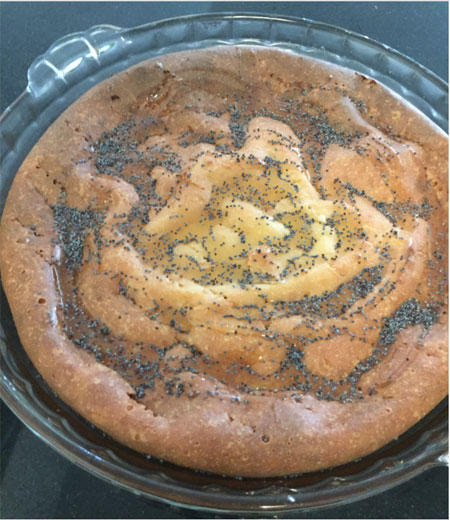
This is Cathy Kaufman’s reconstruction in her book Cooking in Ancient Civilizations (2006).
The savillum will puff up into a golden brown mound as it cooks, which looks pretty cool but is unfortunately ruined by poking holes for extra honey to soak in. It’s mushy, so serve with a spoon, hot or room temperature.
3 1/2 cups ricotta or farmer’s cheese, drained and densely packed
3/8 of a cup honey, plus another 3/4 of a cup
1 1/4 cup flour, whole-wheat (more authentic) or white
1 beaten egg
poppyseeds
Preheat the oven to 350 degrees. In a bowl, mix all the ingredients except the 3/4 cup honey and the poppyseeds. Pour into a deep pie dish or springform cake pan and cook for 1 hour and 40 minutes.
When the cake is firm, poke some holes to allow the additional honey to seep in. Top with 3/4 cup of honey and the poppyseeds and bake for 10 minutes more.
THE VERDICT This is one of my favorite Roman recipes I’ve tried. You could easily serve it at a modern dinner-party and none would be the wiser.
