Scottish Shortbread
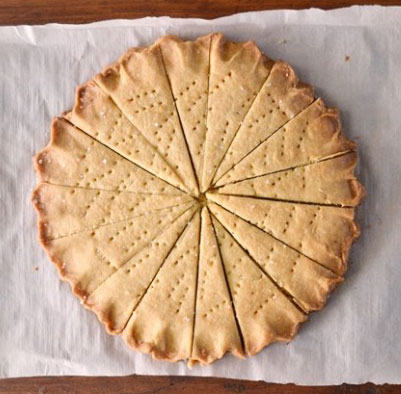
Petticoat Tails
Traditional round shortbread, 16th century
Scottish in origin, shortbread are rich, tender and crumbly butter cookies once served only during Christmas and New Year's Eve. It is the most basic of all cookie recipes. Butter, flour and sugar with maybe some salt. It has a crisp and yet crumbly texture and will absolutely melt in your mouth. Shortbread is so named because of its crumbly texture (from an old meaning of the word short). The cause of this texture is its high fat content, provided by the butter. The short or crumbly texture is a result of the fat inhibiting the formation of long protein (gluten) strands.
Although a type of shortbread was prepared during much of the 12th century, the refinement of shortbread is credited to Mary, Queen of Scots in the 16th century. The name of one of the most famous and most traditional forms of shortbread, petticoat tails, may have been named by Queen Mary. This type of shortbread was baked, cut into triangular wedges, and flavored with caraway seeds. Shortbread was expensive and reserved as a luxury for special occasions such as Christmas, Hogmanay (Scottish New Year's Eve), and weddings.
Butter appeared in a relatively small proportion of the dishes in medieval recipe books, which were written mainly for and by the cooks of the nobility. It was only in Tudor times that an emerging middle class, which did not despise butter as the food of the poor, began to use it liberally in every possible sphere of cookery, setting a trend that was to last for some two hundred years. This explains why the first shortbread recipes date only back as far as Elizabethan times.
Shortbread History
Shortbread cookies are ancient. They started in Scotland way back and of course they have evolved over time to what we know today. The original shortbread cookie recipe probably included oat flour but when the English adopted it they substituted wheat flour. In Tudor England oats were considered animal food. Traditional shortbread is baked in a round and then cut into wedges. The story has it that the ancient Scots baked shortbread in the winter months and put cuts in the shortbread rounds to represent the suns rays. This was perhaps some sort of ritual to persuade the sun to return and do away with the cold winter. The wintertime tradition holds on though because shortbread cookie recipes are among the most popular Christmas time cookie recipes.
Recipe 1694
"Short Cakes Made at ye Bathe. Take a pound of flower & rube into it a half pound of flouwer butter very fine; then put in half a pound of flo sugar & wet it with white wine to a paste; the rowle it very thick & cut it round with ye top of ye Drudger, & knotch it round with a squef [sic]& bake them upon a tin." ---Receipt Book of Mrs. Ann Blencowe, facsimile 1694 edition, with an introduction by George Saintsbury [Polyanthos: Cottonport LA] 1972 (p. 14)Recipe 1829
"1014. Scotch short-bread.--To the fourth of a peck of flour, take six ounces of sifted sugar and of candied citron and orange peel, and blanched almonds, two ounces each. Cut these in rather large slices, and mix them with the flour. Rub down among the flour a pound of butter in very minute bits, and melt a half-pound more, and with this work up the flour, &c. The less kneading it gets the more short and crisp the cakes will be. Roll out the paste into a large well-shaped oval cake, about an inch and a half thick, and divide this the narrow way, so as to have two cakes somewhat the shape of a Gothic arch. Pinch the cakes neatly at the edges, and mark them on the top with and instrument used for the purpose, or with a fork. Strew caraway-comfits over the top, and a few strips of citron peel. Bake on paper rubbed with flour. The cakes may be squares, or oblong figures.--Obs.
Plainer short-bread may be made by using less butter and no candied peel. The whole of the butter may be melted, which makes the process easier. Chopped almonds are used in larger quanitity for very rich short-bread."
---The Cook and Housewife's Manual, Mistress Margaret Dods, facsimile 1829 4th edition revised and enlarged [Rosters Ltd.: London] 1988 (p. 446-447)
[NOTE: The author's real name was Mrs. Isobel Christian Johnston (b. Fife 1781, died 1857). "Meg Dods" was a character invented by Sir Walter Scott. According to Theodora Fitzgibbon, Traditional Scottish Cookery c. 1980 (p. 6) Mrs. Johnston was a great friend of Scott.]
Shortbread Pans and Shortbread Molds
If you would like to stick to the traditional round shortbread any round cake pan will do. Just press the dough in the pan and smooth out by pressing with any flat surface. However if you really want to get fancy go for some of the shortbread pans or shortbread molds that are available.
Using a mold for your shortbread cookie recipe is not difficult. Just be sure to dust it with powdered sugar before filling and refrigerate for a time before baking. The powdered sugar dusting will ensure an easy release from the mold and the refrigeration will help the dough maintain its design during baking.
The seven-item Scandinavian cookie plate is a tradition of serving seven different types of cookies at Christmas. The cookies are typically made from a shortbread dough called mördeg, and all seven are made with an initial dough that is modified by adding cocoa or chopped nuts, dipping the finished cookies in chocolate, shaping the dough into a small cup and filling with jelly, among other modifications.
Traditional Shortbread Recipe
This recipe is a version that is currently accepted as traditional Scottish shortbread. It's 3 parts flour, 2 parts butter and 1 part sugar. This recipe is for a small batch of cookies, but it doubles or triples with no troubles. Just maintain the ratio.
Butter is the only flavoring in this cookie. You get sweetness from the sugar and the flour gives it body but it's the butter that supplies the taste. All true shortbread cookie recipes should include butter. Not lard, not butter flavored shortening and definitely not margarine but honest to goodness butter. It should also be the freshest butter you can find.
Shortbread is baked at a low temperature to avoid browning. When cooked, it is nearly white, or a light golden brown. Traditionally, the cookies are scored for cutting as soon as they come out of the oven.
3/4 cup flour, sifted
1/4 cup superfine sugar
Pinch of salt
1/2 cup room temperature unsalted butter
Preheat your oven to 350 degrees F.
Combine the flour, sugar and salt in a mixing bowl. Work in the butter with a fork or pastry cutter until the dough has the consistency of short crust.
Pulsing in a food processor will work also.
Sprinkle a board or your counter top lightly with flour. Turn the dough onto the board and knead until it's smooth. Refrigerate the dough for a couple of hours or overnight.
You should have approximately 8 ounces of dough. Divide the dough into four equal portions for large cookies or eight equal portions for small cookies and shape into rounds. For consistency you might want to pull out your kitchen scales.
Place each round on a parchment paper lined baking sheet and flatten them with the bottom of a glass to about 1/4 inch thickness. Prick with a fork.
Bake at 350 degrees F. for 20 to 30 minutes, until the cookies begin to brown slightly. Allow the cookies to cool on the baking sheet.
Whipped Shortbread Cookies
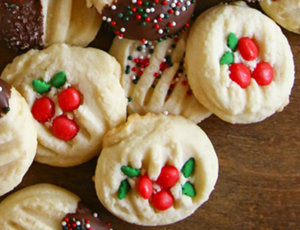
This Whipped Shortbread Cookies recipe is all over the Internet. One recipe even called them a Lorna Doone copycat recipe. Supposedly these shortbreads are very light and almost melt in your mouth.
The recipe basically follows the ratio of flour, butter and sugar as the standard shortbread recipe, but uses confectioner’s sugar and replaces some of the flour with cornstarch, both of which make the cookies tender and light.
8 ounces butter – softened
1 1/2 cups all-purpose flour
1/2 cup confectioner’s sugar
1/4 cup cornstarch
1 tsp vanilla extract
1-2 tbsp sprinkles of choice
½ cup chocolate melting wafers – if dipping
Preheat the oven to 350 degrees. Line 2 baking sheets with parchment and set aside. [Does not need greasing.]
Whip the soft butter in the mixer using the paddle attachment.
Slowly stir in the flour, confectioner’s sugar, cornstarch and vanilla until the dough pulls together.
Use a 4 tsp cookie scoop to scoop the dough onto the prepared baking sheets. [Or roll the dough into balls with your hands and place on sheets.]
Press a fork gently into the tops of the cookies.
Add sprinkles – if desired.
Bake for 14 minutes. Remove and allow to cool completely before decorating with chocolate.
To decorate, melt the chocolate in a microwave-safe bowl according to package directions.
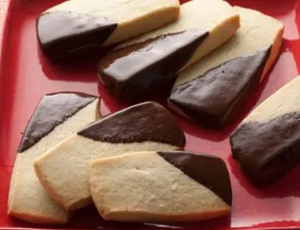
Dip each cookie halfway into the chocolate, place back on the parchment lined sheet and immediately add sprinkles before the chocolate solidifies again.
Store in an airtight container at room temperature.
Makes 28 cookies
Shortbread Cookies
from https://sallysbakingaddiction.com/
I test varying amounts of flour in shortbread recipes regularly and find 2 cups of spooned & leveled flour paired with 1/4 cup cornstarch produces sturdy, yet terrifically tender shortbread wedge cookies. For an optional sparkly crunch on your shortbread wedges, add a sprinkle of coarse sugar before baking.
1 cup (16 Tbsp; 226g) unsalted butter, softened to room temperature
2/3 cup (135g) granulated sugar
1 and 1/2 teaspoons pure vanilla extract
1/2 teaspoon salt
2 cups (250g) all-purpose flour (spooned & leveled)
1/4 cup (28g) cornstarch
optional: coarse sparkling sugar
Preheat oven to 325°F (163°C). Line two 8-inch cake pans with parchment paper leaving enough overhang around the sides to easily lift shortbread out. (Tip: Parchment is used so you can easily remove the shortbread and not cut it while it’s in the pan. I like to use a square of parchment and I cut a 1-inch slit in the center of each side. This helps reduce the amount of creases when lined in the pan.)
Using a hand mixer or a stand mixer fitted with paddle attachment, beat the butter and granulated sugar together on medium-high speed until smooth and creamy, about 2 minutes. Scrape down the sides and up the bottom of the bowl as necessary. Add the vanilla and salt and beat until combined, about 1 minute. Scrape down the sides and up the bottom of the bowl as necessary. Add the flour and cornstarch and beat on low speed for 1 minute as the mixture begins to combine. Turn the mixer up to medium speed and beat for 1-3 minutes or until the dough clumps together. (It will eventually, just keep mixing it.) If you’re adding dry add-ins (see above), this is when you’ll add them.
Divide dough in half. If you want to be totally accurate, weigh the halves to make sure they’re even. Recipe makes almost 1.5 lbs of plain dough (will weigh more if you added add-ins). Press each half of dough into a prepared cake pan. You want it nice and compact in the pans. Sprinkle with optional coarse sugar. Dock the surface all over with a fork to prevent air bubbles.
Bake the shortbread for 28-30 minutes or until very lightly browned on top and around the edges.
Remove from the oven, place pans on a wire rack, and cool shortbread for 10-15 minutes. Carefully remove the shortbread from the pans by picking it up with the parchment paper on the sides. Cut each into 8 large, 12 medium, or 16 small wedges. You want to make sure you cut the shortbread while it’s still warm. Enjoy warm or cool shortbread completely on wire racks.
Cover and store shortbread at room temperature for up to 1 week. If you added a topping such as glaze, icing, buttercream, or melted chocolate, refrigerate after 2 days.
Makes two 8-inch shortbreads
Flavors & Add-Ins
Add liquids/zest when you add the vanilla & beat in dry add-ins (such as nuts, sprinkles, or chocolate chips) on low speed after the dough is all mixed/clumped together. If adding spices such as cinnamon, add when you add the flour & cornstarch. *You can also divide the dough in half and beat half of these add-ins (including liquids/extracts if needed) into half of the dough.
Plain: Keep the recipe as written. Feel free to drizzle with salted caramel or melted chocolate or decorate with royal icing, cookie icing, or vanilla buttercream.
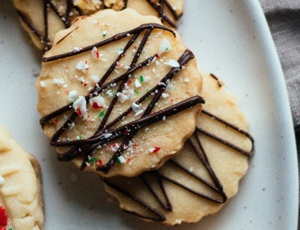
Peppermint: Add 1 teaspoon of peppermint extract. After the cookies have cooled, drizzle 4 ounces (113g) of melted semi-sweet chocolate on top, and sprinkle with crushed candy canes.
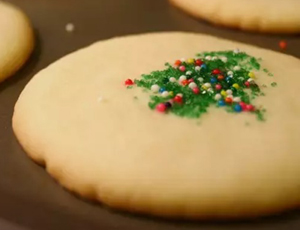
Sprinkles: Add 1 teaspoon of almond extract and 1/3 cup (about 50g) of sprinkles. Instead of coarse sugar, sprinkle a few teaspoons of more sprinkles on top of the pressed dough before docking and baking.
Chocolate Chip: Add 3/4 cup (135g) mini chocolate chips. I recommend mini size so you get more chocolate in each cookie. Keeping that in mind, feel free to use 1 cup (180g) regular size instead.
Cinnamon Pecan: Add 1 teaspoon of cinnamon and 1 cup (130g) chopped pecans. Instead of coarse sugar, sprinkle the pressed dough with a mixture of 1 Tablespoon granulated sugar and 1/4 teaspoon ground cinnamon.
Other add-ins: 1 cup (about 130g) chopped any nut variety, 3/4 cup (about 115g) dried cranberries or raisins, 1 cup (about 180g) flavored morsels such as butterscotch or white chocolate, 1 teaspoon your favorite extract, 1 Tablespoon (15ml) citrus juice such as lemon or orange + 2 teaspoons zest, or 3/4 cup (about 115g) Heath Bar Bits O’ Brickle English Toffee. Feel free to combine add-ins such as citrus juice, zest, 1/2 cup white chocolate chips, and 1/2 cup dried cranberries. These are the add-ins I’ve tested, so let me know if you try others!
Other Shortbread-type Cookies
Many Christmas cookies use a shortbread-type base in making them. Many of them cream the butter and sugar together instead of being cut-in at the end of mixing as in the traditional recipe. This seems to be a more modern change to the recipe as most cookie recipes use it. Not creaming the butter and sugar can lead to dense, grainy cookies. Creaming the butter and sugar until the mixture is light and fluffy dissolves the sugar crystals into the butter, and ensures the cookies will hold together. Creaming also incorporates air into the batter, which results in lighter cookies.
Spritz Cookies - a type of shortbread with egg added to the batter. The dough is often colored for Christmas and is shaped using a cookie press.
*Chocolate Dipped Coconut Shortbread - a shortbread with coconut and baking powder added and one half of the cookie dipped in chocolate. The butter is creamed with the sugar instead of being cut-in at the end of mixing.
Pecan Sandies - This Pecan Sandies Recipe is a shortbread-type cookie. Using granulated sugar and a few other adjustments to a standard shortbread recipe makes a cookie up to the standards of the Keebler Elves. One of the adjustments, along with the addition of a little water and vanilla extract, is creaming the butter and sugar.
Russian Tea Cakes - also called Mexican Wedding Cakes, these are a shortbread-type cookie that use confectioner's sugar and incorporates finely chopped walnuts. Once baked and still warm, the cookies are rolled in more confectioner's sugar. Another cookie where the butter is creamed with the sugar instead of being cut-in at the end of mixing.
Thumbprints - another shortbread-type cookie except that it uses brown sugar and egg yolk in the dough. After being rolled into small balls, they are dipped in egg white, then finely chopped walnuts. A depression is created in the center of the balls and filled with jelly after baking.
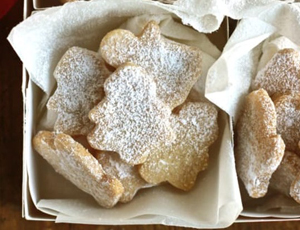
Many basic shortcrust recipes just have you roll out the dough and cut with cookie cutters, or even just cut with a knife into squares or rectangles. Another way of shaping them is to roll into balls and press down with a glass or fork. Here are some simple ideas for decorting from the Internet. Dust with sugar, cinnamon sugar and decorating candy, dip or drizzle with chocolate. . .