Jambalaya
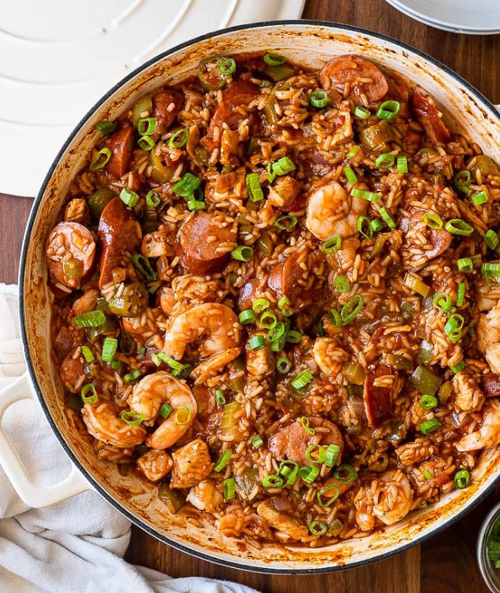
Creole style jambalaya with sausage & shrimp
One of Creole cookery's hallmarks, jambalaya is a New World version of the Old World dish paella that combines cooked rice with a variety of ingredients including tomatoes, onion, green peppers and almost any kind of meat, poultry or shellfish. It was an attempt by the Spanish to make paella in the New World, where saffron was not readily available due to import costs. Tomatoes became the substitute for saffron.
As time went on, French influence became strong in New Orleans, and spices from the Caribbean changed this New World paella into a unique dish. It's thought that the name derives from the French jambon, meaning "ham," the main ingredient in many of the first jambalayas.
There are two primary methods of making jambalaya, differentiated by the presence or absence of tomatoes.
The first is Creole jambalaya (also called "red jambalaya"). First, meat is added to the trinity of celery, peppers, and onions; the meat is usually chicken and sausage such as andouille or smoked sausage. Next vegetables and tomatoes are added to cook, followed by seafood. Rice and stock are added in equal proportions at the very end. The mixture is brought to a boil and left to simmer for 20 to 60 minutes, depending on the recipe, with infrequent stirring. Towards the end of the cooking process, stirring usually ceases. Some versions call for the jambalaya to be baked after the cooking of all the ingredients.
The second style, more characteristic of southwestern and south-central Louisiana, is Cajun jambalaya, which contains no tomatoes (the idea being the farther away from New Orleans one gets, the less common tomatoes are in dishes). The meat is browned in a cast-iron pot. The bits of meat that stick to the bottom of the pot (sucs) are what give a Cajun jambalaya its brown color. A little vegetable oil is added if there is not enough fat in the pot. The trinity (of 50% onions, 25% celery, and 25% green or red bell pepper, although proportions can be altered to suit one's taste) is added and sautéed until soft. Stock and seasonings are added in the next step, and then the meats are returned to the pot. This mixture is then simmered, covered, for at least one hour. Lastly, the mixture is brought to a boil and rice is added to the pot. It is then covered and left to simmer over very low heat for at least 1/2 hour without stirring. The dish is finished when the rice has cooked.
Jambalaya is differentiated from other traditional ethnic Louisiana dishes, such as gumbo and étouffée, by the way in which the rice is included. In the latter dishes, the rice is cooked separately and is served as a bed which the main dish is served on. In the usual method of preparing Jambalaya, a rich stock is created from vegetables, meat, and seafood. Raw rice is then added to the broth and the flavor is absorbed by the grains as the rice cooks. A good cast iron Dutch oven with a tight fitting lid works best for this recipe.
Creole Style Jambalaya
If desired, you could add chunks of chicken or shrimp to this recipe. Use 1/2 pound and cut the kielbasa back to 1/2 pound. Chicken, if raw, should be cooked along with the sausage (or fry each separately) and removed from the pot before adding the trinity (bell pepper, onion, celery). Then the rice is sauteed in the pot, then the liquids and seasonings are added, along with the chicken and sausage. The rice is cooked until all liquid is absorbed, with the shrimp added at the very end. I like the combination of kielbasa and shrimp. Using these steps builds great flavor. After taking the shells off the shrimp if necessary, but into pieces. This is not necessary but I like smaller chunks in mine.
A note about converted rice which is recommended for this dish: Converted rice is steamed before it's husked, a process that causes the grains to absorb many of the nutrients from the husk. When cooked, the grains are more nutritious, firmer, and less clingy than white rice grains. Uncle Ben's is a well-known brand.
FMM: Makes 1/2 recipe using 1/4 pound kielbasa and 1/4 pound shrimp. Cut the shrimp into pieces before adding the the jambalaya at the end.
1 pound smoked sausage, such as Andouille*
(1/2 pound or so chicken or shrimp may be added - shrimp and chicken that is already cooked at the very end)
2 tablespoons vegetable oil
1 chopped green bell pepper
1 chopped onion
2 ribs chopped celery
1-1/2 cups [uncooked] converted rice (Uncle Ben's is preferred)
2 cloves minced garlic
1 can (15 oz.) diced tomatoes (use less tomatoes, or use whole tomatoes that you squeeze apart)
[the juice is strained from the tomatoes and water is added to make 3 cups for cooking the rice]
1 teaspoon ground cumin (or touch more)
2 teaspoon Creole Seasoning (or more), provides a touch of heat
1 teaspoon salt
Green onion, sliced, for garnish if desired
*Note: If Andouille sausage is unavailable, substitute Kielbasa (Polish sausage) or other smoked sausage.
In a cast iron Dutch oven heat the oil. Slice the sausage (and chicken if using) and saute until lightly browned. Remove and set aside.
Add the bell pepper, onion and celery to the pot and saute until soft and transparent. Add the garlic and the rice and continue sauteeing until the rice is brown.
Strain the tomatoes, reserving the liquid, and add the tomatoes to the rice. Combine the tomato liquid with
enough water to make 3 cups
(1 1/2 cups if making 1/2 recipe). Add the cumin, Creole Seasoning, and salt to the liquid mixture, mix well. Pour the liquid into the Dutch oven with the sausage (and chicken) and bring to a boil
for 1 minute. Reduce the heat to a simmer, cover and cook
for 30 minutes. Do not stir, but check every so often to make sure there is liquid still at the bottom of the Dutch oven by pulling the jambalya away from the side of the pan.
(If using shrimp, about 5 minutes before the rice is done, place the shrimp on top of the Jambalaya mixture, stir through gently and cover with lid. Allow to simmer, until the shrimp are cooked through and pink, about 5-6 minutes, depending on the size/thickness of the shrimp being used.)
When the rice is done and the liquid has been absorbed, remove from the heat and let stand for 5 minutes. Uncover, and fluff with a fork.
Good served with corn bread and a salad. The salad could be served as a first course.
Chef Paul Prudhomme molds his rice in an 8 oz. cup and inverts it on the serving plate, 2 cups per plate for a main course. He also likes to serve jambalayas with Creole Sauce.
6 - 8 servings
