Ausgezogene Krapfen (German doughnuts)
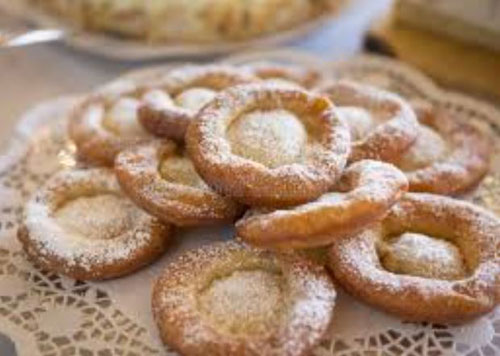
Ausgezogene Krapfen, which literally means pulled out doughnuts, also known as Hutkrapfen, Auszogne, Küchle or Knieküchle (they have so many names), are German doughnuts and a Bavarian specialty. Ausgezogene Krapfen are pulled into a shape that is very thin in the middle and thicker on the edges. It has no filling and is typically fried in lard.
Just like German fried pastry aka. Geschnittene Hasen, Ausgezogene Krapfen are normally made for special occasions such as baptism, confirmation, wedding or parish fair.
Confusingly, "Krapfen" in Southern Gemany are what in the North is known as the Berliner, round puffy doughnut-type pastry, traditionally filled with jam. But "Krapfen" in Southern Germany refers generally to any yeast pastries which are fried in fat, so Ausgezogeneare may also be called Krapfen in the south.
Of the two longer recipes below, the one from https://www.esterkocht.com/ goes into a lot of detail, with photos, on their web page explaining how to make these, as does the one from https://www.thechoppingblock.com/, but the technique for shaping the doughnuts is quite different. One shapes the donuts using an upsidedown canning jar, and the other rolls the dough out and cuts circles, then shapes the outer ridge [this technique seems to be less traditional], The same with the two older recipes, listed first, I found two different techniques. Because this is a very light pillowy dough, maybe shaping them is the better way to go. Less air will be pushed out of the dough. One other technique I read about is to use a jar the size of the indent you want and press down and turn. This recipe says to fry with the indentation facing down first - you will notice the centers puff up.
Funkaküachle choux pastry
500 g flour
20 g yeast
2 egg yolks
1/4 l milk
50 g melted butter
50 g sugar
A splash of rum
A pinch of salt
Mix flour, yeast, egg yolks, rum, sugar, butter, milk and salt to form a dough, knead well and leave to rise until doubled in size (around 1/2 hour). Roll out to 1cm thick and, using a round cutter, cut out Küchle approximately 10cm in size. Cover and leave for another 1/2 hour. Pull apart the centres slightly and deep fry on each side until golden brown.
Serving suggestions:
fill the indent in the middle with lingonberry jam;
sprinkle the Küchle with icing sugar and cinammon;
serve the Küchle with warm custard.
Pulled Out German doughnuts (Ausgezogene Krapfen)
from https://www.esterkocht.com/
Learn how to make these perfectly flat, very thin in the middle and thick on the side Bavarian style doughnuts flavored with rum.
1 kg (2.2 lbs/ 8 1/4 cups) plain flour plus extra for dusting
40 g (1.4 oz ) fresh yeast/ 4 1/2 teaspoons dryyeast
2 teaspoons vanilla sugar
2 middle eggs
120 g (4 oz/ 2/3 cup) sugar
100 g (3.5 oz) butter
500 ml (16.9 fl.oz/ about 2 cups) milk
a pinch of salt
1 shot glass of fruit brandy of your choice (around 20 ml/ 1.3 tablespoons)
1 tablespoon sunflower oil
1500 g (3 lbs) clarified butter (or vegetable oil) to deep fry
sunfloweroil to grease the bowl, your hands, the dough and the cling film
Heat milk and butter in a pot at medium heat. Stir continuously until butter has melted. Remove from the pot from the heat and let the mil-butter mixture cool. Next combine fresh yeast and 1 tablespoon of sugar in a bowl. Using a spoon break the yeast into small pieces, then mix well until you have a watery mixture. Leave the mixture for 10 minutes.
If you’re using dry yeast, add 2 tablespoons flour (from the 1 kg (2.2 lbs/ 8 1/4 cups), 1 tablespoon sugar (from the 120 g (4 oz/ 2/3 cup) and yeast to the jar with half of lukewarm milk. Stir well and let the mixture stand for about 10 minutes. Then follow the recipe.
Put the flour, the remaining sugar, vanilla sugar and a pinch of salt in a bowl. Make a hole in the middle, then pour in the yeast – sugar mixture in the middle. Mix well. Add the eggs, then start mixing and slowly adding the lukewarm milk – butter mixture. Finally add slowly the fruit brandy shot while the dough is busy kneading.
Add a tablespoon of sunflower oil and knead the dough very well. With the hands, I knead the dough for about 10 to 12 minutes. If the dough is sticky when kneading with the hands, just oil them with few drops of vegetable oil. If you’re using a heavy duty kitchen machine, please knead your dough for maximum 7 minutes in total. Otherwise you will be overworking the dough.
Put the dough in the greased bowl. Pour few drops of oil on the dough,so that the dough will not dry out. Using your hands, apply the oil evenly and cover with a kitchen cloth. Let the dough rise for 30 minutes in a warm place.
In the meantime, take an old cloth, spread it out and lightly flour it. The cloth must be spread out in that way that you'll be able to cover the dough balls with it later. Next, oil the cutting board and your hands. Take two tablespoons of the dough and put them directly on the cutting board. Using your hand, form a smooth ball! Do not use flour, use oil!
Put the rolled balls on the kitchen cloth. Put a drop of oil on the surface of each and every ball and massage it nicely. Repeat the process, until you have used up the dough.
Cover with the plastic dust sheet and then with a table cloth. Let the dough balls rise for 30 minutes or until they have doubled in size.
Turn the preserving jar the other way round. Such that the bottom is up. Cover the bottom with a plastic film. Using a rubber ring, fasten the plastic film and oil the surface. Heat the oil in the pot and medium-low heat. Then oil your hands and take a dough ball. Using your hands pull the dough starting from the middle and going to the edges, while pulling. Next put the dough on glass, the exactly same way it was in your hands without turning it. Then keep pulling on the sides, such that the middle is thinner than the sides.
Take the pulled out dough ball from the glass and put it the exactly same way you have it in your hands in the fat without turning it. When you put the dough in the pot make sure that it's not wrinkled, otherwise the doughnut will loose it's form. While the doughnut is in the pot, keep pouring hot oil over it. [I also saw this in a picture on another web site.]
Once the bottom is nicely brown, turn it, until the other side is also golden brown. Remove the doughnut from the fat, let cool a bit on the cooling rack, until you'll be able to touch it with your hands and then move it on a table cloth. This is also very important because the table cloth removes the excess fat. Dust with icing sugar before serving sugar and enjoy!
Servings: 25 Doughnuts
German Küchle
One of the traditional baked goods in the Southern part of Germany: so-called Kuechle.
Recipe:
500 g wheat flour, 50 g sugar, 60 g butter, 2 eggs, 220-250 mL milk, small quantity of salt, yeast.
Prepare a yeast dough, knead it thoroughly, let it rise, knead again, and finally form small round pieces, about 15 pieces. Let rise again for 15 minutes.
For baking [frying] , heat oil (better: clarified butter) to 175-185 degrees C (ideally, use a thermometer). Then, with fingers covered with some oil or butter, pull the kuechle into shape and bake [fry] floating on the oil, turn around once the color of the 1st side is right, bake [fry] the 2nd side, then take out and put on some kitchen paper to soak-off the residual oil. Cover with some powdered sugar. Eat fresh, or freeze.
How to Make Authentic German Krapfen
from https://www.thechoppingblock.com/
1/2 cup warm milk (110-115 degrees)
1 Tablespoon sugar
1 package dry yeast or 2 1/4 teaspoons
2 cups cold milk
2 Tablespoons brandy (secret ingredient)
3 Tablespoons vegetable or grapeseed oil
2 whole eggs
1/4 teaspoon salt
5 cups all-purpose flour
Extra flour for dusting, kneading and rolling surface
Approximately 1/2 gallon vegetable oil for frying
Warm the 1/2 cup of milk on the stove over low heat to 110-115 degrees. You want to keep the milk between 110-115 degrees. If you overheat the milk, it can kill the yeast and if the milk is too cold it will take much longer to activate.
Add 1 tablespoon of sugar to the warm milk and sprinkle the package of yeast over that. Let the yeast set for about 5 minutes until the surface starts to foam up.
While the yeast is proving, start measuring all your liquid ingredients into a large mixing bowl.
Once the yeast is bubbling, pour that mixture into the liquid ingredients.
Add the 2 eggs, 1/4 teaspoon of salt and 5 cups of flour to the liquid ingredients and mix with a wooden spoon until the mixture comes together somewhat.
This dough is relatively sticky to start with. Sprinkle a light and even layer of flour over your dough and mix it in the bowl. Knead together adding flour as needed until the dough is only slightly sticky and starts to smooth out a bit. This should just take just a few minutes, no more than five. Do not over knead this dough, we want a nice tender Krapfen.
Cover the bowl with a clean dry towel or plastic wrap and let it rise in a warm spot.
*Alternatively, you can take the dough and put it in the refrigerator at this point. Make sure to cover it with plastic wrap, which will keep the dough moister than a towel. You can let the dough rise overnight in the refrigerator and pull it out in the morning. You need to let the dough reach room temperature, which will take several hours. Once it reaches room temperature continue to the next step.
Check the dough after 2 hours by pushing into the dough gently with your finger. If the dough bounces back, the dough needs to continue to rise. Let the dough rise until the indentation of your finger remains, somewhere between 2 and 4 hours.
*Remember if you let the dough rise overnight in the refrigerator, just skip this part. The rising happened in the refrigerator. All you do now is to let the dough reach room temperature so you can shape it.
Lightly flour your work surface with an even layer of flour and pour the dough out on to the surface. Divide the dough in half with a dough scraper or knife.
Starting with half of the dough, lightly sprinkle it with flour and form into a smooth even ball. Do the same with the other half of the dough.
Cover the dough balls with a clean dry towel and let them rest for 10 to 15 minutes.
Put an even and light layer of flour onto your work surface and place one dough ball onto the surface. With a rolling pin roll the dough into a 1/4-inch thick circle.
With a 3-inch round cutter, cut the rolled-out dough into circles. Place the circles on a lightly floured sheet pan and cover with a clean dry dish towel.
*You can either re-roll the scraps of dough or do as the Donauschwaben Volunteers do, fry them in their random shapes for the cooks to enjoy! It’s also a great way to cook a practice round of Krapfen.
Leave the dough as is in the 3-inch circles or create a slight divot in the center for a dollop of jam. The divot is made by simply stretching the dough a little thinner in the center.
Heat your pot of oil until it measures 365-375 degrees on a candy thermometer.
Place the Krapfen in the oil dropping them in the oil gently and away from you. Don’t overcrowd your pan with the Krapfen, they will expand in size and take up more room than you might expect but adding too many donuts at one time will also drop the temperature of the oil too quickly. Once the first side is golden brown, turn it over to brown the other side, approximately 2 to 3 minutes per side. Remove the Krapfen out of the hot oil.
If using granulated sugar to coat the donut, place the Krapfen directly into granulated sugar once you take it out of the hot oil and toss it in the sugar.
If using powdered sugar to coat the donut, let the donut cool just slightly then sprinkle with powdered sugar.
Yield: 2 dozen donuts
