Berliner Pfannkuchen (German doughnuts)
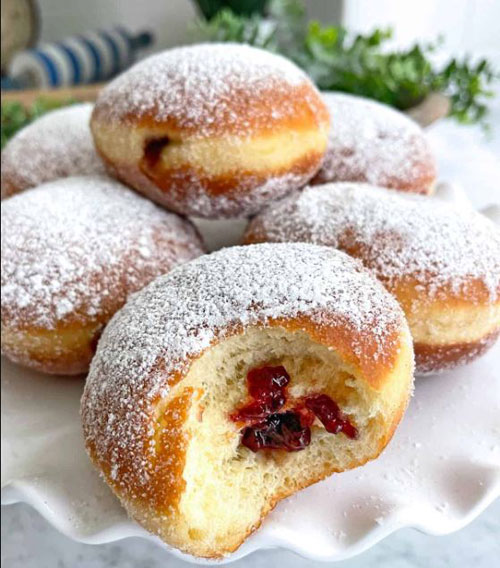
American-style donuts are unique to North America, but Germany has a sweet that is similar. These pastries are called “Berliner (Pfannkuchen)”, in Berlin, they are just called “Pfannkuchen”, in the Frankfurt region sometimes also “Kreppel”. In South Germany, they are called Krapfen. So many names! These are closest to what you'd call a "cream filled donut" in North America, only that in Germany they are typically filled with jam: apple, plum, cherry, apricot, raspberry, etc., or, more recently, custard or pudding or Nutella. Also Berliner tend to be lighter in texture and more evenly round in shape.
There are some variants that may also be called Krapfen like the Ausgezogene which is pulled into a shape that is very thin in the middle and thicker on the edges. It has no filling and is typically fried in lard.
Berliner are enjoyed all year long but it’s a long-held tradition in Germany to eat them at New Year’s and other carnival celebrations.
What makes a Berliner different from a standard jelly donut?
- A Berliner ALWAYS has a white ring around the middle. Always. If it doesn’t have a white ring, it’s not a Berliner. Ask any Berliner (the person, not the donut) and they’ll emphatically tell you so. How do you get that characteristic white ring? Donuts are buoyant, they float. The white ring around the middle is the part of the donut that always remains above the oil line. So you fry one side of the donut, flip it over and fry the other side, but never submerge the donut under the oil. If you do, it’s not a Berliner.
- The Dough is Rolled Into Balls Unlike standard jam donuts that are made by rolling the dough out and then cutting out circles, Berliner are made by taking portions of the dough, rolling them into balls, and letting them proof, which gives them their characteristic round puffy shape.
Other characteristics of a Berliner donut are that they usually include some lemon zest in the dough, they are filled with raspberry jam (sometimes apricot jam or even German plum butter, though less commonly), and they are often rolled in granulated sugar followed by a dusting of powdered sugar.
Pro Tips
- It’s critical to let the individual dough balls get a really good rise so they are nice and puffy. This will 1) ensure a light, fluffy crumb as opposed to a dense and stodgy donut and 2) it will ensure there is enough air in the dough to keep it buoyant while frying in the oil. Meaning they will stay afloat so that they develop that white line around the middle that is a defining characteristic of Berliner.
- Maintain the right oil temperature (between 350-365 F). If the oil isn’t hot enough the donuts will soak up the oil and be greasy. If the temperature is too hot the donuts will burn on the outside before the center is cooked. Personally I like to maintain the temperature at just over 350 F.
- Do NOT push the Berliner under the oil. They need to remain floating so that they can develop the characteristic white ring around the center.
- To make your Berliner (donut) like a true Berliner (local resident), first toss the donuts in granulated sugar mixed with a pinch of cinnamon, and then dust them with powdered sugar. (And now you can understand why the Berliner really don’t like their donuts being called Berliner!)
While a traditional Berliner Pfannkuchen is filled with raspberry (or apricot) jam and dusted with sugar, you can certainly veer off the path of tradition and, as some German bakeries and home bakers do, experiment with flavor variations. For example, try filling your Berliner with vanilla custard (just add a little more cornstarch for thickening), eggnog custard (again, thicken it a little more), caramel sauce, toffee sauce, Nutella, chocolate mousse, or lemon curd. Instead of dusting it with powdered sugar you can glaze your donuts with a vanilla, chocolate, caramel, or other flavored glaze and/or add things like chocolate shavings, chopped nuts, sprinkles, or coconut flakes. The Berliner is a blank canvas for your creativity!
Berliner (German Donuts)
4 cups all-purpose flour
1/3 cup sugar
2 1/4 teaspoons instant yeast
1 1/2 teaspoons lemon zest
1/2 teaspoon kosher salt
3/4 cup milk, room temp, plus more as needed
3 large egg yolks, room temp
5 tablespoons unsalted butter, softened at room temp
1 teaspoon quality pure vanilla extract
1 cup raspberry jam , or jam/filling of choice
granulated sugar, (about 1 cup)
pinch of cinnamon
powdered sugar (about 1/2 cup)
oil for frying, choose a neutral tasting oil with a high smoke point like avocado or canola
Place the flour, sugar, yeast, salt and lemon zest in the bowl of a stand mixer and stir to combine. Add the eggs, butter, vanilla extract, and milk. With the dough hook attached, knead the dough for about 10 minutes or until it's no longer sticky but is soft and supple. Add more milk or flour as needed.
Form the dough into a ball, spray the bowl with oil, and place the dough ball back in the bowl.
Cover the bowl loosely with plastic wrap and let it rise in a warm place for 45-60 minutes or until doubled in size.
Punch down the dough in the center. Divide the dough into uniform pieces. I like to weigh the dough to get themas close to equal as reasonably possible. At about 80 grams per piece you'll get 15 Berliner donuts.
Using the palms of your hands, roll the dough pieces into balls and place them on a lined baking sheet, keeping space between them to allow them room to rise. Cover them with a clean towel or cover loosely with plastic wrap and let them rise in a warm place for another 30-60 minutes or until nearly doubled in size and nice and puffy.
Make sure to give the dough balls adequate time to rise as this will be crucial for achieving the right texture.
Heat the oil in a deep pan. The oil should be at least 2 inches deep. Keep the temperature between 350-365 F. If it's not hot enough the donuts will soak up the oil and be greasy. If the oil is too hot the outside will burn before the inside is fully cooked. I like to keep it at just over 350 F.
Working in batches, carefully lower a few of the dough balls into the hot oil. The temperature should be such that the Berliner will cook on each side for about 2 minutes or slightly less. After about 2 minutes, or when the bottom is a deep golden brown, carefully flip the donuts over and continue to cook for about another 2 minutes or until deep golden brown.
Do not at any point submerge the Berliner under the oil otherwise they will not develop the white rim around the center that is characteristic of Berliner.
Remove the Berliner and place them on paper towels to drain. Repeat the process for the remaining donuts.
Once the Berliner are cool enough to handle, it's time fo fill them.
Place the jam in a piping bag fitted with a filling tip. Push the filling tip into the side of Berliner, along the white rim, and squeeze some jam into the donut. Repeat this for all of the donuts.
Place the granulated sugar into a wide shallow bowl and mix in just a touch of cinnamon. Place a donut on the sugar, scoop some sugar on top of it, and roll it around in the sugar until well coated. Repeat for all remaining donuts.
Place the sugar coated donuts on a wire rack and dust the tops with powdered sugar.
Berliner donuts are best eaten while still a little warm and definitely on the same day, but will keep for a couple of days in an airtight container at room temperature.
Servings 15 Berliner
