German Plates
An article on the Internet stated: “Speckbohnen [German Green Beans] brings back memories of traveling to Germany and Austria when I was a child. As I got to that age when a few bits from your parents meal wasn’t enough, but a whole meal on your own was too much, something we loved to get was a house platter. It was a great way to not really have to decide what you wanted to eat as you got to have a bit of everything! It normally included some pork chops, sausages, Wiener schnitzel and various other meats along with some sides like German potato pancakes and commonly these German green beans.”
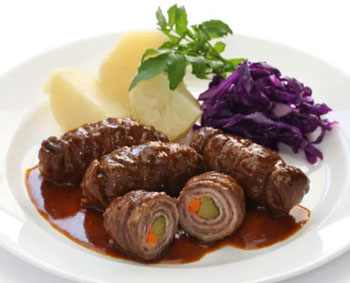
Rouladen
A list of traditional German food wouldn’t be complete without the mention of Rouladen. Rouladen is a typical German dinner, often served with potato dumplings, red cabbage and gravy. It can also be served with vegetables or mashed potatoes.
The rolls are made of thin beef slices that are rolled around bacon, pickles, onions, and mustard before they are roasted with red wine. It’s a time-consuming dish to prepare, but it’s definitely a traditional food from Germany. Rouladen are enjoyed throughout the year in Germany but are often associated with Sunday dinners and special occasions like Christmas Eve.
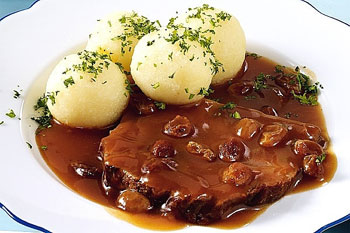
Sauerbraten with potato dumplings
Sauerbraten
Sauerbraten is considered as the national food of Germany. It’s a true traditional German food that takes quite a lot of time to prepare. It’s made of meat, which is cooked slowly in the oven for hours and results in soft and tender meat that will give you an amazing culinary experience. Sauerbraten is usually served with potato dumplings, boiled potatoes or spätzle, Rotkohl (red cabbage), and sauce.
Sauerbraten is cooked mainly in the cold season. Veal, pork, lamb, venison or even horse meat is marinated in a special sauce of wine or vinegar, as well as water with various seasonings, spices and herbs from three to ten days before cooking. There are different ways of preparation in different regions: for example, closer to France, red wine is used as the basis for the marinade, and in Eastern Germany, not far from the Czech Republic and Poland, they prefer vinegar. In the Rhine region, they add beetroot syrup and raisins. Sauerbraten is served with popular side dishes such as potato dumplings, boiled potatoes, red cabbage and Spätzle.
Mom’s recipe for Sauerbraten
Alton Brown’s recipe for Sauerbraten
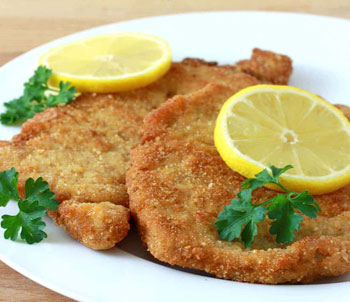
Schnitzel
Schnitzel originated in Austria but is still considered as a traditional food of Germany and you can find it served in restaurants all over the country. One of the most common German variants is Jägerschnitzel, which is schnitzel in mushroom sauce, often served with potatoes or sauerkraut.
Types of Schnitzel
Wiener Schnitzel (traditionally made w/ veal)
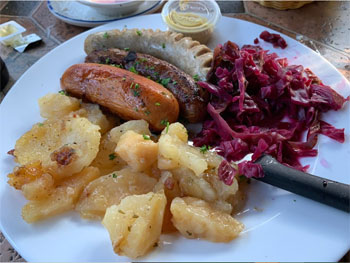
Wurst platte of Bratwurst, Knockwurt, and a
smoked Hungarian sausage with German Potato
Salad and Red Cabbage
Wurst Platte
Most commonly, wursts are regarded as a snack served with or in a white bread roll made from wheat flour and eaten with mustard.
As a pub dish, it is often accompanied by sauerkraut or potato salad and sometimes served with dark, crusty country bread made predominantly from rye flour, less commonly with a Brezel (pretzel). It is a very popular form of fast food in German-speaking countries, often cooked and sold by street vendors from small stands.
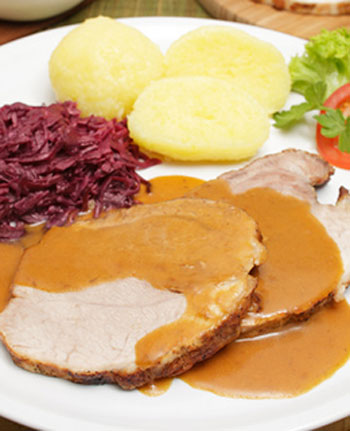
Schweinsbraten
Schweinsbraten, the most popular dish in Bavaria, is slices of pork covered in gravy and served with Knödel (dumplings). You’ll find it on the menu of every beer garden or traditional Bavarian restaurant.
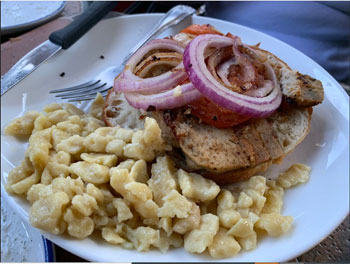
Bavarian Meatloaf and spatzle
Leberkäse (Bavarian Meatloaf)
Leberkäse, literally means 'liver cheese', is a specialty food found in the south of Germany, in Austria and parts of Switzerland, and is similar to bologna sausage. It consists of corned beef, pork and bacon and is made by grinding the ingredients very finely and then baking it as a loaf in a bread pan until it has a crunchy brown crust.
There are several ways that Leberkäse is eaten.
Most of the time it is served hot on a semmel (hard wheat flour bread roll) and traditionally seasoned with mustard or pickles. The result, generally called Leberkäsesemmel, is a staple of South-German and Austrian fast food stalls, butcher shops and supermarkets.
Warm from the oven, it is cut into approximately finger-thick slices and usually served with traditionally medium hot mustard or Bavarian sweet mustard or sometimes ketchup and accompanied by soft pretzels, Sauerkraut or Kartoffelsalat (potato salad).
It is often pan-fried (abgebräunt or gebraten, "browned"), in which case it is commonly accompanied by a fried egg and German potato salad, or Bratkartoffeln (home fries) and sometimes spinach. This is a very common Biergarten dish.
Cold, it can be cut into very thin slices and used on a variety of sandwiches, usually seasoned with pickled cucumbers.
Two slices of Leberkäse with a slice of ham and cheese in the middle are sometimes dipped into eggs and coated with breadcrumbs and then fried in the pan. This variant is called falsches Cordon Bleu ("mock Cordon Bleu").
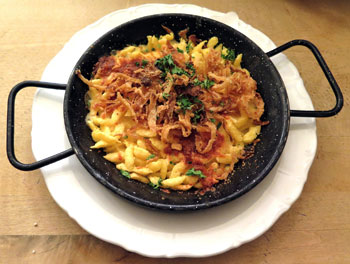
Käsespätzle
Spätzle
Spätzle originally come from Baden-Württemberg, but you can find it all over Germany these days. Essentially a sort of pasta, Spätzle is a simple combination of eggs, flour, salt and often a splash of fizzy water to fluff up the dough - yet in the right hands the results are wonderful.
Traditionally served as a side to meaty dishes, and sometimes dropped into soups, it can be transformed into a simple but delicious main by adding Emmentaler or another Swiss cheese to make what’s often referred to as the German macaroni cheese called Käsespätzle.
Käsespätzle is a traditional German meal coming from Allgäu and Swabia. Käsespätzle can easily be called a variation of the American mac and cheese, but instead of pasta, they use homemade noodles.
This meal is quite cheap and easy to prepare: use the same dough as for dumplings, wipe it through a sieve, boil it, and then bake it with cheese. As a result, you will get a kind of casserole with cheese flavor and threads of melting cheese – a real paradise for those who love cheese! The dish is served directly from the oven with some fried onions on top.
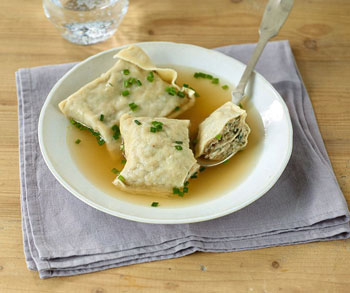
Maultaschen in der Brühe
Maultaschen
Maultaschen are a kind of large meat-filled dumpling in Swabian cuisine. They consist of sheets of pasta dough filled with minced meat, smoked meat, spinach, bread crumbs and onions and flavored with various herbs and spices (e.g. pepper, parsley and nutmeg). Maultaschen are typically 8–12 centimetres (3–4+1⁄2 inches) across. They are square or rectangular in shape. Served as an appetizer or a main, and versatile enough to be fried or boiled, their outer casing of pasta dough can be filled with anything from minced meat to sauerkraut and spinach, usually flavoured with pepper, parsley, nutmeg and other herbs and spices. Heaven on a plate, essentially.
The four most popular ways you’ll find them served in German restaurants are:
- Maultaschen in der Brühe (served in broth - usually beef broth - and eaten as a soup)
- Geschmälzte Maultaschen (fried in butter and served topped with caramelized onions)
- Geröstete Maultaschen mit Ei (sliced Maultaschen are fried in an egg/herb mixture)
- Maultaschen Schweizer Art (Swiss style, which is whole Maultaschen baked with ham and Swiss cheese on top)
The first two are the most traditional but the last two are also very popular.
