Spätzli vs Knöpfli
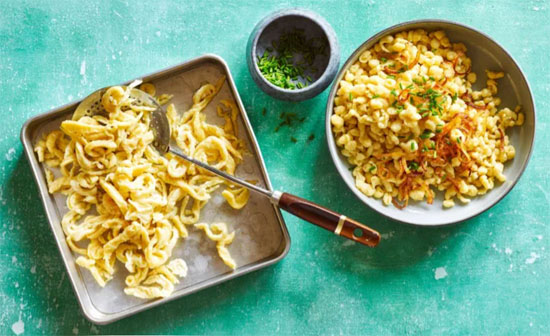
From https://www.familymattersswitzerland.ch/knoepfli-spaetzli/:
“Spätzli and Knöpfli, two forms of fresh noodles or dumplings, are staple foods of the Swiss, especially in the German-speaking area. While we eat them year round, they’re especially popular in autumn, because they go so well with autumn foods like game, hot ham such as Rollschinkli, and red cabbage and caramelised chestnuts. [For further ideas on how to use Spätzli and Knöpfli, see Spaetzle (egg noodles).]
“The dough is the same for both. Spätzli are long in shape, Knöpfli are round. Spätzli are made by spreading the liquid-y dough onto a chopping board and then cutting off a little piece with a knife for each single Spätzli, which is a very time-consuming method. Knöpfli (translated: little buttons) are made by pressing the same dough through a sieve with small holes, which is a lot quicker and done in less than a minute.”
The name, Spätzli, derives from the word spatz (“little sparrows”) but is also thought to mean “clump” in German. It’s known as spätzli in Switzerland and nokedli in Hungary. The short noodles are traditionally made by hand and can take many shapes, such as the smaller knöpfle (“little buttons”). In everyday language usage, the two names, Spätzle and Knöpfle, refer to the same product made from the same dough and are interchangeable. There is no clear distinction between how the two names are used, and usage varies from region to region.
Spätzle come from Swabia, a historical European region of southwestern Germany that includes the present-day regions of southern Baden-Württemberg, southwestern Bavaria, and eastern Switzerland and Alsace, France. Spätzle is also eaten in Austria, Hungary, and Trentino–Alto Adige, Italy, where spätzle under many different names provide a starchy base for different regional braises and gravies.
How to Make Spätzle:
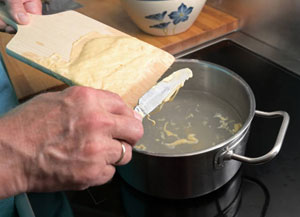
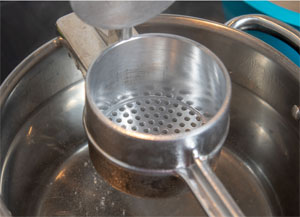
Spätzle board Spätzle press
1. The traditional method for making spätzle relies on a small wooden cutting board called a spätzlebrett (“spätzle board”). To make spätzle by hand the traditional way, dampen a small cutting board and spread spätzle dough to an even thickness on the edge of the board. Holding the board over a pot of boiling water, use a butter knife, offset spatula, or bench scraper to cut small pieces, about 1/8-1/4" widths, of dough into the hot water.
One website said a flat plate would also work. Anything that would allow you to cut pieces of dough off of it.
2. A Spätzle press (or Spaetzle maker) resembles a potato ricer. You place your dough into the press and squeeze it directly over your pot of boiling water. The dough is pushed through small holes, forming little dumplings that drop into the water and cook instantly. This is the most common method used today due to its simplicity and efficiency.
How to Make Knöpfli (following the differentiation from https://www.familymattersswitzerland.ch/knoepfli-spaetzli/):
Knöpfli is made by pushing the dough through holes in either some special kitchen tool or by using other items you may have in the kitchen with holes that are big enough. Many recipe for making Spätzle use one of the techniques below, which are actually for making Knöpfli (“little buttons”). Even the names of tools usually use the name Spätzle in them.
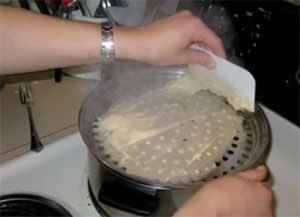
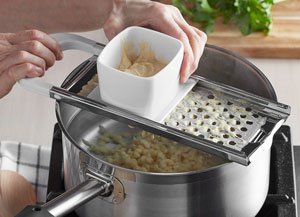
Knöpfli pan Spätzle grater
1. Kitchen Tools specially made for making Knöpfli. One is a Knöpfli pan; another is a Spätzle grater.
2. Colander or Slotted Spoon Technique: To make the shorter Knöpfli, a colander with ¼-inch-wide holes or a large slotted spoon can be used. Simply hold your chosen tool over the pot of boiling water and push the dough through the holes using a spatula or another spoon. The dough will drop into the boiling water in small pieces, similar to the methods above for spätzle. While it might not produce the most consistent shapes, it’s a fantastic makeshift solution for anyone keen to try Spaetzle without investing in a special tool.
3. Steamer Inserts Method: Some pots come with a special insert for steaming that fits into the pot have holes about the right size for making knöpfli. Hold the insert over the pot of boiling water and push the dough through the holes using a spatula or another spoon, as above.
4. Box Grater Method: Another alternative method involves using the large holes on a box grater - the kind that is flat is even easier to use than the box. This technique closely resembles the colander method, but instead of pushing the dough through, it is pulled across the grater’s coarse holes from the inside of the box. The box can rest on the pot while you push the dough through with a spatula. The dough forms short, thin strands, mimicking the look and texture of traditional Spaetzle.
5. Anything with large enough holes that you can pass dough through would work.
