Spaetzle (egg noodles)
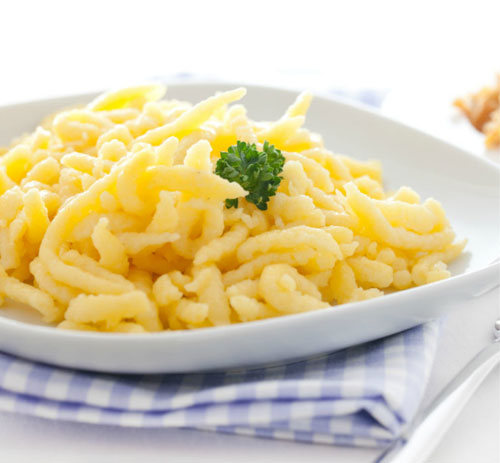
Spätzle (swabian diminutive of Spatz, thus literally "little sparrow") are a type of egg noodle or dumpling of soft texture found in the cuisine of Germany and of Austria, Switzerland, Hungary, Alsace and of Bolzano-Bozen. Spätzle are also known as Spätzli or Chnöpfli in Switzerland or Knöpfle or Hungarian nokedli.
Spätzle is a Swabian specialty. It is a special type of egg noodle that is enjoyed with sauces and gravies as well as incorporated into a variety of different dishes. One example is Käsespätzle (a cheese spatzle casserole with crispy fried onions).
Traditionally, Spätzle was made by hand using a Spätzlebrett, or Spaetzle board. You would rub a slab of dough out onto a wetted board and use a pastry cutter or long sharp knife to quickly cut off strands of the dough into simmering water. Swabian women of previous generations were highly skilled at this and could do it so fast it would make you dizzy to watch.
Knöpfle (“little buttons”) is another version of noodle that uses the same batter but are shaped into shorter pieces. Both the recipes below actually tell you how to make Knöpfli, a shorter variation of Spätzle, where you push the dough through small holes into boiling water. Spätzle is made with a Spätzle board, as described in the last paragraph, and thin pieces are cut off the end into the water. See Spätzli vs Knöpfli.
Tips:
- Mind the Dough Consistency: The key to perfect Spaetzle starts with the dough. It should be wetter and stickier than typical pasta dough, but not runny. A good rule of thumb is that it should slowly “ooze” rather than pour. If it’s too firm, your Spaetzle will turn out too dense, and if it’s too runny, it will fail to hold its shape.
- Keep Your Tools Wet: Before you begin forming your Spaetzle, wet your Spaetzle maker, board, or other tools with the boiling water. This prevents the dough from sticking and makes the process smoother. Remember to wet your tool of choice occasionally throughout the cooking process as well.
- Don’t Overcrowd Your Pot: Boil your Spaetzle in batches to prevent them from sticking together. Overcrowding the pot can also lower the water temperature too much, causing uneven cooking.
- Refresh with Cold Water: Once cooked, drain your Spaetzle and rinse them briefly under cold water. This stops the cooking process and ensures that they remain firm.
Spaetzle
If serving with sauerbraten, try adding 1 tsp. ground nutmeg to the following recipe.
Water for boiling, about 4 cups
2 cups all-purpose flour
1/2 teaspoon salt
3/4 cup milk
2 eggs, beaten
Chopped parsley
To prepare the spaetzle, bring 4 cups of the water to a boil in a large saucepan.
In a bowl, combine the flour and salt. Add beaten eggs and milk and stir just until mixed. The dough should be soft and slightly sticky, yet elastic. Add a bit more flour if the dough is too soft. [A good rule of thumb is that it should slowly “ooze” rather than pour. If it’s too firm, your Spaetzle will turn out too dense, and if it’s too runny, it will fail to hold its shape.] Let dough rest 5 - 10 minutes.
Reduce the heat to maintain a steady boil, and drop small pieces of dough into the water - use a spaetzle maker or press the dough through the slits or holes of a large-holed colander or slotted spoon with the back of a wooden spoon. (A spaetzle maker resembles a large garlic press.) Boil the noodles, which look like small dumplings, for 5 - 6 minutes, until tender, but firm. Stir occasionally to prevent sticking. Rinse the cooked noodles with very hot water.
Serve immediately, garnished with chopped parsley. Or, toss with butter, herbs, bread crumbs, or grated cheese OR add to soups or broths.
4 - 6 servings
Spaetzle
Recipe courtesy Tyler Florence
1 cup all-purpose flour
1 teaspoon salt
1/2 teaspoon ground pepper
1/2 teaspoon ground nutmeg
2 large eggs
1/4 cup milk
3 tablespoons unsalted butter
2 tablespoons minced fresh chives
In a large bowl, combine the flour, salt, pepper, and nutmeg. In another mixing bowl, whisk the eggs and milk together. Make a well in the center of the dry ingredients and pour in the egg-milk mixture. Gradually draw in the flour from the sides and combine well; the dough should be smooth and thick. [A good rule of thumb is that it should slowly “ooze” rather than pour. If it’s too firm, your Spaetzle will turn out too dense, and if it’s too runny, it will fail to hold its shape.] Let the dough rest for 10 to 15 minutes.
Bring 3 quarts of salted water to a boil in a large pot, then reduce to a simmer. To form the spaetzle, hold a large holed colander or slotted spoon over the simmering water and push the dough through the holes with a spatula or spoon. Do this in batches so you don't overcrowd the pot. Cook for 3 to 4 minutes or until the spaetzle floats to the surface, stirring gently to prevent sticking. Dump the spaetzle into a colander [or remove with a slotted spoon if you have more to make] and give it a quick rinse with cool water.
Melt the butter in a large skillet over medium heat and add the spaetzle; tossing to coat. Cook the spaetzle for 1 to 2 minutes to give the noodles some color, and then sprinkle with the chopped chives and season with salt and pepper before serving.
Yield: 6 servings
Both Knöpfli and Spätzle typically accompany meat dishes prepared with an abundant sauce or gravy, such as German Meatballs w/ Spaetzle, Sauerbraten or Rouladen. In Hungary spätzle is often served with Hungarian Goulash or used in soup. Knöpfli or Spätzle are used as a primary ingredient in many dishes including:
Savory:
- The classic German noodles recipe calls for sautéeing boiled spätzle in melted butter until golden, then garnishing with fresh herbs such as parsley, dill, or chives. Peas, caramelized onions or shallots, cheese, breadcrumbs, and bacon are all typical additions.
- This one is great for using as a side to meats and stews or for using up leftover Spätzle or Knöpfli. Add a dollop of butter and the Knöpfli to a frying pan and fry, without a lid, until the Knöpfli are light brown and a little crunchy on the outside.
- Zwiebelrostbraten: a typical Austrian entrée made from a standing rib roast cut, which is called “Rostbraten” in German. The beef is cut as a escalope and flash-fried in a pan; then served with a buttery onion and beef broth gravy.
- With meat or mushrooms and brown sauce: Knöpfli go really well with any meat and sauce. Voressen (Swiss beef or veal stew with brown sauce) or any other meat stew, or Zurich Geschnetzeltes (diced veal with brown sauce), or the autumn classic – game with brown sauce and red cabbage with caramelised chestnuts. If you want to do it vegetarian, a creamy brown sauce with mushrooms and a little parsley works well too.
- In Hungary, spätzle is served as a side dish to accompany national favorites such as goulash and chicken paprikash.
- Spätzle is perfect for soaking up the liquids of a braise, such as braised short ribs.
- Linsen, Spätzle und Saitenwürstle (frankfurters): with lentils and fine-skinned, frankfurter-style sausages.
- Käsespätzle: Spätzle mixed with grated cheese (typically Emmenthaler) and crispy fried onion. (Sauté thinly sliced onion in 2 tablespoons of butter until browned. Set aside.) Add butter, the cooked Spätzle and a good quantity of grated cheese (Appenzeller or Gruyere cheese works very well, or cheddar if you like) to a frying pan. Add the cheese a bit at a time and stir in. Add a dash of milk, cover with a lid and cook for 5 minutes until cheese is melted. Top with crispy fried onions.
- Gaisburger Marsch: Traditional Swabian beef stew.
- Krautspätzle: Spätzle mixed with Sauerkraut, onion, butter and herbs and spices such as marjoram and/or caraway.
- Knöpfli pan (Knöpflipfanne): There are hundreds of recipes for this. The general idea is that you cook your Spätzle or Knöpfli in a pan together with other ingredients. An example: in a frying pan, fry some chopped onions and chopped bacon, add the Knöpfli and any steamed vegetables, cover with a lid and cook for 2 minutes, then add some cream, grated cheese, chopped herbs and salt and pepper and mix until cheese is melted.
- Leberspätzle (Liver Spätzle): Heartier than plain spätzle, these go well with roasted onions, scrambled eggs, or Sauerkraut. However, traditionally they are served in a clear beef or chicken broth.
- Coloured Knöpfli or Spätzle: For a bit of a twist, add vegetables to your Knöpfli or Spätzle dough. Blended spinach makes them green, carrot purée makes orange-coloured ones, beetroot makes them red, and adding fresh herbs gives them a further twist. The ingredients for coloured Knöpfli or Spätzle are often a little different from the basic recipe, so do some research before preparing them.
Sweet:
- Kirschspätzle: Spätzle mixed with fresh cherries, dressed with butter, sugar and cinnamon and/or nutmeg. In Allgäu, this is served as a one-dish supper in late summer.
- Apfelspätzle: Spätzle with grated apples in the dough, dressed with butter, sugar, and cinnamon. In Allgäu, this is served as a one-dish supper in autumn.
