Mu Shu Pork
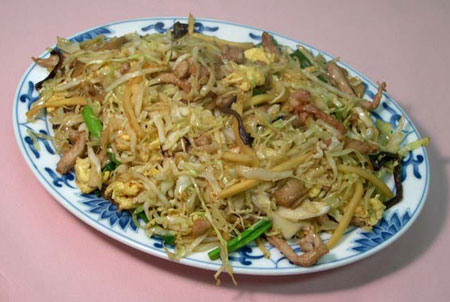 This famous dish is from northern China, possibly originally from Shandong, where rice is seldom used; instead, flour-based noodles, steamed buns, and pancakes are served. The thin pancakes, called Mandarin pancakes, are the same as those featured in Peking Duck. Indeed, Mu Shu Pork is known in China as the poor man's Peking Duck, in part because very little meat is required, and in part because while the duck takes at least a day to make, the pork filling for Mu Shu is ready in minutes. It is believed to have first appeared on the menus of Chinese restaurants in the United States in the late 1960s.
Mu Shu Pork, normally served with mandarin pancakes, is supposed to represent a colorful forest, with the pancakes forming the ground or base. In its traditional Chinese version, Mu Shu Pork consists of sliced or shredded pork chop meat and scrambled eggs, stir-fried in sesame and/or peanut oil together with thinly sliced wood ear mushrooms (black fungus) and day lily buds. Thinly sliced bamboo shoots may also be used. The dish is seasoned with minced ginger and garlic, scallions, soy sauce, and rice cooking wine (usually huangjiu).
In the United States in the 1960s, wood ears and day lily buds were scarce, and a modified recipe was developed. In this modified recipe, which gradually came to predominate in North America, green cabbage is usually the predominant ingredient, along with scrambled eggs, carrots, day lily buds, wood ear mushrooms, scallions, and bean sprouts. Shiitake mushrooms, bok choy, snow pea pods, bell peppers, onions, and celery are sometimes also used, and dry sherry is often substituted for the huangjiu.
Mu Shu Pork
c.1998, M.S. Milliken & S. Feniger, all rights reserved
FMM Note: We used leftover Red Cooked Pork to make Mu Shu Pork once and thought that the star anise used in it was a bit too strong for this dish.
2 tablespoons soy sauce
1 tablespoon dry sherry
1 teaspoon hoisin sauce
1/2 pound cooked boneless lean pork, shredded [many recipes use uncooked boneless pork chops cut into thin strips]
4 dried black mushrooms (wood ears)
2 cups finely shredded Napa cabbage
1 carrot, julienned
3 scallions, white and light green parts, slivered
1 cup bean sprouts
3 tablespoons peanut oil
2 eggs, lightly beaten with 1/2 teaspoon salt
3 cloves garlic, minced
3 teaspoons freshly grated ginger
3 tablespoons chicken stock
2 tablespoons soy sauce
1 tablespoon dry sherry
2 teaspoons sesame oil
1 teaspoon sugar
Hoisin sauce, for serving
Mandarin Pancakes, for serving
Combine soy sauce, sherry and hoisin sauce in a bowl. Add the pork, toss to coat evenly, cover, refrigerate and marinate for 30 minutes. Meanwhile, soak the mushrooms in enough hot water to cover for 20 minutes. Drain and thinly slice. Set aside on a plate, along with the cabbage, carrot and scallions.
Heat a wok or large skillet over medium/high heat. Add 1 tablespoon of the peanut oil and swirl to coat. Pour in the eggs, swirling and tilting the wok to form a thin film. Cook just until the eggs are set and feel dry on top, about 1 minute. Transfer to a platter, let cool slightly and cut into 1 inch strips.
Return the wok to high heat, and swirl in the remaining 2 tablespoons oil. Add the garlic, and ginger, and stir-fry to release the aromas, about 1 minute. Add the pork and stirfry until lightly browned, about 2 minutes. Add the reserved mushrooms, cabbage, carrot, bean sprouts, and scallions, along with the chicken stock, and stir-fry another 2 minutes. Stir in soy sauce, sherry, sesame oil, and sugar, and cook, stirring until sauce boils, about 1 minute. Add egg strips and mix well.
To serve, spread a small amount of hoisin sauce on a warm Mandarin Pancake. Spoon about 1/2 cup Mu Shu mixture in center of pancake, wrap like a burrito, folding the ends to close. Serve with a side salad of orange segments drizzled with rice vinegar.
4 - 6 servings
