Types of Chinese Dumplings & Buns
Dumplings are a famous traditional northern Chinese food consisting of a semi-circular or half-moon pasta shape with different fillings inside. Dumplings are given different names because of their various fillings. There are different ways to cook dumplings, such as fried dumplings or steamed dumplings. China has been perfecting the art of dumpling making since the Sung dynasty (960 - 1279 A.D.).
Eating dumplings during New Year's Eve is the traditional habit for most Chinese. Eating dumplings on the occasion of New Year's represents making wishes and the expression of praying for good luck in a unique way. Eating dumplings in the Spring Festival brings good luck.
Chinese dumplings may be round or crescent-shaped, boiled, steamed or pan-fried. The filling may be sweet or savory; vegetarian or filled with meat and vegetables. Of course, all this variety can be confusing.
In general, there are two broad categories of Chinese dumplings: gao, or crescent shaped dumplings (see jiazi below); and bao, or round, purse-shaped dumplings (see Siu Mai below). Within these categories there are nearly endless variations, depending on the type of wrapper (wheat and rice are the most common), what type of filling is used, and whether the dumpling is boiled, steamed or fried.
Also see Types of Asian Wrappers
Here is a description of different types of Chinese dumplings:
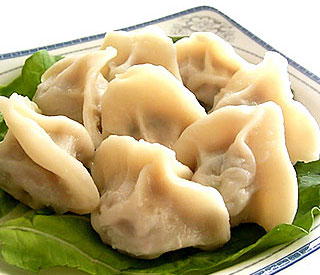
Jiaozi
Jiaozi (pronounced "jow-zee") are perhaps the most common type of Chinese dumpling. Crescent-shaped and formed with an opaque wrapper made from wheat dough, jiaozi are usually filled with ground pork, cabbage, and scallions, and served with a dipping sauce made of soy sauce, vinegar, and sesame oil.
Jiaozi should not be confused with wonton: jiaozi have a thicker, chewier skin and a flatter, more oblate, double-saucer like shape (similar in shape to ravioli), and are usually eaten with a soy-vinegar dipping sauce (and/or hot chili sauce); while wontons have thinner skin, are sphere-shaped, and are usually served in broth, as in Wonton Soup. The dough for the jiaozi and wonton wrapper also consist of different ingredients. The dumplings are usually boiled, although they may also be pan-fried. See Potstickers below.
In northern China, it is customary for families to spend New Year’s Eve preparing batches of Jiaozi dumplings. Families start eating the dumplings after midnight. And, just as nineteenth-century English cooks hid a silver thruppence inside each batch of Christmas pudding, one lucky family member may discover a gold coin inside their dumpling.
Chinese dumplings (jiaozi) may be divided into various types depending on how they are cooked:
Boiled dumplings; (shuijiao) literally "water dumplings" (水餃; pinyin: shuǐjiǎo).
Steamed dumplings; (zhengjiao) literally "steam-dumpling" (蒸餃; pinyin: zhēngjiǎo).
Shallow fried dumplings (guotie) literally "pan stick", known as "potstickers" in N. America, (鍋貼; pinyin: guōtiē), also referred to as "dry-fried dumplings" (煎餃; pinyin: jiānjiǎo).
Sichuan Boiled Dumplings w/ Spicy Dipping Sauce
Dipping Sauces:
Dumpling Dipping Sauce
Dim Sum Dipper
Ginger Dipping Sauce
Cranberry-Teriyaki Glaze
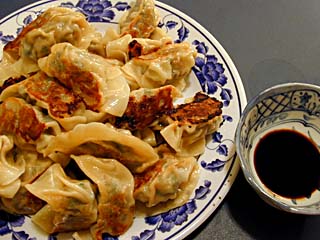
Potstickers (Guotie, Peking Ravioli)
The difference between jiaozi and potstickers comes down to how the dumpling is cooked. Potsticker dumplings are basically jiaozi that are pan-fried on the bottom after steaming. For potstickers, you want to make (or buy) wrappers that are slightly thicker. These dumplings need to withstand the heat of pan frying and hot steam, so thicker wrappers are better suited for the task. It’s traditional to flip them over before serving so that the browned, pan-fried side is on top.
They are a Northern Chinese style dumpling popular as a street food, appetizer, or side order in Chinese. This dish is sometimes served on a dim sum menu, but may be offered independently. The filling for this dish usually contains pork (sometimes chicken, or beef in Muslim areas), cabbage (or Chinese cabbage and sometimes spinach), scallions (spring or green onions), ginger, Chinese rice wine or cooking wine, and sesame seed oil.
Guotie are shallow-fried in a wok (Mandarin 'guo'). A small quantity of water is often added and the wok is covered. While the base of the dumplings is fried, the upper part is steamed and this gives a texture contrast typical of Chinese cuisine. An alternative method is to steam in a wok and then fry to crispness on one side in a shallow frying pan.
Exactly the same dumpling is boiled in plenty of water to make jiaozi (see above) and both are eaten with a dipping sauce. Three or five folds are made on one side of the round wrapper that is rolled so that the edges are thinner than the middle. This gives the base a large surface area that helps to give the dumpling stability to stand up in the pan.
Gyoza is the Japanese version of potstickers using Japanese ingredients, except they follow a more consistent shape (long and thin) and has a much thinner outer skin. The boiled version of gyoza is called sui-gyoza. They are usually made from pre-fabricated wrappers that are thinner, smaller, and more delicate, and the filling is more finely textured.
The Chinese method of preparing the dough is to pour boiling water onto the flour and letting stand for five minutes and then adding a small quantity of cold water. This helps to activate the gluten in the dough.
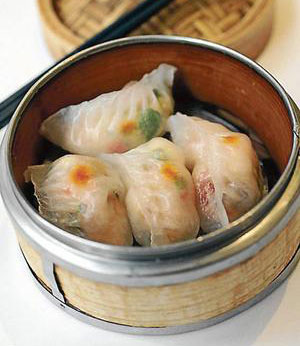
Gow Gee
The words Gow gee and jiaozi mean one and the same: Gow gee is simply the Cantonese romanization (representation) of the Mandarin jiaozi. However, gow gee recipes normally call for the dumplings to be cooked by steaming or deep-frying instead of boiling.
Cantonese style Chinese dumplings (gaau) are standard fare in dim sum. The immediate noted difference to jiaozi is that they are smaller and wrapped in a thinner translucent skin, and usually steamed. The smaller size and the thinner pastry make the dumplings easier to cook through with steaming. The most common type are shrimp dumplings (har gow) - see below. Other fillings include scallop, chicken, tofu, mixed vegetables, and others. Wonton wrappers are an acceptable substitute for dumpling skins in most gow gee recipes.
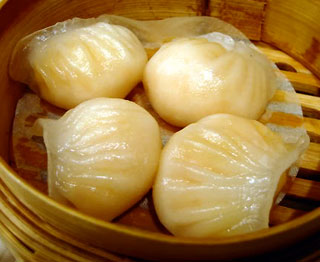
Har Gow (Har Gau)
Har Gow (pronounced "ha-gow"). These plump snacks filled with shrimp (har = shrimp) and bamboo shoots are famous for a smooth, shiny skin that is nearly translucent, and is sometimes called a shrimp bonnet for its pleated shape. Traditionally, har gow should have at least seven and preferably ten or more pleats imprinted on its wrapper.
The wrappers are made with boiling water, to which wheat starch, tapioca starch, oil and a small amount of salt are added. Thanks to the use of tapioca starch in the mix, the dough is stretched incredibly thin, allowing the skin to be almost translucent. The filling contains shrimp, cooked pork fat, bamboo shoots, scallions, cornstarch, sesame oil, soy sauce, sugar, and other seasonings. The pouch-shaped dumpling is then steamed in a bamboo basket until translucent; at the table it is usually dipped in soy sauce, or red color rice vinegar. When the dough for the wrapper is properly prepared and cooked, the dumpling has a slightly sticky, chewy texture. The shrimp are not overcooked, so they retain a slightly crisp texture. Ingredients vary regionally, but most versions contain sesame oil, salt, sugar. Other versions may contain oyster sauce, water chestnuts, or ginger.
This dish is said to be the one that the skill of a dim sum chef is judged on. The most challenging part of har gow is handling the dough, which is very sticky and can break apart easily. The skin must be thin and translucent, yet be sturdy enough not to break when picked up with chopsticks. It must not stick to the paper, container or the other har gow in the basket. The shrimp must be cooked well, but not overcooked. The amount of meat should be generous, yet not so much that it cannot be eaten in one bite. When steamed, the pork fat liquefies, giving a dumpling a firm (the shrimp should be cooked through without being tough or rubbery), yet juicy bite.
The secret to the dough is wheat and tapioca starch, available in Asian markets – you won’t get the same result using a flour and water dough or wonton wrappers. This dish is often served together with sieu mai (see sui mai below); when served in such a manner the two items are collectively referred to as hargow-sieu mai.
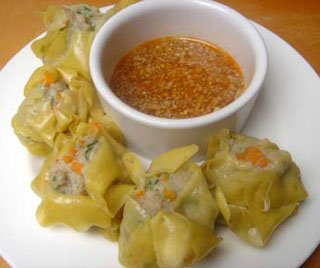
Siu Mai (pronounced “Shu My,” also called Cook and Sell Dumplings)
Siu Mai (pronounced "shoo-my"), also called Pork Dumplings, is a traditional Chinese dumpling served in dim sum. They are mild tasting steamed dumplings recognizable by their cup or basket shape, with the filling sticking out at the top. One food writer compared eating Siu Mai to biting into a soufflé, because the dumpling is so soft and puffy.
There are many regional varieties of shumai in China, such as the Huhhot version, the Cantonese version and the version from the Jiangnan region, along with many other variations in other countries. As prepared in Cantonese cuisine, siumai is also referred to as "pork and mushroom dumpling." Its standard filling is a combination of ingredients, consisting primarily of seasoned ground pork, whole and chopped shrimp, and Chinese black mushroom in small bits.
The outer covering is made of a thin sheet of lye water dough, an alkaline solution that gives the pastry a yellow colour and springy texture. The center is usually garnished with an orange dot, made of roe or diced carrot, although a green dot made with a pea may be used. The decorative presentations vary.
Siu Mai are normally made with round skins. Ready-to-use shumai wrappers are available in general Asian/Chinese stores. If they come in frozen form, simply defrost in fridge overnight before using. Ready-to-use, square wonton wrappers can be a substitute. Simply trim four corners to get a round shape.
Steamed Chinese Dumplings (Shu Mai)
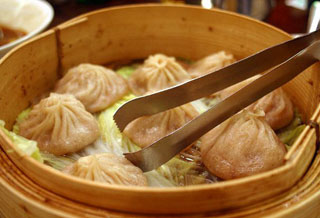
Shanghai Steamed Buns (Xiao long bao)
The famous ‘soup dumplings’ of Shanghai. Not buns at all, but meat or seafood-filled dumplings famous for being very juicy and flavorful. Xiao long bao, literally "little basket bun" , is a type of bao zi (filled bun or bread-like item) from Shanghai, China. They are a round, purse-shaped dumpling made of a relatively thick (thicker and doughier than jiaozi, for instance) wheat wrapper, which is crimped on the top.
Xiao long bao are traditionally steamed in bamboo baskets, hence the name. It can be filled with hot soup and meat and/or vegetarian fillings, as well as other possibilities. The fillings are wrapped in something like a jiaozi wrapper that turns almost translucent after being steamed. Shanghai Steamed buns are recognizable for their unique design, as the filled wrapper is gather up into several folds prior to steaming.
They can be eaten at any meal in Chinese culture, and are often served in restaurants that have dim sum service. The xiao long bao is also popular when eating jiaozi or with Shanghai La mian.
To eat these, peel the dumpling off the lettuce or cabbage leaf taking care not to break the dumpling skin and deposit it into a Chinese soup spoon, which is usually provided, adding the vinegar provided as desired. Some places may also have shredded ginger. Take a small bite of the skin, allowing some of the broth to drain, and drink a bit of it. Then eat the rest of the dumpling from the spoon. Doing so will allow you to savor the taste without scalding the tongue. The soup inside is created by placing some meat gelatin inside the dumpling before steaming. The steam heat melts the gelatin into soup.
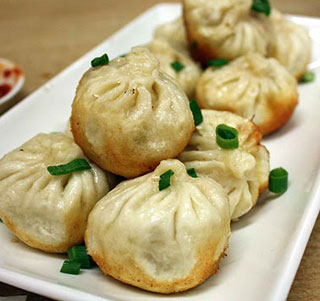
Sheng Jian Bao
Sheng jian mantou (also known as the sheng jian bao outside Shanghai) are a type of small, pan-fried baozi which is a specialty of Shanghai. It is usually filled with pork and gelatin that melts into soup/liquid when cooked. Shengjian mantou has been one of the most common breakfast items in Shanghai for the last century. As a ubiquitous breakfast item, it has a significant place in Shanghainese culture.
Xiao long bao are made by first making a hearty pork stock with pig’s feet. The pig’s feet provide ample amounts of gelatin, so when the pork stock cools, it turns naturally into jelly. Cubes of the pork stock jelly are mixed with pork and often crab meat and/or roe, and wrapped into a rounded, bun shape with a row of pleats. When the dumpling steams, the jelly melts, creating soup within the dumpling.
Shengjian is made from semi-leavened dough, wrapped around pork and gelatin fillings. The "knot" of the bun, where the dough is folded together, faces downwards when cooling to prevent the crispy bottom from getting soggy. Chopped green onions and sesame are sprinkled on the buns during the cooking process.
The name of the bun comes from its method of cooking. The buns are lined up in an oiled, shallow, flat pan. Typical commercial pans are more than a metre in diameter. Water is sprayed on the buns during cooking to ensure the top (which is not in contact with the pan or the oil) is properly cooked. After frying, the bottom of the bun becomes crunchy, and the gelatin melts into soup. This combination gives the shengjian its unique flavour. Because the buns are tightly lined up in the pan, they become somewhat cube-shaped after cooking.
The traditional shengjian has pork fillings. Common variations include chicken, pork mixed with prawns, and pork mixed with crab meat.
Shengjian is traditionally sold in lots of four. It is usually eaten at breakfast, and can be accompanied by a small bowl of clear soup. The buns themselves can be dipped in Chinkiang vinegar (black rice vinegar) and ginger. Because of the method of cooking, especially the relatively hard bottom, the buns are quite durable, and are therefore easily portable. They are often packed in paper bags for take-away consumption. Some shops or restaurants sell the item throughout the day as a dianxin or snack. It is rarely found as a dish in a main meal.
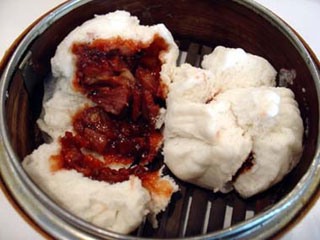
Steamed Char Siu Bao (Chinese Barbecue Pork Buns)
Bao zi is the general category for dumplings made with a thick, wheat dough resembling a bun. One common version of bao zi are the barbecued pork-filled buns known as char siu bao.
Char Siu Bao, also known as Cantonese barbecue pork buns (baozi), are fluffy, white buns that are commonly served at Chinese restaurants during dim sum during yum cha and are sometimes sold in Chinese bakeries. At their best, Char Siu Bao are soft as a pillow and filled with a savory mixture of minced Chinese barbecue pork (char siu), soy sauce, oyster sauce, scallions and sugar. Cha siu refers to the pork filling; the word bao simply means "bun."
There are two major kinds of char siu bao: steamed (蒸 zing1) and baked (焗 guk6). Steamed cha siu bao has a white exterior, while its baked counterpart is browned and glazed (see below).
Although visually similar to other types of steamed baozi, the dough of steamed cha siu bao is unique since it makes use of both yeast and baking powder as leavening. This unique mix of leavening gives the dough of cha siu bao the texture of a slightly dense, but fine soft bread. Encased in the center of the bun (bao), there is tender, sweet, slow-roasted pork tenderloin called char siu. The char siu is diced, and then mixed into a syrupy mixture of oyster sauce, hoisin sauce, roasted sesame seed oil, rice vinegar, shaoxing wine or dry sherry, soy sauce, sugar and cornstarch.
Recipe for Pork Buns (Char Siu Bao)
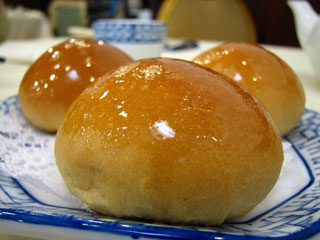
Baked Char Siu Bao (Chinese Barbecue Pork Buns)
Steamed cha siu bao has a white exterior (see above), while its baked counterpart is browned and glazed. The dough for baked cha siu baau is different from the steamed version. Cha siu refers to the pork filling; the word bao means "bun".
Baked Pork Buns (Baked Char Siu Bao) - uses yeast in the bun dough
Wontons
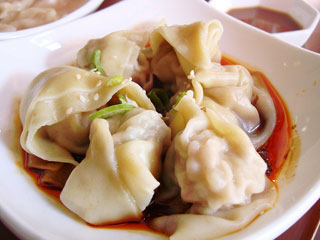
Wontons (Cantonese) or huntuns (Mandarin) are another generic category of Chinese dumplings, which can be prepared in all kinds of ways depending on their filling and whether they're prepared by boiling, steaming or frying. Wontons are typically filled with minced pork and shrimp and wrapped in thinner, silkier square skins made from wheat flour, egg, and water (similar to Italian ravioli, but somewhat thinner). They are boiled and served in clear broth (for instance, as in Won Ton Soup), with or without noodles, or fried and served with a dipping sauce.
There are several common shapes, including triangular and globular. Different regions have their own versions. For example, Chengdu, capital of Sichuan province, is famous for Chengdu huntuns, boiled then tossed in a hot and spicy sauce with mouth-numbing Sichuan peppercorns. See recipe below
Wontons are more popular in Southern China (Shanghai, Guangdong, Hong Kong etc.), whereas in Northern China, jiaozi are more popular. Since the Tang Dynasty (618–907), it has been a custom for people to eat wontons on the winter solstice.
Wonton Wrappers
Won Ton Soup (pork filled wontons in chicken broth w/ scallions & julienned pork)
Wor Wonton Soup
Crab Rangoon (deep-fried wontons filled w/crab, cream cheese, & green onions)
Sichuan-Style Wontons in Hot and Sour Vinegar and Chili Oil
