Beignets
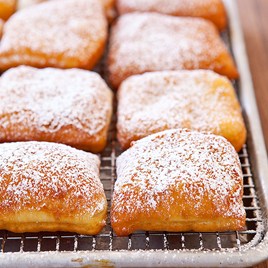
A beignet, "pronounced" ben–YAY, from the Middle French word for "bump", in American English, refers to a pastry made from deep-fried dough and sprinkled with confectioner's sugar, effectively a sort of French doughnut. Beignets are often found in, and typically associated with, the city of New Orleans, Louisiana. Versions of beignets are also popular as an appetizer, with fillings such as crawfish or shrimp. One of New Orleans' star tourist attractions is Cafe du Monde, a 24-hour French Quarter cafe that serves only two items: chicory-infused coffee and beignets. The beignets are square shaped, have no hole, and come three to an order under a signature pile of powdered sugar.
Two varieties of beignets:
- The term "beignet" can be applied to two varieties, depending on the type of pastry. The French doughnut is simply a deep-fried choux pastry; this variety is very similar to Italian zeppole and Germany's spritzkuchen. This is the style of beignets that were introduced to New Orleans by French immigrants in the 1700s.
- Beignets can be made with yeast pastry as well however - such "yeast donuts" might be called "boules de Berlin" in French, referring to Berliner doughnuts which have a ball shape filled with fruit or jam. This variety is similar to the Polish pączki. Louisiana-style beignets are made from leavened dough rather than choux pastry, and are generally square or rectangular shaped. In New Orleans, they are often consumed as a breakfast item served with powdered sugar on top.
In France, "beignet" is an umbrella term for a large variety of pastries made from deep-fried dough with fruit or vegetable filling. They may contain other fillings, as well: potatoes, mushrooms, or even meat. The tradition of deep-frying fruits for a side dish dates to the time of Ancient Rome. Names for beignet recipes can differ throughout France - "beignets", "bugnes", "merveilles", "oreillettes", "beignets de carnaval", "bottereaux", "tourtisseaux", "corvechets", "ganses", "nouets", "vautes" and more. The western parts of Germany took over the name beignet mainly for beignet variants with a fruit filling while referring to other variants as Krapfen (another name for Berliners).
Beignets
From Cook's Country February/March 2013
To replicate the airy, crisp texture and tangy yeast flavor of these classic New Orleans doughnuts, we began by using plenty of yeast and prodding it with warm water and sugar to start developing flavor right off the bat. A super-hydrated dough means lots of steam, which creates an open, honeycombed structure as soon as the beignets hit the hot oil. Since wet dough is tricky to roll out, we let it rise in the refrigerator to firm it up. After a few minutes of frying and a shower of powdered sugar, our beignets were ready to be enjoyed, Big Easy–style.
This dough is very wet and sticky, so flour the counter and baking sheet generously. You’ll need a Dutch oven with a capacity of at least 6 quarts.
1 cup water, heated to 110 degrees
3 tablespoons granulated sugar
1 tablespoon instant or rapid-rise yeast
3 cups (15 ounces) all-purpose flour
3/4 teaspoon salt
2 large eggs
2 tablespoons plus 2 quarts vegetable oil
Confectioners' sugar
1. Combine water, 1 tablespoon granulated sugar, and yeast in large bowl and let sit until foamy, about 5 minutes. Combine flour, remaining 2 tablespoons granulated sugar, and salt in second bowl. Whisk eggs and 2 tablespoons oil into yeast mixture. Add flour mixture and stir vigorously with rubber spatula until dough comes together. Cover bowl with plastic wrap and refrigerate until nearly doubled in size, about 1 hour.
2. Set wire rack inside rimmed baking sheet. Line second sheet with parchment paper and dust heavily with flour. Place half of dough on well-floured counter and pat into rough rectangle with floured hands, flipping to coat with flour. Roll dough into ¼-inch-thick rectangle (roughly 12 by 9 inches). Using pizza wheel, cut dough into twelve 3-inch squares and transfer to floured sheet. Repeat with remaining dough.
3. Add enough of remaining 2 quarts oil to large Dutch oven to measure about 1½ inches deep and heat over medium-high heat to 350 degrees. Place 6 beignets in oil and fry until golden brown, about 3 minutes, flipping halfway through frying. Adjust burner, if necessary, to maintain oil temperature between 325 and 350 degrees. Using slotted spoon or spider, transfer beignets to prepared wire rack. Return oil to 350 degrees and repeat with remaining beignets. Dust beignets with confectioners’ sugar. Serve immediately.
Our dough is very wet, a quality that allows a network of delicate holes to develop in the beignets. However, wet dough can be tricky to work with. Here's how to easily shape and cut the beignets.
STOP STICKING: Dust the counter and rolling pin heavily with flour before you roll out the chilled beignet dough.
CUT INTO SQUARES: Traditionally, beignets are measured by the size of the cook's hands: four fingers by four fingers. We cut 3-inch squares with a pizza wheel.
Makes about 2 dozen beignets
