Cassoulet
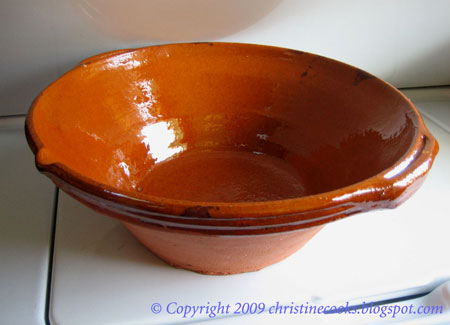
Earthenware pot known as a Cassole
Cassoulet (pronounced cass-ooh-lay) is a classic French dish from the Languedoc region of southwestern France which is traditionally cooked in an earthenware pot known as a cassole (hence the name). In essence cassoulet is a slowly cooked casserole of beans and meats. It is classic hearty peasant food which matches the earthy wines of the region perfectly.
It is the perfect union of meat and bean, and as humble as bread. When cassoulet, a slow-cooked French country stew of plump beans, broth and succulent meats, is right, it can be one of the most memorable, most satisfying dishes in the world.
Traditional cassoulet is very time-consuming to prepare, for the ingredients are legion and traditionally prepared over days and weeks by hand: they include duck confit (duck preserved in its own fat); pork rinds fried in the fat from the confit; fresh handmade lamb or pork sausage; homemade broth; and dried beans which are soaked overnight, drained, blanched and drained again, and then cooked in the broth; all combined and baked slowly in the cassole.
Amanda Hesser, wrote in the New York Times, "I tasted my favorite cassoulet at Gertrude's, just before the restaurant closed. Laurent Manrique, the chef, made a deeply flavored, robust stew. The beans -- a variety called Tarbais, from southwest France -- were plump and seething, the duck confit had slackened and was falling off the bone. You could eat it with a spoon. There were fat pork sausages and hearty slabs of garlic saucisson, and the only aromatics were whole roasted garlic and a little thyme. Best of all was the lump of salty, tender gizzard."
There are 3 (primary) schools of thought on cassoulet, based on geography. These are from the cities of Toulouse, Castelnaudry and Carcassone. These people are serious about it, like Americans argue about chili recipes. All are made with white beans (haricots blancs/navy pea beans or lingots/cannellini beans), duck or goose confit, sausages, and additional meat. In the cassoulet of Toulouse, the meats are pork and mutton, the latter frequently a cold roast shoulder. The Carcassonne version is similar but doubles the portion of mutton and sometimes replaces the duck with partridge. The cassoulet of Castelnaudary uses a duck confit instead of mutton. Andre Daguin, a famous chef of Gascony says, "Cassoulet is not really a recipe, it's a way to argue among neighboring villages of Gascony."
Which Sausage is Traditional
Saucisse de Toulouse (Toulouse Sausage) is a variety of fresh sausage originating from Toulouse in the southwest of France. It is made from pork (75% lean, 25% belly), has a natural casing of about 3 cm in diameter and is usually sold in a coil like Cumberland sausage. It is flavored with onion, white wine, salt, pepper, and spices (nutmeg, coriander, caraway, allspice) and has a natural pork casing.
Most recipes suggest using a garlic sausage such as kielbasa, unsmoked, if you cannot find Toulouse sausage.
What Beans to Use
FMM: Brian and I made cassoulet, including making our own duck confit and were not impressed. The beans were mushy. We used navy beans and I cooked them for hours and hours trying to get them tender and full of flavor from the stock per the recipe I was using. It was a mistake. Be careful not to overcook the beans. I have added some notes from Internet board discussions on which beans to use. None of the posters were impressed with cassoulet made with navy pea beans. So I was not the only one having problems with navy pea beans.
Jeanne Strang explains in Goose Fat and Garlic: "The essence of a good cassoulet is that the beans, while not falling apart, should be tender and should have absorbed the aromas and savours of the other ingredients." Elisabeth Luard, the author of European Peasant Cookery, points me towards haricots de soissons for optimum soft creaminess, but these big white beans prove elusive, so I have to make do with ordinary dried haricot (similar to navy pea ban), and the cannellini suggested as a substitute by Caroline Conran in her award-winning book, Sud de France.
The bean many recipes recommend is dried Tarbais, which come from a small village in the south of France named Tarbais, and were developed by generations of farmers in this village. The beans are quite costly, though. Here are some of the opinions I found:
The orginal Tarbais seed is a New World runner bean (Phaseolus coccineus), like Scarlet Runner or Runner Cannellini, and most likely orginated in Mexico. Regular cannellini may make a nice dish but they're very different. If you want something more traditional, go with a runner cannellini or an ayocote blanco.
Elisabeth Luard, the author of European Peasant Cookery, points me towards haricots de soissons for optimum soft creaminess, but these big white beans prove elusive, so I have to make do with ordinary dried haricot, and the cannellini suggested as a substitute by Caroline Conran in her award-winning book, Sud de France.
Any decent bean that holds its shape during the long cooking process works fine, thus lingots in France (cannellini), Great Northern's in the states will work fine. Some grandmothers recipes recommend Pamiers beans, or lingots de Vendée, or even lingots de Soissons. So no flageolets (which are green and a bit too flimsy), no pea beans, and in some cases that leaves out even the Tarbais since these tend to be too tender when they're young, they seem to need a little ageing.
Before haricot beans were known in Europe, cassoulet was made with broad beans (fava). It is certainly one of the oldest peasant dishes in France, dating back to long before foods from the New World were brought here. Haricots were adopted into cassoulet probably because they taste better, but fava bean cassoulet did not completely disappear during later centuries.
"Bean cooking technique, ah, bean cooking...well, we've learned a lot. We tested three kinds of beans, Navy, Great Northern and Cannellini, some soaked for 24 hours, and some soaked 12 hours. Then we cooked them over low heat in low sodium chicken broth for 2 hours.
For flavor and texture, the navy beans were right out. Watery and bland, they also were still too crunchy, even after 24 hours of soaking and 2 hours of cooking.
The Great Northerns fared better, especially the ones soaked for 24 hours, although there was something slightly grainy about their texture.
For full flavor and creaminess, the clear winner was cannellinis, soaked 24 hours, and cooked 2 hours. So if we can't have the Tarbais or flageolets, then we'll keep the cannellinis as a worthy backup plan."
Inexpensive (comparatively) Tarbais Beans
"We grew Tarbais beans here in California with a lot of success. We hope to offer them next year, if we can build our seed stock up enough. They are a runner bean (Phaeseolus coccineus), like Scarlet Runner or Runner Cannellini. Regular cannellini may make a nice dish but they're very different. If you want something more traditional, I'd go with a runner cannellini or an ayocote blanco."
- from Rancho Gordo
Even though Rancho Gordo obtained their original seed from France, they sell their beans as "Cassoulet Beans" so as not to infringe on the name "Tarbais" from France.
