Famous French Chefs
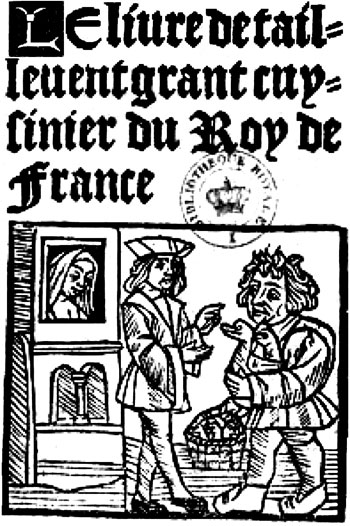
Le Viandier de Taillevant, from a 15th-century edition.
TAILLEVENT (born ca. 1310 in Pont-Audemer – 1395)
Guillaume Tirel was cook to the Court of France at the time of the first Valois kings and the Hundred Years War. In his career, Guillaume would simply go the by name of Taillevent (Old French: "slicewind," which means in French a light sail or a jib used for tacking on a sail boat.) The name was in reference to his very large, pronounced, aquiline nose.
His first position was enfent de cuisine (kitchen boy) to Queen Jeanne d'Évreux. From 1326 he was queux (chef) to Philip VI. During the reign of Philip VI, Taillevent was a major influence in the rise of imperial favor for the strong red wines being produced in the south of France as well as those coming out of Burgundy. In 1347, he became squire to the Dauphin de Viennois and his queux in 1349. In 1355 he became squire to the Duke of Normandy, in 1359 his queux and in 1361 his sergeant-at-arms. The Duke of Normandy became Charles V in 1368 and Tirel continued in his service. Taillevent was promoted to chief cook (“premier queux”). From 1381 he was in service to Charles VI and was promoted to Premier Ecuyer (“first squire”) of all the royal kitchens, a position he retained until 1392, when he was approximately 80 years of age. He died in 1395 at around 85 years of age. His career spanned sixty-six years, and upon his death he was buried in grand style between his two wives. His tombstone represents him in armor, holding a shield with three cooking pots, marmites, on it.
Le Viandier (often called Le Viandier de Taillevent is a recipe collection generally credited to Guillaume Tirel (alias Taillevent). While “viande” means “meat” in French today, back then it meant “provisions.” Suggested dates for the book include 1375, 1380 and 1381. However, the earliest version of the work was written around 1300, about 10 years before Tirel's birth. The original author is unknown, but it was common for medieval recipe collections to be plagiarized, complemented with additional material and presented as the work of later authors. This earlier copy with the core material in it, might mean that Taillevent himself simply enlarged on a previous work, just as others after him kept on adding to it. Le Viandier de Taillevent was commissioned by Charles V and was influential on subsequent books on French cuisine and important to food historians as a detailed source on the medieval cuisine of northern France.
There are four extant manuscripts of Le Viandier. The oldest, found in the Archives cantonales du Valais (Sion, Switzerland), was written in the late 13th or very early 14th century, and was largely overlooked until the 1950s. It is this manuscript that calls into question the authorship of Tirel, but a portion of it is missing at the beginning, so the title and author given for this earlier work are unknown. A manuscript from the 14th century housed in the Bibliothèque nationale de France (Paris), was formerly thought to be the oldest. The version in the Biblioteca Vaticana (Vatican City), is from the early 15th century. The fourth extant version is in the Bibliothèque Mazarine (Paris) and also dates to the 15th century. There are variations from manuscript to manuscript, both in their original form and in what has been preserved or lost over the centuries. Many copies circulated, copied out by hand at first; the first printed edition was probably in 1490. The later the version is, the more that has been added to it by the people who copied it out.
Le Viandier is one of the earliest and best-known recipe collections of the Middle Ages, along with the Latin-language Liber de Coquina (early 14th century, believed to contain recipes from France and Italy) and the English The Forme of Cury (c. 1390). Le Viandier was one of the first "haute cuisine" cookbooks, offering a framework for its preparation and presentation at table. Being a master cook to Charles V gave him extensive experience in serving French nobility. Among other things, it contains the first detailed description of an entremet.
The entremet was meant to appeal to all the senses, and to showcase expensive and unusual ingredients. The purpose of the entremet was to provide entertainment as well as food, and to set off the boundaries between courses at a formal banquet. An entremet could be anything from a simple frumenty (a type of wheat porridge) that was brightly colored and flavored with exotic and expensive spices to elaborate models of castles complete with wine fountains, musicians, and food modeled into allegorical scenes. In Le Viandier, Taillevent describes a dish of boiled and fried chicken liver with chopped giblet with ground ginger, cinnamon, cloves, wine, verjuice, beef bouillon and egg yolks served with cinnamon on top, and was supposed to be of a bright yellow color.
In any event, the cookbook mostly records what royalty would eat. It is medieval cooking. It records heavy, heavily-spiced dishes, spicy sauces, soups, and stews, verjuice, and the use of roasted breadcrumbs as a thickening agent instead of flour, which came later. Roasting and boiling are the most common cooking methods. There is great attention paid, as would have been necessary, to Church feast and fasting days, when religion completely dictated what should be eaten.
Today, many restaurants named "Taillevent" capitalize on the reputation of Guillaume Tirel."
ANONYMOUS - Le Menagier De Paris (1393)
In the closing years of the fourteenth century, an anonymous French writer compiled a book addressed to a fifteen-year-old bride, narrated in the voice of her husband, a wealthy, aging Parisian. The book, long recognized for its unique insights into the domestic life of the bourgeoisie during the later Middle Ages, was designed to teach this young wife the moral attributes, duties, and conduct befitting a woman of her station in society, in the almost certain event of her widowhood and subsequent remarriage. The work also provides a rich assembly of practical materials for the wife's use and for her household, including treatises on gardening and shopping, tips on choosing servants, directions on the medical care of horses and the training of hawks, plus menus for elaborate feasts, and more than 380 recipes. Often abbreviated as Le Menagier (The Good Wife's Guide or The Goodman of Paris) is important for its language and for its combination of prose and poetry.
The book was made available in English translation in its entirety only in 2009, published by Cornell UP; until that publication, the most complete translation in English was Eileen Power's 1928 The Goodman of Paris. Since earlier translations and editions have focused mainly on the recipes, the book is often incorrectly referred to as a medieval cookbook or an "advice and household hints book," and mined for the history of medieval cuisine.
The book's central theme is wifely obedience and contains three main sections: how to attain the love of God and husband; how to "increase the prosperity of the household"; and how to amuse, socialize, and make conversation. Like many medieval texts, the argument relies heavily on exempla and authoritative texts to make its point; included are selections from and references to such tales and characters as Griselda and the tale of Melibee (known in English from Chaucer's "The Clerk's Prologue and Tale" and "The Tale of Melibee"), Lucretia, and Susanna.
The second section of the book, article five, contains the cookbook. Le Menagier lincludes a variety of different types of recipes; soups, preparations for meats, eggs, fish, sauces, beverages, pastry, tarts, and so on. Despite the popular conception of medieval food being, merely, "meat on a stick," Le Menagier shows us a staggering variety of foods available to the medieval eater. The cookbook section contains over 350 recipes, and if many of them are taken from authorities such as the royal chef Taillevent, the author is quite opinionated about what works and what doesn't; he improves some recipes and offers others that seem to be his own.
FRANÇOIS PIERRE LA VERENNE (1615 – 1678)
The seventeenth-century French chef Pierre François de la Varenne, the first cookbook writer to achieve an international reputation, introduced the tradition of classic French cuisine. For members of the French upper class during the reign of Louis XIV, dining in a lavish, luxurious style was integral to the display of wealth and privilege. La Varenne was the most renowned and imitated chef of the period. With information and expertise they obtained from the market stalls and vendors of Paris’s Les Halles, men such as La Varenne and Nicolás de Bonnefons, the king’s valet de chambre and the author of Les Delices de la Campagne (The Delights of the Countryside, 1654), codified kitchen techniques that have been preserved and passed on by subsequent generations of culinary innovators.
François Pierre de la Varenne (1615 – Dijon 1678), Burgundian by birth, was the author of Le cuisinier françois (1651), the founding text of modern French cuisine. La Varenne broke with the Italian traditions that had revolutionized medieval French cookery in the 16th century. La Varenne was the foremost member of a group of French chefs, writing for a professional audience, who codified French cuisine for the age of Louis XIV. The others were Nicholas de Bonnefons, Le jardinier François (1651) and Les Délices de la Campagne (1654) and François Massialot, Le Cuisinier royal et bourgois, (1691), which was still being edited and modernized in the mid-18th century.
The seventeenth century saw a culinary revolution which transported French gastromomy into the modern era. The heavily spiced flavours inherited from the cuisine of the Middle Ages were abandoned in favour of the natural flavours of foods. Exotic spices (saffron, cinnamon, cumin, ginger, nutmeg, cardamom, nigella, seeds of paradise) were, with the exception of pepper, replaced by local herbs (parsley, thyme, bayleaf, chervil, sage, tarragon). New vegetables like cauliflower, asparagus, peas, cucumber and artichoke were introduced. He used New World foods such as Jerusalem Artichokes (which he referred to as “Topinambours”), and gave the first recipes in print for that other New World food, turkey (“dindons”). Special care was given to the cooking of meat in order to conserve maximum flavour. Vegetables had to be fresh and tender. Fish, with the improvement of transportation, had to be impeccably fresh. Preparation had to respect the gustatory and visual integrity of the ingredients instead of masking them as had been the practice previously.
La Varenne's work was the first to set down in writing the considerable culinary innovations achieved in France in the seventeenth century, while codifying food preparation in a systematic manner, according to rules and principals. He introduced the first bisque and Béchamel sauce. He replaced crumbled bread with roux as the base for sauces, and lard with butter. Here one finds the first usage of the terms bouquet garni, fonds de cuisine (stocks) and reductions, and the use of egg-whites for clarification. It also contains the earliest recipe in print for mille-feuille. The cooking of vegetables is addressed, an unusual departure. In a fragrant sauce for asparagus there is evidence of an early form of hollandaise sauce:
"make a sauce with good fresh butter, a little vinegar, salt, and nutmeg, and an egg yolk to bind the sauce; take care that it doesn't curdle..."
In Le Cuisinier François, Varenne listed recipes in alphabetical order, as opposed to by meal or course, though he did group together recipes for fish, eggs, meat-free times of the year, etc. He provided no measurements. The book is written in a surprisingly charming, warm fashion, with lots of tips about what to do if a fish is too large, or if you have to delay serving a dish, etc.
He gave several recipes for food wrapped in greased paper and baked in ashes. Wrapping food up in something and baking it in the ashes of a fire or hearth was traditionally a method just used by the poor, who might not have many if any cooking vessels, and some recipes from the time of hearth cooking call for the cook to avoid getting the food smoky. Varenne, however, seems to call for the cooking method both to slowly concentrate the flavours (as opposed, say to boiling, which would leach flavours out), and to impart a smoky flavour that he seemed to want in some dishes.
La Varenne preceded his book with a text on confitures—jams, jellies and preserves— that included recipes for syrups, compotes and a great variety of fruit drinks, as well as a section on salads (1650).
La Varenne was well known for creating recipes that relieved the dreariness of the meatless meals authorized by the church for Fridays, holy days, and some Wednesdays. He devised popular dishes such as artichokes with hollandaise sauce. He also published Le Pâtissier Français (The French Pastry Chef, 1653), the first comprehensive guide to pastry making, which provided additional meatless egg recipes and introduced waffles, petits fours, darioles (cream tarts), and puff pastry to the French kitchen. He followed this successful publications with Le Confiturier Français (The French Confectioner, 1664) and compiled L’École des Ragoûts (The School of Stews, 1725), published posthumously.
La Varenne followed his groundbreaking work with a third book, Le Pâtissier françois (Paris 1653), which is generally credited with being the first comprehensive French work on pastry-making. In 1662 appeared the first of the combined editions that presented all three works together. All the early editions of La Varenne's works—Le Cuisinier françois ran through some thirty editions in seventy-five years—are extremely rare; like children's books, they too were worn to pieces, in the kitchen, and simply used up.
Pirated editions of Le Cuisinier françois were printed in Amsterdam (1653) and The Hague (1654-56). Soon there were imitators: Le cuisinier françois méthodique was published anonymously in Paris, 1660. The English translation, The French Cook (London 1653) was the first French cookbook translated into English. It introduced professional terms like à la mode, au bleu (very rare), and au naturel which are now standard culinary expressions. Its success can be gauged from the fact that over 250,000 copies were printed in about 250 editions and it remained in print until 1815
La Varenne was the first food writer to unify tone and style and the first to speak of his opinions and experience in first person. He pioneered systematizing recipes in cookbooks and added to French cuisine foodstuffs from the New World. A departure from the inexact food writing of the Middle Ages, his Le Cuisinier Français (The French Cook), also called Le Vrai Cuisinier (The True Cook, 1651) was the first compendium to spell out rules and principles of cooking. The book contained the first French recipe for roux, the fat and flour mix used to thicken sauces. La Varenne flavored his roux with onions and stored it in an earthenware pot.
It is said that La Varenne's first training was in the kitchens of Marie de Medici. At the time his books were published, La Varenne had ten years' experience as chef de cuisine to Nicolas Chalon du Blé, Marquis of Uxelles (marquis d'Uxelles in French), to whom he dedicated his publications and whom he immortalized in duxelles, finely-minced mushrooms seasoned with herbs and shallots, which is still a favourite flavouring for fish and vegetables. The Marquis of Uxelles was the royal governor of Chalon-sur-Saône, thought by some to be the birthplace of La Varenne.
Although La Varenne influenced French cooks to abandon over-spicing and parboiling of meats and to return to the fresh herbs of their kitchen gardens, he profited little from a dual career as chef and food writer and died in poverty. Over time, his classic works remained in circulation, influencing subsequent generations of cooks, including Elena Burman Molokhovets, author of the classic Russian cookbook, A Gift to Young Housewives (1861), which included her adaptation of his potage de pigeons aux pois verts (pigeon stew with green peas). In particular, he inspired the English chef Anne Willan, a London Cordon Bleu graduate and author of La Varenne’s Paris Kitchen (1981) and My Château Kitchen (2000). In 1975, she founded L’Ecole de La Varenne (La Varenne Cooking School) in Paris. His legacy lives on in his continuing influence on chefs and in his printed works.
His Legacy
Varenne is said to represent the starting point of French cooking. He codified and defined the point in time where a medieval style of cooking, which had been more or less universal amongst the aristocracy throughout Europe, was replaced in France by a new, uniquely French way of cooking. Varenne rode this trend away from the past and made it a decisive break.
Varenne didn’t do this in isolation. There already was a direction happening around him. Sweet was being separated from savoury. Exotic spices from far-off lands such as cardamon, nutmeg and cinnamon were being taken out of savoury main courses and relegated to sweets. They were replaced with local herbs such as bay, chervil, parsley, sage, tarragon and thyme.
He did not claim to have originated the new cooking styles. He wrote that he found the secret of preparing foods delicately. He did not claim to have invented this style of cooking, although he gained lasting fame by becoming the first to describe it in detail.
He was part of a generation of cooks making a clean break away from the medieval view that food was medicine, and that ingredients in a dish therefore were to be selected based on their effect on the body (the Greek four humours theory of health that lasted until the end of the Middle Ages).
FRITZ KARL VATEL (1635-1671)
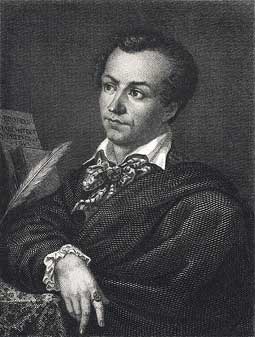 CARÊME, MARIE ANTOINE (1784 - 1833)
Marie Antoine Carême was born into a working class family in Paris in 1784, just before the French revolution (1789–1799). This shows in his work, as it reflects the freedom of thought and action that flooded France during the years that followed. When he died in 1833, he was recognized as the greatest chef of his time, and his name was familiar to the rich and famous throughout Europe.
Today he is considered the founder and architect of French haute cuisine. He was the first to distinguish this rich, meat-heavy, decorative, more labor-intensive cuisine from regional French home cooking, and the first to catalogue and organize it so it could be easily understood by future generations. From a relative disarray of recipes and techniques, he extrapolated four essential sauces, known as "mother sauces," which formed the basis of and garnish for hundreds of dishes. Over a century later Auguste Escoffier would update and revise this system, but Carême gave Escoffier something to build upon.
Culinary Career
Carême’s achievements are even more amazing considering his early childhood and teenage years. Carême was totally self-educated and the son of a hard drinking labourer. At the age of 10 Marie-Antoine (or Antonin as he called himself) was turned out onto the harsh streets of Paris with the apparant words: "Go my child, and fare well in the world. Leave us to languish; poverty and misery are our lot and we will die as we have lived. But for those like you, with quick wits, there are great fortunes to be made". With these words Carême left his family behind.
He was taken in by the owner of a small tavern on the edge of Paris called the Fricassée de Lapin, where he engaged to serve a six-year apprenticeship. He started as a dishwasher and gopher, or runner. In those days, taverns were hubs for city life and often operated as inns for travelers passing through town. They always served alcohol, and occasionally served food as well. Carême’s abilities were noticed by one of the greatest pattiseurs of the day; Bailly, because of this Carême began working for him at the age of 17. Carême had nothing but praise for Bailly, who allowed him to study in the Cabinet des Gravures, where he taught himself to draw and read.
In Carêmes time, the pâtissieur was as prestigious as that of the cuisinier himself (head chef). Pastry cooks were responsible for the great decorative centrepieces or pièces montées' and the crowning glory of grand dinners. Carême excelled at these flights of fancy. In his spare moments, he read cookbooks and studied classical architecture at the Bibliothèque Royale and applied neoclassical structural design to his famous pièces montées (mounted presentations). Using spun sugar, dough, and wax, he constructed elegant temples, ruins, crenellated castles, and belvederes and set them on elaborate china pediments to grace Napoleon’s table. For the natural glue needed for pastillage (sugar paste decorations), he chose tragacanth, or gum dragon, a natural gum that exudes from a shrub of the genus Astragalus. In his first two books, Le Pâtissier Royal and Le Pâtissier Pittoresque, he produces hundred of designs for rustic pavilions, ruins, cascades, temples, forts, windmills and other ornate creations. Carême insisted that his fine art was confectionary. With such miniature fantasies, their components surrealistically coloured and shaped to look anything but themselves, made a mockery of nature. Nonetheless they appealed to Carêmes patrons.
With his two-year training with Bailly completed, members of France's ruling class began to notice the young apprentice's work and contracted him for special-occasion pieces outside the pastry shop. Charles Maurice de Talleyrand-Périgord (Talleyrand) kept one of the best tables in Paris, for an hour each morning he conferred on the menu of the day. Carême had been engaged as Pâtissier, but was determined to learn from Boucher; Talleyrand’s chef, the art of the Cuisinier, the savory side of the kitchen. After working with Boucher for twelve years, Carême had outclassed his mentor. This was done partly by working on the shadow of many of the top chef’s of the day, as one of the extras called in to help on special occasions.
To better establish himself, Carême left Talleyrand's household on 1815 and crossed the channel to work for the Prince Regent of Wales, who later became King George IV. Carême was depressed by the climate and the attitude of his fellow cooks, who resented the attention paid to their foreign Pâtissier. Two years of England were enough for Carême and in 1818 he returned to Paris where even more offers awaited him. Carême joined the staff of Czar Alexander, but Russia proved to be no more to Carêmes taste than England. Carême returned to France and in 1820 went to work for the British ambassador. After returning to Paris in 1823, Carême accepted a position from baron James de Rothschild, the founder of the Paris branch of the banking family. He stayed with the financier from 1824 through 1829.
The last few years of his life, Carême spent in semiretirement as the proprietor of a patisserie and tending to his literary legacy, with the assistance of his wife and daughter.
Changing Times
Carême’s career seems to have been guided by conflicting needs. He needed the independence to do what he wanted, but also the means to execute large projects; a highly cultivated audience, but an undemanding one; work to be able to develop his talent and present its products, but leisure to be able to leave a record of them in his books.
That Carême did not fit well into any social niche had as much to do with his society as it did with him as an individual. French society in the Age of Revolution was a fluid society in which the old aristocratic structure was dissolving and the new bourgeois structure was only beginning to crystallize. From the beginning of haute cuisine to the eve of the French Revolution, from the 1650s to the 1780s, the leading chefs were for the most part domestic servants working in the kitchens of aristocrats and financiers, and many of the latter, such as Grimod’s grandfather and James Rothschild, were eventually ennobled. From the 1880s to the present, the leading chefs have generally been proprietors of their own restaurants or patisseries, that is, entrepreneurs. In the intervening century, chefs found themselves in diverse and unstable situations.
During Carême's time the dilemma was this: as entrepreneurs, chefs had the independent status of artists but the means only to be craftsmen; as employees of the aristocracy, chefs had the means to be artists but the status only of servants. Carême made his choice, consistently arguing that the true home of haute cuisine was private households rather than business establishments, but the tension remained. On the one hand, he objected to the idea that chefs such as Beauvilliers (Antoine Beauvilliers, 1754-1817) and Baleine, the proprietors of two of Paris’s most highly regarded restaurants, had been responsible for the renaissance of the art of cooking. On the other hand, he apostrophized the nobility on behalf of their chefs “not to confound us with the servant class!” Rather than a servant, the chef was an independent artist: “The master chef has only himself to answer to in his work.”
Cookbooks
Carême's colleagues, and the public at large, first discovered his talents with the publication of Le Pâtissier royal parisien in 1815. It was only the third French treatise devoted entirely to French pastry, following Le Pâtissier françois (1653) by François Pierre de la Varenne and La Pâtisserie de santé (1790). Carême's approach to pastry was innovative in more than one way. Not only did he perfect and diversify the uses of now classic preparations, such as génoise and biscuit (sponge cakes) or cream puff pastry, but appears to be the first to give recipes for fromage bavarois (pastry cream lightened with whipped cream and stiffened with gelatin) and its elegant derivative, the Charlotte russe.
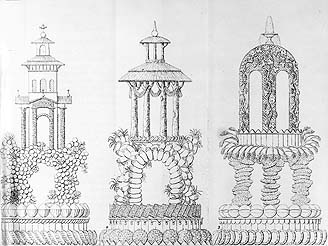 |
Three designs by Carême for pièces montées ("assembled pieces" or "mounted pieces") |
In addition to presenting a far greater number of preparations than his predecessors, Le Pâtissier royal parisien was also one of the first to include a profusion of engraved plates throughout. Until then, French cookbooks contained very few illustrations, and when they did, they were almost exclusively devoted to table settings, some of which, nevertheless, included instructions for building very elaborate centerpieces for dessert tables. Carême's engravings, on the other hand, were for finished dishes. To the modern eye, they look less like pictures of food than elaborate architectural constructions: temples, helmets, waterfalls, all made of cooked sugar, almond paste, nougatine, and so on, to serve not only as centerpieces, but also as presentation pedestals for his elaborate pâtés and desserts. For Carême, the way food was served was as important as the way it tasted. He criticizes the way his predecessors seasoned and served "mountains of food," and he even attacks the size and shape of the china they employed.
La Maitre d'Hotel Francaise was published in 1822. A second edition came out in 1842. La Maitre d'Hotel Francaise is a fascinating and unusual cookery book. It describes the hundreds of menus he created and cooked in the capitals of Europe including many of his trademark lavish Buffets. The work is a testament to his monumental talent and shows a career that really took off when he left Talleyrand's service in 1815 to go and work in Brighton for the Prince Regent, and after, for Tsar Alexander followed by a time in Paris as Chef to the British Ambassador. Careme was among other things a self-taught artist and all the plates in these volumes are from his designs. In this Carême describes the hundreds of menus, which he created and cooked in the capitals of Europe. Carême was the cold buffet's most brilliant exponent. It also contains a long essay contrasting “old cuisine” with “modern cuisine.” As in his earlier Histoire de la table romaine, Carême criticizes “old cuisine,” but in this case his target is the French nouvelle cuisine of the middle of the eighteenth century.
Le Cuisinier parisien was his initial attempt at a comprehensive cookbook. He was working on a greatly expanded version of it, called L’Art de la cuisine française au XIXe siècle (The Art of French Cooking in the Nineteenth Century), when he died in 1833: Its first two volumes appeared later that same year; the third two years later; the fourth and fifth, completed by one of his students, Pluméry, a decade later.
In his great work on cookery, and last, L'art de la cuisine française au XIXe siècle (1847), Carême carries his love of extravagant decoration to new heights for savory dishes, as well, standing cutlets and poultry on end and presenting them in a circle, turban style, or sticking whole fish and roasts with a wide array of decorative skewers garnished with truffles, crayfish, and mushrooms. More important, he entirely revamps the art of cookery itself, arguing, among other things, for a cuisine based on "velvety" sauces, rather than the thin, watery sauces favored in the past and for developing a series of basic preparations (brown and white sauces, court-bouillons, force-meats, etc.) that would become the building blocks of classic French cuisine upon which entire families of preparations could be constructed by combining them or changing the main ingredient or a flavoring.
L’Art de la Cuisine Français au dix-neavième siècle was an exhaustive survey of classic French cooking, perfected by Carême and followed with little change until the end of the century. In this book he develops several hundred versions of today’s potages and institutes the custom of garnishing meat with meat and fish with fish. Dispensing with the sweetbreads and cockscombs, which had survived from the fifteenth century. The basic sauces – Espagnole, béchamel and velouté – would be familiar to today’s chefs, as would Carême’s 100 and more variations.
Despite all of his modernism, Carême preferred the monumental service à la française—in which all the dishes of a given course were placed on the table at once—to the newly-introduced service à la russe, in which they were kept hot in the kitchen, then served sequentially from platters passed by waiters. "Certainly this method of serving is conducive to good eating," he wrote, "but our service à la française is more elegant and lavish." His influence on French cuisine was enormous, and succeeding generations of chefs continued in the paths he had traced. It was not until 1903, when Auguste Escoffier published his Guide Culinaire, that Carême's authority was finally challenged, but his name is revered to this day as a great master whose contributions irrevocably shaped the course of French cuisine.
Culinary Contribution
In the early 19th century, when Carême's books were being published, chefs learned by apprenticeship, mimicking techniques they saw others develop. It was a process of watching, learning, and repeating. Recipes existed, but were not organized (formal culinary schools would not appear in France until late in the century). There was no comprehensive effort to categorize what was then a very quickly evolving cuisine, specific to high society and France's ruling class, which involved hundreds of new techniques, expensive ingredients, and teams of chefs to execute. Rich in butter and cream, luxurious, decorative, and extremely fussy, this cooking style is called grand cuisine francaise or haute cuisine, and it continues to influence cooking across the globe. Were it not for Carême, however, it may never have been documented as precisely or as extensively.
Driven by art rather than greed, Carême devised aspics, galantines, borders of greenery, and fruit baskets and invented mille-feuille, a flaky pastry; sultanes, a large pastry set on sugar lattice and topped with sugar plums; and croquembouche, a crunchy casing for sweets. From orange rinds, he made decorated baskets with handles for holding orange gelatin. From Monsieur Eugène, chef to Prince Schwartzenberg, the Austrian ambassador, he learned to make kugelhopf (or kougloff), a lofty risen pastry that Queen Marie Antoinette admired. He defended roux, the butter-flour mixture used as a base and thickener for gravies and sauces.
"His most lasting change is that he systematized cuisine," Ferguson says. "He starts his last book with how you make bouillon, and then that bouillon is a basis for several different kinds of soup; separately, it is a basis for his sauces. Then, like Legos, you start with one recipe and build upon it, and build upon that." Eventually you have a complete dish, a full banquet, a massive slew of foods of all temperatures, textures, and utilizing a range of techniques. "It's that rationalization," Ferguson says, "that set him apart from his contemporaries." Carême similarly systemized dress as a way to professionalize the culinary arts: Just as doctors and lawyers were expected to dress in a certain way, Carême felt that chefs should wear uniforms. He donned a double-breasted jacket as a uniform, and popularized a version of the chef's toque.
Carême is probably best known for came up with the methodology in the early 19th Century by which hundreds of sauces would be categorized under four basic sauces, these were:
"Allemande" based on stock with egg yolk & lemon juice
"Béchamel" based on flour and milk
"Espagnole" is based on brown stock, beef etc.
"Velouté" based on a light broth, fish, chicken or veal.
It would take another century and another chef — Escoffier — before the systemization of French haute cuisine would be complete, and before Carême's work on the savory side of the kitchen would be appreciated by future generations. Master Chef Auguste Escoffier updated the classification, replacing sauce Allemande with the egg-based emulsions (Hollandaise and mayonnaise), and adding tomato.
Quails: Petits Croustades de Cailles (Small Bread Croustades with Quails)
From Cooking for Kings: The Life of Antonin Carême, the First Celebrity Chef by Ian Kelly (Walker, 2003), Adapted by StarChefsYield: 6 Servings
- 1 loaf stale French bread
- 6 ounces clarified butter
- 6 quails, boned
- ½ pound forcemeat
- 12 slices unsmoked bacon
Sauce espagnol:
- 2 ounces butter
- 1 ounce flour
- 1 pint dark meat stock Bouquet garni
- 1 ounce tomato puree
For quails:
Take a stale French loaf and cut it into two-inch slices. Cut a hole in the middle of about two inches diameter. The same number of slices as quails. Fry these croustades in clarified butter and drain on a napkin.Lay them on a baking tray and place first a spoonful of good forcemeat and then a boned quail, chest upwards, into each.
Lay bacon over them and cover with parchment paper. Let them bake in a moderate oven for an hour and a half. Let them drain on a napkin, after which pour over them a good sauce Espagnol.
Instead of quails you may use larks or other small game. A claw may be retained to garnish each. Quails may be similarly baked all together in a croustade made from a large fluted loaf from which the crumbs have been removed.
For sauce espagnol:
Melt the butter, stir in the flour and cook gently on a low heat until well browned. Add the stock and stir until it thickens. Add the bouquet garni and simmer half an hour. By this time the sauce will have reduced. Remove the bouquet garni, add the tomato puree and simmer another five minutes. Makes one pint. (Carême - and this recipe – were instrumental in bringing the tomato into the culinary mainstream).
The recipes of Careme are endless. Reproduced here are two of the more simple ones that you may wish to enjoy:
Autumn Soup
White part of 3 medium leeks, cut in julienne strips
Leaves of 2 celery hearts, cut in julienne strips
½ head of romaine lettuce, cut in julienne strips
3 ¼ pints / 2 quarts / 2 litres well flavoured consommé
5 oz / 1 cup/150 g fresh green peas
Pinch of sugar
Pinch of white pepper
Salt (optional)FOR THE LIAISON:
1 ½ oz / ½ cup/45 g flour
6 fl oz / ¾ cup /175 ml cold consomméFOR THE CROUTONS:
6 slices bread, crusts discarded, diced
2 oz / ¼ cup / 60 g butter
3 - 4 tbsp oil
- Wash and drain the leek, celery, and lettuce strips. Bring the consommé to a boil
- For the liaison, mix the flour with the 6 fl oz/ ¾ cup / 175 ml cold consommé and blend until smooth. Add to the boiling consommé, stirring constantly, and simmer until the consommé is thickened and smooth, 2 to 3 minutes. Add the leek, celery and lettuce strips with the peas, sugar and pepper and simmer, uncovered, until the vegetables are tender, 15 to 20 minutes. Taste the soup for seasoning, adding more salt and pepper if necessary.
- For the croutons: heat the butter and oil and fry the diced bread, stirring, until browned on all sides. Drain the croutons thoroughly on paper towels and keep warm. If serving in a tureen, put in the croutons and pour over the soup; if serving in individual bowls, serve the croutons separately.
Butter Sauce A L’Italienne
½ bay leaf
Sprig of thyme, or ½ tsp dried thyme
1 whole clove
2-½ tbsp butter
2 tbsp chopped parsley
3 mushrooms, finely chopped
1 truffle, finely chopped (optional)
½ clove garlic, crushed
Pinch of grated nutmeg
Salt and pepper
4 fl oz / ½ cup / 125 ml champagne
Double quantity of butter sauce
2 tbsp olive oil
Juice of ½ - 1 lemon
- Tie the bay leaf, thyme and clove with thread or wrap them in a piece of cheesecloth. In a heavy based pan melt 1 tablespoon of the butter and add the parsley, truffle (if using), garlic, tied herbs, nutmeg, and a little salt and pepper. Sauté over medium heat until the mushrooms are soft 1-2 minutes. Add the champagne, simmer 5 minutes, and discard the tied herbs.
- Make the sauce in the top of a double boiler or in a saucepan placed in a water bath. Stir in the champagne and mushroom mixture, then gradually stir in the oil. When the sauce is smooth, add the remaining butter in small pieces and stir until incorporated. Add lemon juice to taste with more salt and pepper if needed.
Note: This sauce separates easily and should be made over hot, not boiling, water. The sauce should be served tepid.
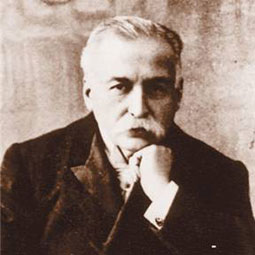 GEORGES AUGUSTE ESCOFFIER (1846 - 1935)
Georges Auguste Escoffier (28 October 1846 – 12 February 1935) was a French chef, restaurateur and culinary writer who popularized and updated traditional French cooking methods. He is a legendary figure among chefs and gourmets, and was one of the most important leaders in the development of modern French cuisine. Much of Escoffier's technique was based on that of Antoine Carême, one of the codifiers of French haute cuisine, but Escoffier's achievement was to simplify and modernize Carême's elaborate and ornate style. Referred to by the French press as "Emperor of the world kitchens", Escoffier was France's pre-eminent chef in the early part of the 20th century.
Alongside the recipes he recorded and invented, another of Escoffier's contributions to cooking was to elevate it to the status of a respected profession by introducing organized discipline to his kitchens. He organized his kitchens by the brigade de cuisine system, with each section run by a chef de partie.
Returned to civilian cooking, in 1882, Escoffier worked on the Riviera as manager of the Swiss hotelier César Ritz’s chain and became head chef at the Grand National Hotel at Lucerne. He was known for his watchword, “Faites simple!” (Do it simply). (Walker 1996, 25) To streamline food preparation, he stressed the basics. To simplify ordering in restaurants, he developed the à la carte menu. To tame the chaos of restaurant kitchens, he organized the brigade de cuisine (cooking team), an assembly-line system that prevails in restaurant and institutional kitchens, and supported the Russian method of table service.
Escoffier was a promoter of spit roasting over oven roasting as a means of preserving natural juices. He invented the fumet, a liquid flavoring whisked from natural pan juices and arrowroot, and the profiterole, a succulent ice-cream-filled puff pastry topped with chocolate sauce. He gave explicit instruction on how to whip a bavaroise (tea with sugared syrup) and serve it in special crystal beverage glasses. In 1890, he opened London’s Savoy Hotel, where he prepared the coronation dinner for George V; eight years later he took up a similar post at the Carlton Hotel.
In addition to managing kitchens at the Grand Hotel in Monte Carlo and overseeing the kitchen of the Hamburg-America Line, Escoffier co-authored the classic Le Guide Culinaire (The Cookery Guide; 1903), which clarified changes to French cuisine. The work stresses what Escoffier considered the basics, beginning on page one with this advice: “In cooking, stock is everything, without it nothing can be done. If the stock is good, what remains of the work is easy. If it is bad, it is quite hopeless to expect anything even approaching satisfactory results.” (Bensky 2000)
The text demonstrates Escoffier’s willingness to incorporate New World foods into his repertoire, for example with his recipe for pommes de terre Pont-Neuf, fried potatoes he described as crispy potato “batons,” and his directions for steaming unhusked corn, peeling off the husk, and serving it on a napkin with butter. Le Guide Culinaire in 1903, which is still used as a major reference work, both in the form of a cookbook and a textbook on cooking. Escoffier's recipes, techniques and approaches to kitchen management remain highly influential today, and have been adopted by chefs and restaurants not only in France, but also throughout the world.
He followed with Le Carnet d’Epicure (A Gourmet’s Notebook; 1911), Le Livre des Menus (Book of Menus; 1924), and Ma Cuisine (My Kitchen; 1934), a handbook for the home cook. Retired at age seventy-four with his wife, Delphine Daffis, he received the French Legion of Honor and advanced in honorary rank to an officer in 1928. He also earned respect among his peers for aiding poor, disabled, or substance-addicted chefs, for boosting military morale, and for publishing a book on poverty.
Escoffier died on February 12, 1935 in Monte Carlo, at the age of 88 in Monte Carlo, a few days after the death of his wife. He contributed celebrated dishes to food history: sauce Robert, sauce diable, pear Hélène, dodine au Chambertin, strawberries Romanov, and chaud-froid Jeannette, a commemoration of an arctic shipwreck. In 1894, he named Melba toast and peach Melba (ice cream and peaches soaked in vanilla and topped with puréed raspberries) for the Australian opera singer Nellie Melba, who was a guest at the Savoy Hotel during his tenure.
Ritz Hotels
In 1897, Ritz and Escoffier were both dismissed from the Savoy Hotel. Ritz and Echenard were implicated in the disappearance of over £3400 of wine and spirits, and Escoffier had been receiving gifts from the Savoy's suppliers. By this time, however, Ritz and his colleagues were already on the point of commercial independence, having established the Ritz Hotel Development Company, for which Escoffier set up the kitchens and recruited the chefs, first at the Paris Ritz (1898), and then at the new Carlton Hotel in London (1899), which soon drew much of the high society clientèle away from the Savoy. In addition to the haute cuisine offered at luncheon and dinner, tea at the Ritz became a fashionable institution in Paris, and later in London, though it caused Escoffier real distress: "How can one eat jam, cakes and pastries, and enjoy a dinner – the king of meals – an hour or two later? How can one appreciate the food, the cooking or the wines?"
In 1913, Escoffier met Kaiser Wilhelm II on board the SS Imperator, one of the largest ocean liners of the Hamburg-Amerika Line. The culinary experience on board the Imperator was overseen by Ritz-Carlton, and the restaurant itself was a reproduction of Escoffier's Carlton Restaurant in London. Escoffier was charged with supervising the kitchens on board the Imperator during the Kaiser's visit to France. One hundred and forty-six German dignitaries were served a large multi-course luncheon, followed that evening by a monumental dinner that included the Kaiser's favourite strawberry pudding, named fraises Imperator by Escoffier for the occasion. The Kaiser was so impressed that he insisted on meeting Escoffier after breakfast the next day, where, as legend has it, he told Escoffier, "I am the Emperor of Germany, but you are the Emperor of Chefs." This was quoted frequently in the press, further establishing Escoffier's reputation as France's pre-eminent chef.
Ritz gradually moved into retirement after opening The Ritz Hotel in 1906, leaving Escoffier as the figurehead of the Carlton until his own retirement in 1920. He continued to run the kitchens through World War I, in which his younger son was killed in active service. Recalling these years, The Times said, "Colour meant so much to Escoffier, and a memory arises of a feast at the Carlton for which the table decorations were white and pink roses, with silvery leaves – the background for a dinner all white and pink, Borscht striking the deepest note, Filets de poulet à la Paprika coming next, and the Agneau de lait forming the high note."
FERNAND POINT (1897 - 1955)
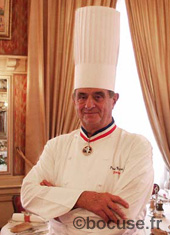 PAUL BOCUSE (1926 -
Paul Bocuse (born 11 February 1926 in Collonges-au-Mont-d'Or, Rhône) is a French chef based in Lyon who is famous for the high quality of his restaurants and his innovative approaches to cuisine. He is one of the most prominent chefs associated with the nouvelle cuisine, which is less opulent and calorific than the traditional cuisine classique, and stresses the importance of fresh ingredients of the highest quality. Paul Bocuse claimed that Henri Gault first used the term, nouvelle cuisine, to describe food prepared by Bocuse and other top chefs for the maiden flight of the Concorde airliner in 1969. In 1975, he created the world famous soupe aux truffes (truffle soup) for a presidential dinner at the Elysée Palace. Since then, the soup has been served in Bocuse's restaurant near Lyon as Soupe V.G.E., V.G.E. being the initials of former president of France Valéry Giscard d'Estaing.
Bocuse's main restaurant is the luxury restaurant l'Auberge du Pont de Collonges, near Lyon, which has been serving a traditional menu for decades. It is one of a small number of restaurants in France to receive the coveted three-star rating by the Michelin Guide. As of late 2009, there were only 26 three-star restaurants in France, and only 81 in the world. He also operates a chain of brasseries in Lyon, named Le Nord, l'Est, Le Sud and l'Ouest, each of which specializes in a different aspect of French cuisine.
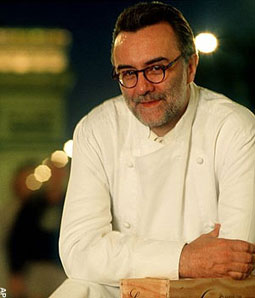 ALAIN DUCASSE (1956 -
