Fougasse
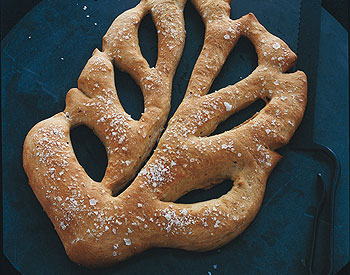
In French cuisine, fougasse (pronounced FOO-gass) is a type of bread typically associated with Provence but found (with variations) in other regions. Some versions are sculpted or slashed into a pattern resembling an ear of wheat. After the dough is rolled into the appropriate shape, it is often brushed with olive oil and the herbs are sprinkled on the top of the bread before baking.
In ancient Rome, panis focacius was a flatbread baked in the ashes of the hearth (focus in Latin). This became a diverse range of breads that include focaccia in Italian cuisine, hogaza in Spain, fogassa in Catalonia, fugàssa in Ligurian, pogača in the Balkans, pogácsa in Hungary, fougasse in Provence (originally spelled fogatza), fouace or fouée in other French regions and on the Channel Islands. The Provence version is more likely to have additions in the form of olives, cheese, or anchovies, which may be regarded as a primitive form of pizza without the tomato.
Unlike the Italian focaccia, which is often crisp on the bottom, but notably airy and lighter, what makes the French fougasse shine is its crunch! By cutting out several spaces, this bread maximizes surface area and thus maximizes the amount of crust the bread will have. Biting into a fougasse has a nice crunchy outside, and a doughy inside.
To the taste it's distinctly sour inside, and often cooks will use a sourdough style recipe to make the dough. Commonly, fougasse bakers may add additional flavors. The style typical to the famous fougasse of Provence can include olives and a mixture of herbs including rosemary and thyme. In the Ariege, in the mountains of the Midi-Pyrenees where everything is a bit heartier, it often includes lardon (bacon). Breads flavored with orange and anise are traditionally one of the 13 desserts of a Provençal Christmas Eve.
Recipe for Provençal Olive Fougasse
Recipe for Fougasse (Provençal Flat Bread) with rosemary and thyme herbs
