Focaccia
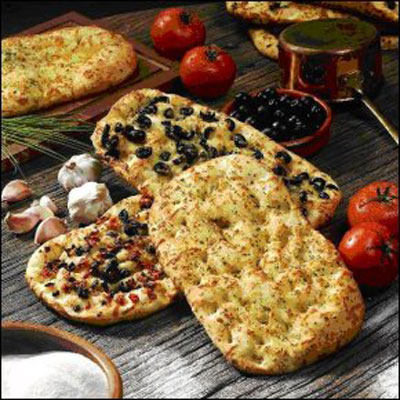
This flat bread, which is often topped with olive oil, onions, herbs and other ingredients, is an early prototype of modern pizza. The basic recipe is thought by some to have originated with the Etruscans or Ancient Greeks. It belongs essentially to the northern shores of the Mediterranean and has its origin in classical antiquity. In ancient Rome panis focacius denoted a flat bread cooked in the ashes ("focus" meant hearth). This became the term focacia, then focaccia in modern Italian.
This basic recipe has only olive oil and salt added to the top. For variations, see below. Tomato sauce, seasoned with salt, pepper, and perhaps garlic, is a perfect dip for focaccia.
Another recipe makes a sponge from the yeast, 1/2 cup water and 1 1/2 cups flour. Once this has doubled in bulk, the rest of the ingredients including more water are added and left to rise again.
The difference between Ciabatta and Focaccia is that a proper ciabatta starts with a biga (a yeast starter) while a focaccia doesn't use a biga. So when they are baked, a focaccia is a little denser, while a ciabatta is light and full of holes. And the denser crumb of focaccia makes for a bread that is easier to add things to like more olive oil, olives, whole fresh spices and cheese, whereas the lightness of a ciabatta is enjoyed plain.
Brining and Salting Your Focaccia (Ligurian focaccia)
Brining and salting your focaccia for the best flavor. To make plain focaccia, mix salt and water to create a salty brine and brush liberally over the dough before baking. The brine settles into the dimples and around the edges creating salty pops of flavor and a golden, crunchy exterior. Another option is to brush with extra virgin olive oil and Maldon sea salt. After baking brush one more time with more extra virgin olive oil.
1 1/2 teaspoons Diamond Crystal kosher salt
1/3 cup lukewarm water
Pour the brine over the dough (13 x 18" pan) to fill dimples. Set the focaccia aside to rise until the dough is light and bubbly. After baking brush with abundant extra virgin olive oil.
Basic Focaccia
by Peter Reinhart, from http://www.finecooking.com/
FMM: I thought the bread needed more flavor, like it was missing salt. Try Samin Nosrat’s recipe to the right.
Although the making of this recipe is spread over two days, the actual hands-on time is quite short. After you mix the dough, it rises overnight in the refrigerator, where the cold slows yeast activity dramatically. This cold fermentation technique is the key to truly flavorful focaccia. The cold dramatically slows yeast activity, allowing enzymes in the flour to coax more flavor from the flour's complex starch molecules. This simple tactic alone will take you far. But another trick will take you even farther: making a wet, sticky dough. (Don't worry; the olive oil in the recipe makes it possible to handle the dough.) A wet dough creates a crust with large, irregular holes that soak up the wonderful flavors of the olive oil.
Yields a 13x18-inch loaf; 12 to 15 pieces.
1 lb. 9 oz. (5-1/2 cups) unbleached bread flour
2-1/2 cups cold water (about 55°F)
2 Tbs. plus 1 tsp. granulated sugar (1 oz.)
2 tsp. table salt or 3-1/2 tsp. kosher salt (1/2 oz.)
1 packet (1/4 oz. = 2 1/4 teaspoons) instant yeast (also called quick-rise, rapid-rise, or fast-rising yeast)
10 Tbs. extra-virgin olive oil
Sea salt or kosher salt for sprinkling
Mix the dough:
The day before baking, mix the dough and let it spend the night in the refrigerator. Combine the flour, water, sugar, salt, and yeast in the large bowl of a stand mixer (use the paddle attachment, not the dough hook). Slowly mix until the ingredients form a ball around the paddle, about 30 seconds. Switch to the dough hook and mix on medium low for another 3 minutes. Stop the machine to scrape the dough off the hook; let the dough rest for 5 minutes and then mix on medium low for another 3 minutes, until it's relatively smooth. At this point, the dough will resemble melted mozzarella and be very sticky. If you stretch a small piece, it will barely hold together.
Coat a bowl large enough to hold the dough when it doubles in size with 1 Tbs. of the olive oil. Transfer the dough to the bowl and rotate the dough to coat it with the oil.
Hold the bowl steady with one hand. Wet the other hand in water, grasp the dough and stretch it to nearly twice its size.
Lay the stretched section back over the dough. Rotate the bowl a quarter turn and repeat this stretch-and-fold technique. Do this two more times so that you have rotated the bowl a full 360 degrees and stretched and folded the dough four times. Drizzle 1 Tbs. of the olive oil over the dough and flip it over. Wrap the bowl well with plastic and refrigerate it overnight, or for at least 8 to 10 hours.
Shape the focaccia:
Remove the bowl of dough from the refrigerator and start shaping the focaccia 3 hours before you intend to bake it (2 hours on a warm day). The dough will have nearly doubled in size. Cover a 13x18-inch rimmed baking sheet with parchment or a silicone baking mat and coat the surface with 2 Tbs. of the olive oil.
Gently slide a rubber spatula or a dough scraper under the dough and guide it out of the bowl onto the center of the pan. The dough will sink beneath its own weight, expelling some gas but retaining enough to keep an airy gluten network that will grow into nice holes.
Drizzle 2 Tbs. of the olive oil on top of the dough. (Don't worry if some rolls off onto the pan; it will all be absorbed eventually.)
Dimple the entire dough surface, working from the center to the edges, pressing your fingertips straight down to create hollows in the dough while gently pushing the dough down and out toward the edges of the pan. At first you might only be able to spread the dough to cover about one-half to three-quarters of the pan. Don't force the dough when it begins to resist you. Set it aside to rest for 20 minutes. The oil will prevent a crust from forming.
After letting the dough rest, drizzle another 2 Tbs. olive oil over the dough's surface and dimple again. This time, you will be able to push the dough to fill or almost fill the entire pan. It should be about 1/4 to 1/2 inch thick. If it doesn't stay in the corners, don't worry; the dough will fill the corners as it rises.
Cover the dough loosely with oiled plastic wrap, put the pan on a rack to let air circulate around it, and let the dough rise at room temperature until it's about 1-1/2 times its original size and swells to the rim of the pan. This will take 2 to 3 hours, depending on the temperature of the room. Thirty minutes before baking, heat your oven to 475°F.
Bake the focaccia:
Just before baking, gently remove the plastic wrap and sprinkle a few pinches of sea salt or kosher salt over the dough. Put the pan in the middle of the hot oven and reduce the heat to 450°F. After 15 minutes, rotate the pan to ensure even baking.
Check the dough after another 7 minutes. If it's done, it will be golden brown on top and, if you lift a corner of the dough, the underside will be golden as well. If not, return the pan to the oven for another 1 to 2 minutes and check again.
Set a cooling rack over a sheet of aluminum foil or parchment (to catch drippings). Use a metal spatula to release the dough from the sides of the pan. Slide the spatula under one end of the focaccia and jiggle it out of the pan onto the rack. If any oil remains in the pan, pour it evenly over the focaccia's surface. Carefully remove the parchment or silicone liner from beneath the focaccia. Let cool for 20 minutes before cutting and serving.
Nutrition Information (per serving):
Size : based on 15 pieces; Calories (kcal): 250; Fat (g): 9; Fat Calories (kcal): 80; Saturated Fat (g): 1; Protein (g): 6; Monounsaturated Fat (g): 7; Carbohydrates (g): 36; Polyunsaturated Fat (g): 1; Sodium (mg): 310; Cholesterol (mg): 0; Fiber (g): 1;
Samin Nosrat’s Ligurian Focaccia
from https://www.saltfatacidheat.com/
From https://www.thekitchn.com/: “There’s a couple things you need to know about this recipe before you jump in. First, is that the ingredients are important here. For example, this is not the recipe to swap fancy flour in for all-purpose. If you can, I also recommend searching for Diamond kosher salt, as Samin recommends. I used a different kind of kosher salt, and my focaccia was on the saltier side of things (but still very delicious). This is also the time to use a higher-quality olive oil because it will really come through.
“Second, if you’ve never made focaccia you should know that this recipe is a little different. As Samin talks about in this particular episode, you brine the focaccia before putting it in the oven. You’re going to think it looks too wet, but I promise it’s probably perfect. The brine adds a delicious saltiness that you don’t find in other recipes.”
“My Honest Review of Samin’s Ligurian Focaccia To put it simply, this focaccia was perfect. The inside was light and soft while the outer crust was crisp and beautifully browned. When I sliced into it, it was filled with the gorgeous air pockets I associate with the best focaccia breads.
“In addition to looking amazing, this focaccia also tasted amazing. Even though I’d watched Samin and Diego pour the saltwater brine over their dough, I was still so nervous doing it! The bread looked really wet, but once I tasted the final product, it was clear to me exactly why the brine is necessary: It imparts so much flavor into the dough. While you can add aromatics like rosemary and sage, this focaccia honestly doesn’t need it, which I think is the ultimate test of a good focaccia recipe.
All in all, Samin’s recipe is a testament to learning straight from the source: in this case, focaccia expert Diego.”
For the dough:
2½ cups (600 grams) lukewarm water
½ teaspoon active dry yeast
2½ teaspoons (15 grams) honey
5 1/3 cups (800 grams) all-purpose flour
2 tablespoons (18 grams) Diamond Crystal Kosher salt or 1 tablespoon fine sea salt
¼ cup (50 grams) extra-virgin olive oil, plus more for pan and finishing
Flaky salt for finishing
For the brine:
1½ teaspoons (5 grams) Diamond Crystal Kosher Salt
⅓ cup (80 grams) lukewarm water
In a medium bowl, stir together water, yeast, and honey to dissolve. In a very large bowl, whisk flour and salt together to combine and then add yeast mixture and olive oil. Stir with a rubber spatula until just incorporated, then scrape the sides of the bowl clean and cover with plastic wrap. Leave out at room temperature to ferment for 12 to 14 hours until at least doubled in volume.
Spread 2 to 3 tablespoons oil evenly onto a 18-by-13 inch (46-by-33 cm) rimmed baking sheet. When dough is ready, use a spatula or your hand to release it from the sides of the bowl and fold it onto itself gently, then pour out onto pan. Pour an additional 2 tablespoons of olive oil over dough and gently spread across. Gently stretch the dough to the edge of the sheet by placing your hands underneath and pulling outward. The dough will shrink a bit, so repeat stretching once or twice over the course of 30 minutes to ensure dough remains stretched.
Dimple the dough by pressing the pads of your first three fingers in at an angle. Make the brine by stirring together salt and water until salt is dissolved. Pour the brine over the dough to fill dimples. Proof focaccia for 45 minutes until the dough is light and bubbly.
Thirty minutes into this final proof, adjust rack to center position and preheat oven to 450°F (235°C). If you have a baking stone, place it on rack. Otherwise, invert another sturdy baking sheet and place on rack. Allow to preheat with the oven until very hot, before proceeding with baking.
Sprinkle focaccia with flaky salt. Bake for 25 to 30 minutes directly on top of stone or inverted pan until bottom crust is crisp and golden brown when checked with a metal spatula. To finish browning top crust, place focaccia on upper rack and bake for 5 to 7 minutes more.
Remove from oven and brush or douse with 2 to 3 tablespoons oil over the whole surface (don’t worry if the olive pools in pockets, it will absorb as it sits). Let cool for 5 minutes, then release focaccia from pan with metal spatula and transfer to a cooling rack to cool completely.
Serve warm or at room temperature.
To store, wrap in parchment and then keep in an airtight bag or container to preserve texture. Gently toast or reheat any leftover focaccia before serving. Alternatively, wrap tightly to freeze, then defrost and reheat before serving.
Variations:
Peter Reinhart's Herb Oil topping - from American Pie: My Search for the Perfect Pizza:
1/4 cup (60ml) olive oil
1 teaspoon dried basil
1 teaspoon dried oregano
1 tablespoon fresh rosemary leaves
1/4 teaspoon dried thyme
1 teaspoon granulated garlic powder
1/4 teaspoon freshly ground black pepper
1/2 teaspoon chili flakes (optional)
pinch salt
Make the herb oil:
In a bowl, whisk together all the ingredients. Let sit at room temperature for 2 hours before using. Drizzle over the dough as in the recipe above when shaping the dough in the pan and creating dimples.
Other Variations:
Oil a cookie sheet. Roll out dough and place on cookie sheet. Make indentations with your fingertips. Top with desired flavorings and toppings. Let rise in warm place about 1 hour and then bake until golden.
Garlic Oil and Rosemary Focaccia:
6 large garlic cloves, halved lengthwise
1/2 cup olive oil
1 tablespoon coarsely chopped fresh rosemary
Coarse salt, for sprinkling
Freshly ground black pepper, for sprinkling
Preheat oven to 300 degrees F.
Combine garlic and oil in a very small metal bowl and set on a baking sheet. Bake in lower third of oven for 1 hour. Cool on a rack 30 minutes. Pour oil through a small sieve into another bowl and discard garlic. Roll out the focaccia, drizzle with some garlic oil and sprinkle with rosemary, coarse salt, and pepper, and bake until golden brown.
Thyme Focaccia and Parmesan Focaccia (divide the dough in two and make one of each)
2 teaspoons minced fresh thyme leaves
1/2 cup coarsely grated Parmesan Coarse
salt for sprinkling
Freshly ground black pepper for sprinkling
For thyme focaccia, knead thyme into dough after first rest.
For Parmesan focaccia, sprinkle dough with Parmesan before baking.
Sprinkle both doughs with salt and pepper before baking.
Other Toppings:
Focaccia can be topped with just about anything. Here are some ideas. Press these ingredients into the top of the dough while dimpling and shaping the dough. See recipe.
- Pine nuts, garlic and parsley
- Olive oil, onions, crumbled Gorgonzola, black olives, parsley and hot pepper flakes
- Crisp bacon, carmelized or sauted onions, and sage
- Sun-dried tomatoes, black olives, and romano cheese
- Marinated artichoke hearts, roasted red pepper, olives, and romano cheese
- Lightly brush marinara sauce on top, add black olives, parmesan cheese and pine nuts
- Sesame, poppy, and fennel seeds with dried minced onion and garlic, rosemary, pinch red pepper flakes, salt and olive oil
- Mushrooms, onion and
- The Caprese Focaccia: Ripe cherry tomatoes cut in halves; basil leaves (add at the last minute!); thinly sliced mozzarella; a drizzle of fine olive oil.
- The Pizza Focaccia: Pepperoni, black olives, pepperoncini or red pepper flakes; tomato puree on the side
