Aloo Samosas
From Food Network Kitchens
Samosas are perhaps the most popular vegetarian Indian appetizer, street food, tiffin (light lunch) in not only India but throughout whole Indian subcontinent and its diaspora throughout the world. It is believed that Samosa was first introduced at Lahore railway station and spread to all the corners of India along every train stop. Every railway station had the hawkers selling Samosa and Garam Chai (sweetened hot tea latte). It is no wonder that the Samosa with the traditional stuffing of potatoes and peas is also called Lahori Samosa.
The samosa has a Central Asian origin. The earliest mention of the samosa was by Abbasid-era poet Ishaq al-Mawsili, praising the sanbusaj. Recipes are found in 10th–13th-century Arab cookery books, under the names sanbusak, sanbusaq, and sanbusaj, all deriving from the Persian word sanbosag. Abolfazl Beyhaqi (995–1077), an Iranian historian, mentioned it in his history, Tarikh-e Beyhaghi. The Central Asian samsa was introduced to the Indian subcontinent in the 13th or 14th century by chefs from the Middle East and Central Asia who cooked in the royal kitchens for the rules of the Delhi Sultanate. Amir Khusro (1253–1325), a scholar and the royal poet of the Delhi Sultanate, wrote in around 1300 CE that the princes and nobles enjoyed the "samosa prepared from meat, ghee, onion, and so on". Ibn Battuta, a 14th-century traveler and explorer, describes a meal at the court of Muhammad bin Tughluq, where the samushak or sambusak, a small pie stuffed with minced meat, almonds, pistachios, walnuts and spices, was served before the third course, of pulao.
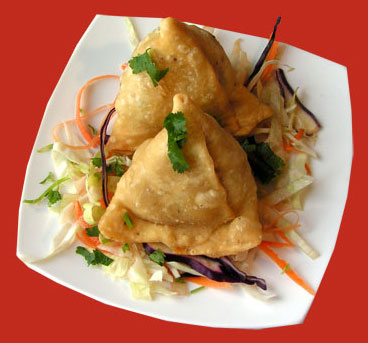
Aloo Samosas have a spicy boiled potato stuffing inside a crispy flour dough and are served with a spicy chutney. A popular non-vegetarian variant of this classic dish would have spicy ground meat (usually lamb), called Kheema, instead or along with potatoes.
 Dough:
2 cups all-purpose flour
1 1/4 teaspoon ajawain* (optional) (available at South Asian or specialty spice markets)
1/2 teaspoon fine salt
6 tablespoons vegetable oil, plus more as needed
5 tablespoons cold water
Filling:
4 russet potatoes (about 2 pounds), peeled and cut into 1-inch pieces
Kosher salt, as needed, plus 1 tablespoon
1/2 medium yellow onion
One 1 1/2-inch piece fresh ginger, peeled
4 cloves garlic
1 serrano chile (with seeds), stemmed
3 tablespoons water
3 tablespoons ghee or oil, recipe follows
1 teaspoon black mustard seeds (available at South Asian or specialty spice markets)
1/2 teaspoon cumin seeds
1/2 teaspoon fennel seeds
1 1/2 teaspoons garam masala
2 teaspoons ground turmeric
1/2 cup cooked peas
2 tablespoons freshly squeezed lemon juice
Serving suggestion: Tamarind Chutney, Tamarind Sauce, or Hari Chutney (Green chutney made with cilantro)
*Ajwain (pronounced uj-wine) is a seed-like fruit often used in Indian cooking as part of a spice mixture. It looks similar to fennel and cumin seeds and is highly fragrant, smelling like thyme. Its taste, however, is more like oregano and anise due to the bitter notes and strong flavor. Because of its pungency, a little goes a long way. Grown in India and Iran, ajwain, also known as carom seeds or bishops weed, is rarely eaten raw and instead is cooked before adding to a recipe.
To make the dough: Whisk together the flour, ajawain, if using, and the salt. Add the oil and, using your hands, rub it into the flour mixture until fully incorporated. While stirring with a wooden spoon, gradually add the water, until a dough is formed. Transfer the dough to a work surface and knead until soft and pliable, about 3 minutes. Rub a little oil over the dough and cover with a damp towel. Let the dough rest at room temperature for 30 minutes.
Meanwhile, make the filling: Put the potatoes in a medium saucepan, cover with cold tap water by about 2 inches, and season with salt. Bring to a boil, lower the heat, and simmer until tender, about 10 minutes. Drain and set aside to cool slightly. Using a fork, slightly smash the potatoes.
Meanwhile, in a small food processor (mini-chopper), combine the onion, ginger, garlic, chile, and 1 tablespoon water and puree to a paste.
Heat the ghee in a large skillet over medium-high heat. Add the mustard, cumin, and fennel seeds and cook, stirring constantly, until fragrant, about 30 seconds. Add the onion paste, salt, garam masala, and turmeric and cook, stirring, until lightly browned, about 4 minutes. Add the potatoes and cook, stirring and mashing lightly with a wooden spoon, until hot, about 2 minutes. Stir in the peas. Remove from the heat and stir in the lemon juice and remaining 2 tablespoons water.
To form the samosas: Divide the dough into 7 portions. Using your hands, roll each portion into a small ball. On a floured work surface, using rolling pin, roll each ball into a 7-inch wide disc. Cut each disc in half.
Set a small bowl of water beside you. Working with one dough semi-circle at a time, fold one point of the straight edge up to the rounded side and wet its outside edge with a little water. Fold the other point up to form a cone, overlapping it with the other side by 1/4 inch. Press the edges together to form a seal. Hold the cone in one hand and fill it with about 1/4 cup of the potato filling. Slightly wet the inside of the rounded edge and fold it over the filling to enclose it. Press the edges together to seal. Repeat with the remaining dough and filling to make 14 samosas.
See Shaping Samosas
There are two choices at this point. For samosas with a slightly blistered and bubbly crust, store them uncovered in the refrigerator overnight and fry them the next day (the dough becomes soft and moist, creating small puffs in the dough when fried); or continue to the next step and fry them right away for an equally good but smooth crust.
In a large, wide heavy-bottomed pot, pour in the oil to a depth of about 2 inches. Place over medium heat, and heat until a deep-fry thermometer inserted in the oil registers 365 degrees F.
Working in small batches, fry the samosas until golden brown and crispy, about 5 minutes. Using tongs, transfer to a paper towel-lined baking sheet to drain. Serve immediately with tamarind sauce or your favorite chutney.
4 to 6 servings
Tip: Instead of frying, bake somosa to reduce calories in preheated 375-400°F oven, 12 - 15 min. Make sure to make the dough with oil and also coat lightly with oil.
