The Indian Meal: How To Choose Your Dishes
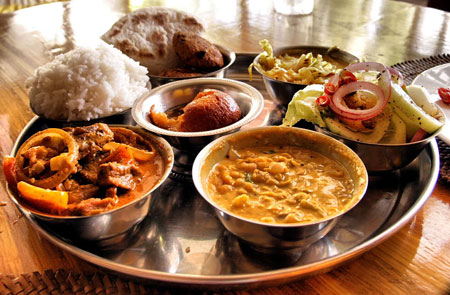
There is basic rule about how to combine dishes to make a complete Indian meal.
Each Indian meal should consist of a starch (for example: rice and/or Indian bread), one or more main dishes (for example: a meat dish or fish dish, or a lentil and vegetable combination) and some kind of chutney. Usually two vegetables and/or lentil dish will be served with the meal; one ‘wet’ with lots of sauce (chutney) and one ‘dry’. For a simple meal there will be only few varieties of dishes while for elaborate parties or festivals, more variety of them are prepared.
Dishes are chosen for variety and contrast. The tastes are well rounded from the sublime yogurts to the fiery curries, from the fresh salads to the pickled vegetables, from the sweet to the sour chutneys. The texture too runs the gamit from the crunchy papads to the softness of the rice and the soupy lentils. At its most basic, a traditional meal is usually made up of the following:
- Rice and/or breads such as chappatis, naans, parathas, puris, plain-boiled rice, pullao (pilaf)
- Dhal, a dish of lentils cooked until tender with spices
- Dry-cooked vegetable or meat/fish dish
- Yoghurt, often plain low-fat yoghurt, or a raita
- Salad, such as diced cucumber, red onions and tomatoes, dressed in lime juice and toasted cumin powder
- Pickles and relishes
In southern India, banana leaves are often used as plates, but more universal is the thali service - the thali being a circular metal tray on which are placed a number of small bowls called katori, also made of metal. Rice or chapati are placed directly on the tray while curries and other accompaniments are served in the bowls. The food is eaten with the fingers, although in most Indian cities, Western customs have taken over and food is served on dinner plates and eaten with spoon and fork.
Rice is served first in the center of the plate, then various curries and accompaniments are placed around it. The rice is the base, and only one curry should be tasted with each mouthful of rice in order to appreciate the individual spicing of each dish.
The matter of proportions is all-important. Rice is the main part of the meal and curries of meat, fish or vegetables should be served in much smaller portions. There is wisdom in this too, because when food is spiced, it needs the bland background of rice to delight the palate and placate the digestion.
When eating Indian breads with a meal, there is no choice but to eat with one's fingers. Tear off a piece of chapati or paratha, use it to scoop up the accompaniment, fold it over neatly, then eat it. Just as Chinese or Japanese food tastes better eaten with chopsticks, Indian food tastes better eaten with the fingers. Fingerbowls are provided, or course.
What to drink with an Indian meal has always been the subject of much argument. Cold water is the most authentic, but many Indians prefer a sweet drink such as sharbat gulab or falooda. These are certainly effective in quenching fiery spices. For those who want an alcoholic beverage, a chilled lager or shandy, or wine cup using a semi-sweet white wine or rose wine is permissible, but fine dry wines and curries do not go together. One warning though, carbonated or 'fizzy' drinks, including lager beer, tend to exaggerate the burning sensation of a really hot curry. So does ice-cold water.
A meal is rounded off with the after-dinner paan or betel leaf which holds an assortment of digestive spices like aniseed, cloves, arecanut, and cardamom. See Mukhwas.
Wet vs. dry curry
“Curry pastes” are built by combining ground dry spice ingredients with oils like sesame or clarified butter. The process usually also includes a selection of mashed or pureed aromatics such as chilis, garlic, ginger and lemongrass. A dish of rice, noodles, vegetables or meats seasoned with this paste is known as a “dry” curry.
“Wet” curries consist of gravy-like sauces, created by loosening a curry paste with a liquid such as water, stock, yogurt or coconut milk. Various vegetables and meats are simmered in these wet curry sauces and usually served over rice or with bread, especially flatbreads for dipping (such as pita or Indian naan.)
Indian Party Menus
from http://www.indianfoodsco.com/Classes/IndianMenu.htm
Delhi Style Party Menu - elegant, perfect, charming New Delhi is, not only the capital of India but, the restaurant capital of India. Delhi has been continuously inhabited by differing groups since at least the 6th century BC, and as a result traditional Delhi cuisine is an amalgam of four popular cuisines namely Bania, Kayastha, Muslim and Mughal. New Delhi is in the eastern part of India. Starters: Main course: Dessert: |
Punjabi Party Menu - hearty, joyous and rich in flavor Punjab (Land of the five rivers) is one of the most fertile regions on earth. The region, which is in north India, is ideal for wheat-growing and is called the "Granary of India." The food is tailor-made for the Punjabi lifestyle in which most of the rural folk burn up a lot of calories while working in the fields. Starters: Main course: Dessert: |
Lucknowi Menu - lavish, splendid and decadant Lucknow is the capital city of Uttar Pradesh, the most populous state of India, which is located in the North. Lucknow has always been a multicultural city known for courtly manners, beautiful gardens, poetry, music, and fine cuisine. Starters: Main course: Dessert: |
Appetizers (from a restaurant menu) Samosa - Potatoes, peas, and cauliflower in a savory crisp pastry. |
New Year's Eve Party Drinks - alcoholic and non-alcoholic Tandoori Tikka - chicken skewers in yogurt marinade Dessert: |
Indian Picnic Ideas Chutney cheese or ham Sandwiches |
"Chaat" or Street Foods Crunchy, tangy, hot and sweet flavors combine to make Chaat delicious to eat as a snack or a great alternative to a meal. Bhel Puri also serve plain sukha (dry) bhel without the chutneys |
Reception or Drinks & Snack Party Samosas |
Non-Vegetarian Menu Sali Seekh |
Vegetarian Menu Starters: Carrot Koshimbir |
Coastal
The cuisine of Bombay, Goa and other coastal cities is rich in seafood. Chilies and coconut are prevalent in many dishes accented by an endless array of exotic spices.
Xacuti - Curry leaves, coriander seeds, coconut, tamarind and chilies, flavor this popular curry from the Koukan region.
Vindaloo - This very popular spicy curry from Goa is made with pork, onions, tomatoes, vinegar, chilies, cumin and coriander.
Gobhi Taka-Tin - Cauliflower cooked with capsicum, tomatoes and fenugreek leaves.
Chicken Caffreal - A classic green herb curry from Goa flavored with cilantro, green chilies and lemon
Kheema Sali - Sour and spicy minced lamb with onions, tomatoes, cumin, coriander, cloves and cardamom
Malwani Macchi - Salmon in a spicy sauce, with tomatoes, coconut, garlic, ginger and red Chilies
Tandoor
Tandoori Chicken - Popular Indian barbeque chicken.
Chicken Malai - Boneless chicken marinated in yogurt, rubbed with spices and cooked over charcoal.
Chicken Khurchan - Boneless chicken tossed with herbs & spices.
Boti Kabab - Lamb chunks rolled in our special marinade and char-grilled.
Kakori Kabab - Lamb minced with herbs and spices.
Salmon Tikka - Gently spiced salmon flavored with onion seeds.
Tandoori Shrimp - Tangy marinated shrimp roasted over charcoal.
Northern India
Saagwala - Freshly chopped spinach cooked with aloo, paneer, chicken or lamb.
Korma - A simple yogurt curry with ginger, garlic, onions, cumin, coriander and cashew nuts.
Kadahi - Tomatoes, onions, green peppers tossed with cumin, coriander, black pepper, chilies, cardamom, cinnamon etc.
Bhindi Masala - Fresh okra cooked with cumin, dry mango, tumeric and onions.
Baingan Bhurta - Mashed eggplant cooked with tomatoes, onions, cumin, coriander and turmeric.
Malai Kofta - Vegetable croquette in a curry of tomatoes, onions, fenugreek, ginger and garlic.
Channa Masala - Popular North Indian staple of chick peas cooked with tomatoes, onions, cumin and coriander.
Dum Aloo - A flavorful potato curry.
Dal Bukhara - Black gram dal in a tomato, onion and cumin base.
Tadka Daal - Yellow lentils cooked with herbs and spices.
Shahi Paneer - Paneer in a rich tomato sauce with onions and fenugreek.
Aloo Paneer - A delightful combination of potatoes and homemade cottage cheese.
Mutter Paneer - A delightful combination of green peas and homemade cottage cheese.
Chicken Tikka Masala - Chicken pieces in a creamy tomato curry with onions, ginger, garlic, fenugreek, turmeric, cumin and coriander.
Chicken Navratan - Cardamom chicken curry.
Chicken Kastoori - A versatile Indian herb, fenugreek, gives this curry its unique flavor.
Rogan Josh - Kashmir is home to this popular lamb curry with tomatoes and onions flavored with garlic, ginger, cinnamon, cardamom, cloves and cumin.
Rah Ra Lamb - A simple yet delicious lamb curry.
Shrimp Masala - Shrimp cooked in an herbed tomato, onion and fenugreek curry.
Salmon Masala - Salmon cooked in an herbed tomato, onion and fenugreek curry.
Balti
An unusual style of North Indian cooking using a cast iron round bottom pot (Balti - similar to a wok) and combination of meat, fish and/or vegetables in carefully guarded usually mild spice combination.
Vegetables and Lentils
Chicken and Whole Spices
Kabab of Ground Lamb in a Curry Sauce
Eastern and Central
Bhindi Aachari - Fresh okra cooked with pickling spices, fennel, onion seeds, mustard and turmeric.
Bhindi Jaipuri - Fresh okra cooked with gram flour, onions, and dry mango.
Gobhi Char Chari - Cauliflower and potatoes cooked with fennel and onion seeds.
Dohi Macchi - A Bengali preparation of salmon in a yogurt sauce flavored with turmeric.
Jhalfrezi - A popular Bengali preparation using turmeric, red chilies, mustard seeds, cumin and coriander.
Basmati Rice/Biryani
Biryani - Basmati Rice cooked with an exotic blend of herbs and spices, served with raita.
Vegetable Pulao - Rice cooked with vegetabies and cumin.
Jeera Rice - Fragrant rice cooked with a hint of cumin
Side Orders
Daal (Mixed Lentils)
Daal (Yellow Lentils)
Saag - Spinach and fenugreek.
Bhurta - Mashed eggplant.
Raita - Home made savory yogurt.
Mango Chutney
Mixed Pickle
Papad - Cumin flavored lentil crisps.
