Italian Cookies
These are some of the more popular and traditional Italian cookies. Others, not shown here, include: baci, canali, farfelette (fried bow ties), milan cookies (butter cookie sandwiches with chocolate filling), rum balls, wedding love knots and wine ring cookies.
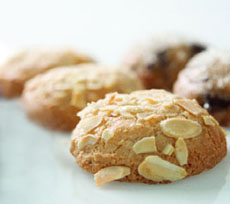
Amaretti
Amaretti, the Italian version of a macaroon, are flavored with chopped bitter almonds or amaretto, bitter almond liqueur. The Italian word amaro means “bitter,” and the literal translation of amaretti is “the little bitter ones.” These Italian cookies have a long history. They are crisp and crunchy on the outside and slightly soft on the inside. Amaretti are tradtionally served with a sweet dessert wine or liqueur.
Recipe for Amaretti
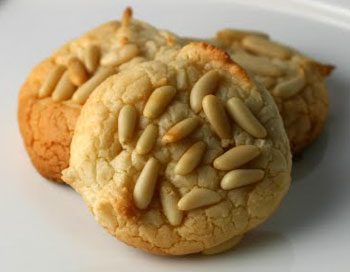
Pignoli
A crunchy Italian cookie made from almond flour or paste, sugar, egg whites and whole pine nuts. Pignolo (plural pignoli) is a macaroon typical of Sicily, Italy and is popular in all of southern Italy and in Sicilian communities in the United States. It is also typical of Catalonia, where it is one of several related cookies called panellets, served on All Saints Day. The cookie is a light golden color and studded with golden pine nuts (also called pignoli). Made with almond paste, beneath the pine nuts the cookie is moist, soft and chewy. Often it is formed in a crescent shape; else it is round. This cookie is a popular Italian holiday treat, especially at Christmas. Because both almond paste and pine nuts are relatively expensive, and this cookie uses substantial amounts of both, this cookie is a luxury food.
Recipe for Pignoli Cookies
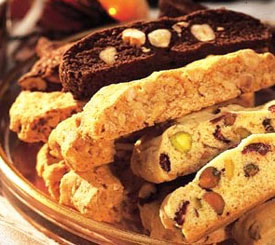
Biscotti
Biscotti (pronunciation: [bisˈkɔtti]), more correctly known as biscotti di Prato are a twice-baked cake originating in the Italian city of Prato. The oven baked goods are baked twice - once in a loaf shape, then sliced and baked again, so they were very dry and could be stored for long periods of time. Pliny the Elder boasted that such goods would be edible for centuries. Such nonperishable food was particularly useful during journeys and wars, and twice baked breads were a staple food of the Roman Legions.
Being very dry, biscotti traditionally are served with a drink, into which they may be dunked. In Italy they are served typically with vin santo. Traditionally, Biscotti are flavored with anisette and almonds, but today you can find biscotti in an endless variety.
Recipes:
Biscotti
Pelligrino Artusi's Biscotti (recipe from 1891)
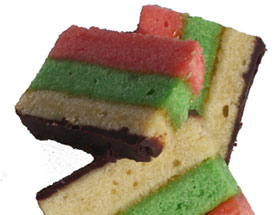
Neapolitan Cookies (Venetians)
Neapolitans or Venetians (also called Rainbow Cookies or Italian Flag Cookies) are bar cookies made with brightly colored, almond-based sponge cake, apricot and/or raspberry jam, and a chocolate coating. They likely originated in Italian communities in the United States during the 1900s, in homage to the community's heritage. They are one of our family's favorite Holiday cookies.
Note: the layers of the cookies shown in the picture do not match my recipe's, which are: the green layer on on the bottom, then raspberry jam topped with the yellow layer, the apricot preserves, the pink layer, and finally the chocolate glaze. This was the best picture I could find, though.
Recipe for Neapolitan Cookies (Venetians)
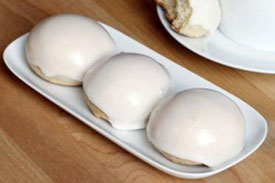
Aginetti (Italian Lemon Drop Cookies)
These Italian cookies are cakey, soft and a bit crumby. They can be made in different flavors, but lemon is traditional. The cookie has a subtle hint of lemon and is topped with a lemon-scented confectioners' sugar frosting.
Recipe for Aginetti
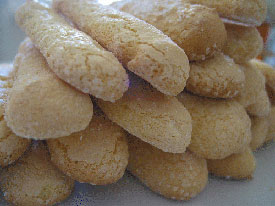
Savoiardi (Ladyfingers)
Savoiardi (better known as ladyfingers abroad) are light and sweet sponge cakes roughly shaped like a large finger that are very popular in Southern Italy. They are called savoiardi in Italian (meaning "from Savoy"), or in French biscuits à la cuillère or boudoirs. In the UK they may be called sponge-fingers, trifle sponges or boudoir biscuits. In Dutch, they are called lange vingers, literally translating to "long fingers".
Like other sponge cakes, ladyfingers traditionally contain no chemical leavening agent, and rely on air incorporated into the eggs for their "sponge" texture. The egg whites and egg yolks mixed with sugar are typically beaten separately and folded together with flour. They contain more flour than the average sponge cake. The mixture is piped through a pastry bag in short lines onto sheets, giving the cookies their notable shape. Before baking, powdered sugar is usually sifted over the top to give a soft crust. The final ladyfingers are usually layered into a final dessert such as the popular Tiramisù.
Ladyfingers originated in the late 15th century at the court of the Duchy of Savoy, and were created to mark the occasion of a visit of the King of France. Later they were given the name Savoiardi and recognised as an "official" court biscuit. They were particularly appreciated by the young members of the court and offered to visitors as a symbol of the local cuisine.
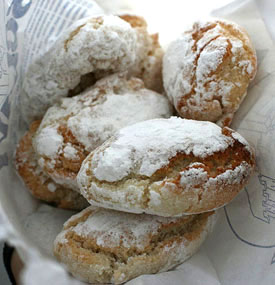
Ricciarelli
Ricciarelli are a traditional Italian cookie with origin in the Tuscan city of Siena dating to the 14th century. Legend holds that they were introduced by Ricciardetto della Gherardesca in his castle near Volterra upon his return from the Crusades.
Today, the biscuits are made using an almond base with sugar, honey and egg white. When prepared in the traditional method, the almonds are ground with a milling machine, and the finished mix is formed into numerous oval- or lozenge-shaped cookies that are set aside for two days before baking. The rough and crackled surface is usually lightly sprinkled with confectioner's sugar. Ricciarelli are typically consumed at Christmas, paired with a dessert wine such as Vin Santo or Moscadello di Montalcino.
Recipe for Ricciarelli
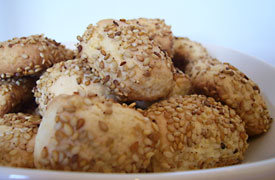
Biscotti di Regina
These classic Italian cookies are also referred to as Queen’s Biscuits or just simply Regina. Their cake-like texture and sweetness will remind you why they’re an old favorite. Tender on the inside, with a crisp coating of sesame seeds on the outside, these buttery, lightly sweet vanilla biscuits are a traditional Italian accompaniment to coffee or wine.
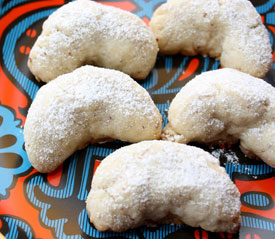
Almondine (Almond Crescent Cookies)
These mezzaluna, or half-moon, shortbread Italian almond cookies are an Italian family favorite.
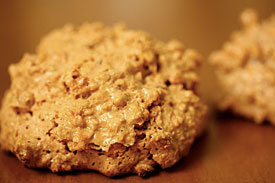
Brutti Ma Bouni
These Italian hazelnut cookies translate into “ugly but good.” Although brutti are basically a meringue cookie, they have a different texture than your run-of-the-mill crumbly cloud of egg white. They are chewy, as though the almond in the batter has morphed into marzipan, and they are deeply, resonantly flavorful.
After whipping up egg whites with sugar and adding the nuts, the batter gets cooked for half an hour on top of the stove before being dropped into cookie portions and baked. This gives them a much richer taste, from the caramelizing of some of the sugar.
Recipe for Brutti Ma Bouni
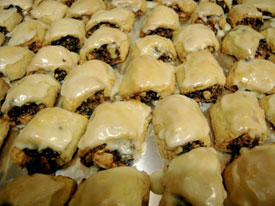
Cuccidati
Cuccidati, also known as Buccellati, is a Sicilian fig and date-filled cookie that is a holiday tradition. These cookies are made from a rich and tender cookie dough and are filled with the finest ingredients including figs, dates, raisins, almonds and a hint of chocolate and apricot.
Recipe for Cuccidati
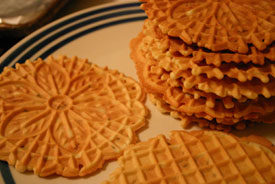
Pizzelles
Pizzelle were originally made in the Abruzzo region of south-central Italy. The name comes from the Italian word for "round" and "flat" (pizze); this is also the meaning of the word pizza. Many other cultures have developed a pizzelle-type cookie as part of their culture (for example, the Norwegian Krumkake). It is known to be one of the oldest cookies, and is believed to have developed from the ancient Roman crustulum.
The cookie dough or batter is put into a pizzelle iron, which resembles a small waffle iron. The pizzelle iron is held by hand over a hot burner on the stovetop, although some models are electric and require no stove. Typically, the iron stamps a snowflake pattern onto both sides of the thin golden-brown cookie, which has a crisp texture once it is cooled.
Pizzelle are popular during Christmas and Easter. They are often found at Italian weddings, alongside other traditional pastries such as cannoli and traditional Italian cookies.
Recipe for Pizelles
Eleanor Mecca's Pizzelles
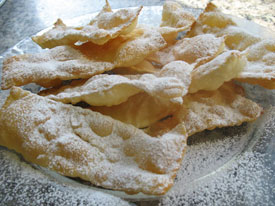
Crostoli
Every town in Italy has its own special name for this traditional Italian delicacy. These light, airy fried cookies are a holiday favorite, especially at Carnevale time. “Carnaval” is a party held traditionally in Roman Catholic societies, forty days before Easter, and right before Lent.
You can find it in all over Italy under several names: In Friuli region Crostoli are called Grostoli, in Emilia-Romagna region they are Sfrappole, in Veneto region their name is Galani or even Crostoli, in Marche region they are known as Frappe, in Tuscany they are named Cenci and in Campania region the name is Chiacchere (that means “chats”). Among all these Italian regions there is only an ingredient which changes in the recipe and that is the use of the alcoholic element. Sometimes it could be Marsala liquor or white wine or Acquavite liquor or Anis liquor.
Recipe for Crostoli
