Panettone
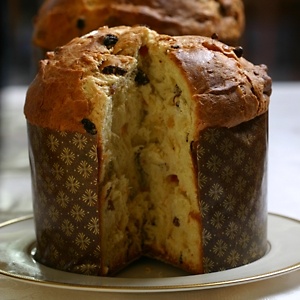
Panettone, the tall, cylindrical, fruit-filled sweet bread from Milan has become an essential part of the Christmas season. You can make panettone two months in advance, wrap it tightly in heavy-duty foil and freeze it. Since the bread making begins with a starter dough, or sponge, and requires a long rising time, it is best to begin the process the evening before baking.
During the Christmas season, Italians eat panettone at breakfast with coffee, between meals with Marsala wine, and after dinner with spumante. Panettone can be toasted and spread with butter or mascarpone cheese for breakfast or used to make a wonderful French toast.
While the origins of a sweet leavened bread date back to Roman times, and a tall, leavened fruitcake can be seen in a 16th century painting by Pieter Brueghel the Elder, the first known mention of panettone with Christmas is found in the 18th century writings of Pietro Verri, who refers to it as “pane di tono.”
Notes:
Some say the secret to panettone is the use of a sourdough starter, or lievito madre, which gives it a unique flavor, texture, and shelf life. The sourdough method is the older and more traditional method of making Panettone. See Traditional Sourdough Panettone
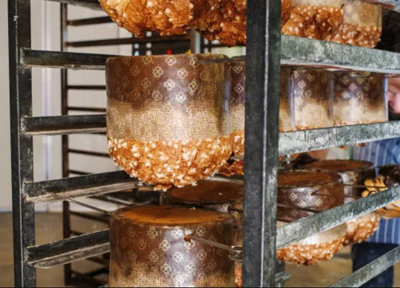
Panetonne needs to cool upside down after baking, because the delicate and fluffy bread would collapse under it’s own weight if you leave it standing up after baking. If the bread collapses the crumb will be dense and will not turn out as light as it should be. Professional bakers use special racks for this, whereas home bakers use whatever they can find. Hang it inside a tall pot (if it is tall enough), hang it between chairs, build up two piles of pantry containers and hang it between . . .
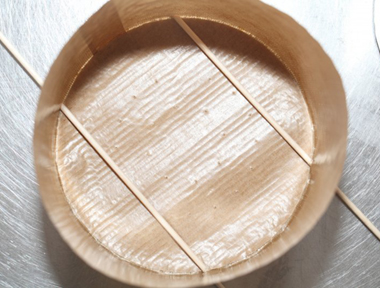
The picture on the left is of a professional bakery hanging their panettone. The picture on the right shows how one person puts the skewers in the collar before adding the dough. They slide the skewers right next to the bottom of the collar. [5" round mold = 500 gm dough, 6" round mold = 750 gm dough, 7" round mold = 1000 gm dough]
There are several ways to decorate the top.
– score a cross and place a knob of butter in the center
– egg wash and sprinkle with pearl sugar
– egg wash and sprinkle with almond flakes
– egg wash and decorate with blanched whole almonds
– glaze made using eggs and almond meal
– leave it plain is always an option too
Panettone (uses yeast only)
from http://www.mangiabenepasta.com/
Sponge:
1 (1/4 ounce) package dry yeast
1/4 cup warm water (110 - 115 degrees F)
1/2 cup flour
Marinate overnight:
2/3 cup golden raisins
1/4 cup grappa or brandy
Dough:
5 tablespoons butter, room temperature
2 eggs
4 egg yolks
3/4 cup sugar
1/4 cup warm water (110 - 115 degrees F)
1 tablespoon vanilla
4-1/2 to 5 cups flour
Grated zest of 1 orange
Grated zest of 1 lemon
1/2 cup chopped candied citron
To make the starter dough, or sponge, dissolve the yeast in 1/4 cup warm water in a bowl. Add 1/2 cup flour and stir to make a very loose dough.
Cover the bowl with a towel of plastic wrap and let rise in a warm place for at least 6 hours or overnight.
In another bowl, combine the raisins and grappa, and let them soak for at least 6 hours or overnight.
In a large bowl, combine the butter, eggs, yolks, sugar, 1/4 cup warm water, and vanilla.
Drain the soaked raisins in a strainer set over a bowl. Press on the raisins with a spoon to extract as much liquid as possible. Set the raisins aside.
Add the liquid to the egg mixture. Add the starter dough and mix well. Gradually add the flour, mixing with your hands until a soft dough forms.
Transfer the dough to a lightly floured surface and knead until smooth and elastic, about 10 minutes. Add more flour as needed.
Butter a large bowl, place the dough in it and turn once to coat both sides with the butter. Cover with a towel or plastic wrap and let rise for 6 hours in a warm place.
Butter and flour a panettone mold or other deep mold that is about 6 inches tall and 8 inches wide.
[Traditionally, panettone is baked in a tall cylindrical pan, 120mm or 5 inches in diameter, and 180mm or just over 7 inches tall. This is how you can bake the bread in a regular deep cake pan if you do not have a panetonne pan. Line the bottom of the pan with a circle of baking paper. Cut off a length of baking paper just slightly longer than the circumference of the pan. Fold the paper in half lengthways. Insert the paper into the pan to line the surround. You can tie a string aroung it to hold it in shape. Another option is to use a bundt pan.]
Punch down the dough and transfer it onto a lightly floured surface. With your hands, flatten the dough into a large rectangle. Evenly distribute the orange and lemon zest, raisins, and citron over the dough.
Fold the dough in half to enclose the fruit and knead to distribute the fruit throughout the dough.
Place the dough in the prepared mold, cover with a towel, and let rise for 45 minutes in a warm place.
Preheat the oven to 375 degrees F.
Cut an X in the top of the dough with a sharp knife. Bake for 15 minutes.
Reduce the heat to 350 degrees F. Continue to bake for 30-35 minutes or until a skewer inserted in the middle comes out clean.
Place the bread on a rack to cool for 30 minutes before removing it from the mold. Be sure that the bread has cooled completely before wrapping it for storage.
[Penettone is traditionally hung upside down as soon as it is taken out of the oven so the top does not collapse in. See Notes above.]
Makes 1 large bread
Pannetone (uses both sourdough starter and yeast)
from https://www.weekendbakery.com/
They based their recipe on Michel Suas' in Advanced bread and pastry. Michel Suas is the French head of the San Francisco Baking Institute. For some reason this recipe uses a lot less eggs than other recipes. "The first attempt we stayed really close to the recipe steps, which are spread over three days. The first day of the process works well if you make large amounts of dough, but for home bakers we found it is no problem to skip this step and still get a great result. That is why our basic recipe version is a two day process, where the steps of day one and two are merged."
Day 1:
This step of making the initial dough is ideally done in the evening. This way you can continue with the recipe on day 2 in the morning, because you must take into account the long proofing times of the final dough (up to 6 hours for the final proofing alone).
Ingredients for panettone dough nr 1
220 g strong white bread flour (13-14% protein)
120 g water
1.5 g instant yeast or 4.5 g fresh yeast
20 g [active] sourdough starter (100% hydration)
one egg yolk (20 g)
45 g sugar
4 g diastatic malt (optional, gives great color)
45 g butter, softened
In the bowl of your standing mixer add all the ingredients from the list above. Mix on a low speed for no more than one minute, until all ingredients are combined. You could call this a ‘shaggy mass’. Cover the bowl and leave to rest overnight (for 12 hours) at room temperature.
[Soak the raisins (see ingredients for Day 2) in some rum overnight.]
Day 2:
Panettone is usually made in classic panettone molds. You can also use a well greased baking tin. The dimensions should be around 13,5 cm / 5.3 inch diameter and a height of 9.5 cm / 3.7 inch.
Panetonne needs to cool upside down after baking, because the delicate and fluffy bread would collapse if you leave it standing up after baking. You can, rather ingeniously, prepare the paneyyone molds for this by sticking bamboo skewers into them (see picture above).
Ingredients for the final panettone dough
The dough you made on day one
60 g strong white bread flour* (13-14% protein)
30 g water (part 1)
one egg yolk (20g)
2.8 g salt
1 tsp vanilla extract
1 tsp orange zest
50 g sugar
70 g butter, softened
30 g water (part 2)
10 g honey
70 g raisins
70 g candied orange peel**
25 g candied lemon peel**
Start by combining dough nr. 1 with the flour, water part 1, egg yolk, salt, vanilla and orange zest.
Knead for 4 minutes (stand mixer on speed 2) to develop the dough. The dough should be well developed before adding sugar or butter, as both sugar and butter prohibited development of the gluten. [Be sure to develop the dough before adding the sugar, and have a nice gluten window before adding the butter.]
Then add half the sugar and knead for 2 minutes. Then add the second half of the sugar and again knead for 2 minutes.
Now gradually add the butter in stages during the next 4 minutes of kneading.
Next add the water part 2 and the honey and slowly knead (lowest possible speed so the water will not slosh out of the bowl) for 2 minutes until the water is completely absorbed by the dough. You should should now have a smooth yet very sticky dough. You should be able to pull a window pane from the dough.
When you have reached this stage you can add the raisins and candied peel and incorporate them into the dough. Knead/mix for 1 minute at a low speed and all the fruit should be distributed through the dough.
Cover the bowl and leave to rest for 45 minutes.
After the rest, perform two complete sets (so one set directly after the other without rest in between) of stretch and folds and see the dough develop from very slack into a plumper shape that somewhat resembles a ball. Use a dough scraper and use some flour on your bench and dough to make this task easier and less sticky.
Cover the dough and let rest for 25 minutes.
Now divide the dough into two equal parts and pre-shape them into a flat ball resembling shape. Again cover and let rest for 25 minutes.
Shape the two pre-shaped pieces of dough into still sort of flat balls as well as you can, use some flour and a dough scraper to tuck the dough under. Make sure the shapes will fit into the panettone molds. Quickly with one swoop of your dough scraper lift each dough ball and put them inside the panetonne molds. Cover the molds with floured cling film.
You are now at the final proofing stage which will take, depending on your room and dough temperature, between 4 and 6 hours.
Baking the panettone
When the top of the dough is starting to reach the rim of the paper mold, preheat your oven to 175 °C / 345 °F, conventional setting. Make sure you have something prepared to hang the panettones upside down as soon as you take them out of the oven. We used two chairs for this.
The panettones are ready for baking when the top of the dough is slightly above the rim of the paper molds. Just before you take the breads to the oven you can cross cut with scissors and/or glaze your panettones and sprinkle them with pearl sugar (use egg white to make the sugar stick) [Some professional bakers, cut a cross, peel the pieces back a bit and add butter]. Take the molds to the oven. You can try and add some steam during the first stages of baking.
Bake for 40 minutes, keep an eye on the color of your panetonne. We had to turn the oven down to 160 °C / 320 °F after 15 minutes to stop the browning process. Take them out of the oven and immediately hang them upside down so they will not collapse and be careful as the panetonnes are very fragile at this stage. Leave them hanging for at least two hours [or overnight], so the crumb can stabilize.
This recipe yields two panettones of around 460 grams each.
