Neapolitan Ragù
taken in part from "Red Sauce Revisited" by Corby Kummer
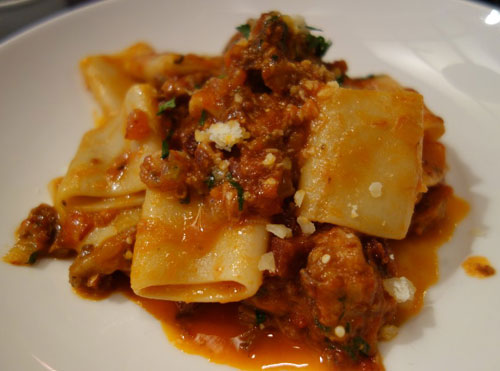
"Ragù is an Italian term for a meat-based sauce, which is traditionally served with pasta. In ragù the tomato's natural sweetness and acidity are concentrated through long cooking and enriched by garlic and the slow cooking of meat. Neapolitan Ragù is the basis for the traditional Sunday meal, whose first course is pasta and second course is the meats used to flavor the sauce, lightly dressed with ragù. This thrifty reuse, reminiscent of the Jewish sabbath meal of chicken soup followed by chicken, differentiates Neapolitan ragù from the version that northern-Italian gourmets know, namely ragù bolognese, which is popular in the region of Emilia-Romagna. Ragù bolognese features ground meat bathed in wine, cream, and tomato. Ragù napoletano starts with pieces of meat, which are stewed in tomato puree and removed after several hours, when they are tender and sweet; the sauce keeps simmering, extremely slowly, for hours more.
Creating this orchestral resonance takes many, many hours: so long does ragù cook that it is also called alla guardaporta, the idea being that doormen stay in one place long enough to tend the sauce. Fresh tomato sauces are made in the summer. This is a sauce tradtionally made from tomatoes that have been preserved for the winter months. The freshest and best flavor can usually be found in canned tomatoes with no added salt or those packed in cans lined with white enamel, which prevents the acid-metal interaction.
Meats Used
Neapolitan ragù makes use of modest secondary cuts of beef and pork that require long and slow cooking to be tender and palatable -- just the cuts that are hard to find today, because dishes that require hours of cooking, even largely unsupervised, have fallen out of most people's everyday repertory. One such cut is beef shins. But pork short ribs are a ragù fundamental, and relatively easy to find in American supermarkets; ask for them trimmed of the brisket meat. Perhaps to make the Sunday lunch more luxurious, Neapolitans often flavor ragù with beef rolls, or braciole, cooked from start to finish in the sauce; in Naples at Table, Schwartz gives a recipe for pounded slices of beef chuck or top round rolled and stuffed with pine nuts, parsley, garlic, Parmigiano-Reggiano, and raisins, simmered in ragù. These will add marvelous complexity (and give you a very nice dinner), but fresh pork sausage made without any seasoning will give an equally typical, and purer, flavor.
How To Make Ragù
[Once the ragù is ready to simmer on the stove-top, you could put it in a 300° oven. The recipe that used this technique, baked it for 3 hours, covered with the lid slightly ajar. It was stirred occasionally, until the rib bones could be easily pulled from the meat. The meats used were pork spare ribs, beef chuck, and a mild sausage.]
"To make ragù, warm a quarter cup of olive oil over medium heat in a wide, heavy-bottomed pan; keep an additional half cup of oil in reserve. Add two and a half pounds of beef or veal shin, cut into roughly three-inch chunks and trimmed of fat but not of the collagen-rich cartilage, and one and a half pounds of pork shin (if you can't find pork shin, use a pound and a half more beef or veal shin). Add one and a half pounds of pork short ribs, cut into sections of one or two ribs each. Over a medium-high flame brown the pieces on all sides in batches, keeping the pieces in one layer and adding more oil as needed. A screened lid will be useful, or leave the meat uncovered. Lightly smash eight large or ten medium cloves of garlic with the flat of a cooking knife, remove the peel and any green shoots in the center, and add the cloves while the meat browns. The garlic will sweeten during the long cooking and disappear into the sauce. It must not brown or blacken, and if you are generous with the oil it won't. Keep sautéing the meat over medium heat for thirty to forty-five minutes, adding oil as needed and moving the pieces so that they don't stick. You need to use all the oil in any case: it will emulsify with the proteins in the meat, carry flavor, and ensure that the sauce coats pasta properly.
Put all the pieces of browned meat back into the pan and add two six-ounce cans of tomato paste whisked or stirred into two cups of a full-flavored red wine; a red typical of Campania -- for example, Taurasi, produced by the Mastroberardini family -- would be appropriate, but a Dolcetto or a Barbera will also do nicely. Cook partly covered over a low flame for at least another hour, until the liquid is reduced by half or more. The sugars in the tomato paste can easily scorch, so it is important to stir often. A traditional Neapolitan technique is to incorporate the dissolved paste in successive additions of several spoonfuls at a time, reducing after each addition; this will result in a deeper and more layered flavor, but it's more work.
When the liquid is reduced, add one pound of fresh sausage and all the puree: three quarts if you are using puree from an aseptic pack or (a better choice) drained whole canned tomatoes passed through a food mill. If you are using canned puree, reduce the amount to two and a half quarts, because in this country canned puree is considerably thicker than what Neapolitans buy in bottles. Make sure the pan is large enough to hold the full amount of liquid before you pour it in: a wide Dutch oven is preferable to a soup pot, because the goal is evaporation. Stir well and bring to a very light simmer. Cover the pan, leaving about half an inch exposed. Lower the flame as far as possible or put the pot over a heat diffuser for the final and very long cooking. The liquid should faintly bubble somewhere on the surface every second or two.
Simmer the sauce for at least eight more hours. About two hours after adding the puree, check the ribs and smaller pieces of shin meat, and remove them if they are done: the rib meat should come away from the bone with hardly a nudge, and the shin meat should cut almost as easily as baked fish. When the larger pieces of shin meat are done, take out all the remaining meat; when you serve it, gently reheated, paint each piece with a bit of sauce. Stir the pot every half hour or so. If you leave the sauce unattended for more than an hour, don't then scrape the bottom of the pan, lest you incorporate charcoal; instead pour the sauce into a clean pot and continue to heat it.
The sauce is ready when it is as thick as applesauce and the oil forms a dark, deep pool on the surface. Total simmering time depends on the width of the pan, the heat of the flame, and the thickness of the puree. The darker the color, the better and more potent the sauce. Final yield will be about two quarts.
Serving Neapolitan Ragù
Neapolitans like showing off ragù with gigantic pasta tubes (such as rigatoni or paccheri) that take the sauce onto their inner surfaces. Cook the widest-gauge pasta you can find al dente; drain the pasta and sauté it, still wet, over medium heat for two minutes along with just enough sauce to coat each piece lightly. Be restrained in the amount of Parmigiano-Reggiano you sprinkle over the pasta before serving. The sauce is the showpiece, and the reputation of an unfairly slighted cuisine is at stake."
