Bolognese Sauce
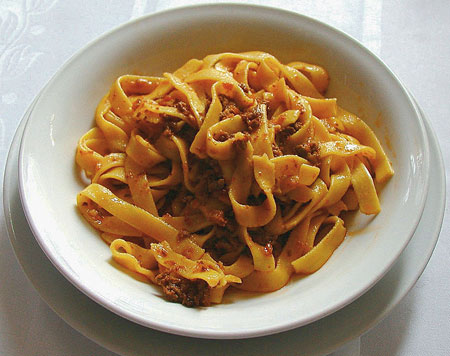
Fresh Fettuccine with Bolognese ragù
FMM: When I was growing up, we called a similar dish without the dairy and the wine, Spaghetti with Meat Sauce, which was basically a marinara sauce with browned meat in it.
Brian and I made this Bolognese recipe once with hot Italian sausage instead of ground beef and it was just as good. Adjust herbs and spices. Brian and I often serve Bolognese Sauce over Bucatini, also called Perciatelli, a long tube shaped pasta with a hole in the center (see Pasta Shapes). Homemade tagliatelle, fettuccine or pappardelle would pair beautifully with the sauce. Pappardelle is traditional (recipe for Homemade Pappardelle).
Bolognese sauce (Italian: ragù alla bolognese, French: sauce bolognaise) is a meat-based sauce for pasta originating in Bologna, Italy. The sauce dates back at least to the 5th century. Tomato was added after the discovery of the New World.
The traditional recipe, registered in 1982 by the Bolognese delegation of Accademia Italiana della Cucina (see below), confines the ingredients to beef, pancetta, onions, tomato paste, meat broth, white wine, and milk or cream.
However, different recipes, even in the Bolognese tradition, make use of chopped pork or pork sausage, white chicken, rabbit, or goose liver may be added along with the beef or veal for special occasions, and today many use both butter and olive oil for cooking the soffritto of small amounts of celery, carrot and onion. Prosciutto, mortadella, or porcini fresh mushrooms when in season may be added to the ragù to further enrich the sauce.
Milk is frequently used in the early stages of cooking to render the meat flavours more delicate but cream is very rare in the everyday recipe and only a very little would be used. According to Marcella Hazan (an Italian-born food writer who is known as the queen of Italian cooking) in The Classic Italian Cookbook, the longer Ragù alla Bolognese cooks the better; a 5- or 6-hour simmer is not unusual.
The people of Bologna traditionally serve their famous ragù with freshly made tagliatelle (tagliatelle alla bolognese) and their traditionally green lasagne. It should be noted that the Italians do not pair Ragù alla Bolognese with the pasta shape spaghetti as is common in other European countries. Wider shaped pastas are thought to hold up to the heavy sauce better.
Traditional Bolognese Sauce
Recipe issued by the Bolognese delegation of Accademia Italiana della Cucina
Recipes differ greatly from a very classic and time-consuming ragù alla bolognese to a much simpler and quicker sugo di carne (‘meat sauce’). This recipe issued in 1982 by the Bolognese delegation of Accademia Italiana della Cucina confines the ingredients to beef, pancetta, onions, carrots, celery, tomato paste, meat broth, white wine, and milk. However, different recipes, far from the Bolognese tradition, make use of chopped pork, chicken or goose liver along with the beef and/or veal for variety, or use butter with olive oil. Prosciutto, mortadella, or porcini mushrooms may be added to the soffritto to enrich the sauce. A simple but authentic form of ragù alla bolognese may be made as follows:
- Prepare a soffritto of finely chopped carrots, onions and celery and other aromatics in olive oil.
- Brown [some recipes say cook it just until it no longer looks raw] finely minced meat (beef flank and pancetta) in the soffritto. (As a shortcut, ground meat can be substituted for minced meat, at the cost of increase textural flaws. Such meat is rarely lean and the sauce is liable to be excessively greasy.)
- A splash of cream or milk should be added now. This protects the meat from the acidity of the next 2 ingredients.
- Add a half-glass of white wine and let it reduce.
- Add small amounts of tomato sauce and stock.
- Simmer very gently until the meat softens and begins to break down into the liquid medium. This may take upward of four hours; classically one to two hours is enough.
The Recipe
300 g beef cartella (thin skirt)
150 g pancetta, dried
50 g carrot
50 g celery stalk
50 g onion
5 spoons tomato sauce or 20 g triple tomato extract
1 cup (250 mL) whole milk
Half cup white or red wine, dry and not frizzante
Salt and pepper, to taste.
Procedure: The pancetta, cut into little cubes and chopped with a mezzaluna chopping knife, is melted in a saucepan; the vegetables, once again well chopped with the mezzaluna, are then added and everything is left to stew softly. Next the ground beef is added and is left on the stovetop, while being stirred constantly, until it sputters. The wine and the tomato cut with a little broth are added and everything left to simmer for around two hours, adding little by little the milk and adjusting the salt and black pepper. Optional but advisable is the addition of the panna di cottura* of a litre of whole milk at the end of the cooking.
*panna di cottura: whole milk reduced in a saucepan to at least half its volume
*Bolognese Sauce (this is the recipe we use)
While traditional Bolognese Sauce does not have herbs added, oregano, parsley and basil are good choices if you would like to add some. Brian and I add 1/2 Tbsp. dried oregano, 2 Tbsp. dried parsley and 1 Tbsp. dried basil - we usually make this in the winter, otherwise we would probably add fresh herbs. I've also added the carrot to the recipe; sometimes the sauce seems to lack some depth that I think the slightly sweet carrot adds to it, plus it is in the traditional recipe. Some Bolognese recipes call for carrots; other don't.
1 Tbsp. olive oil
1 Tbsp. butter
1 medium onion, finely chopped
1 stalk celery, finely chopped
1 carrot, grated
1 clove garlic, minced
1 pound ground beef
1/2 pound ground pork
1/4 pound pancetta or bacon, finely chopped
1/2 cup heavy cream
1 can (14 oz.) whole tomatoes in juice
1/2 cup white wine
1 can (13 3/4 oz) beef broth
1 can (6 oz) tomato paste
Herbs, as listed above
salt and pepper
1 pound bucatini pasta (like spaghetti, but wider and hollow in the center - like a long tube) - also called perciatelli
or homemade tagliatelle or fettuccine
In a 6 to 8-quart, heavy-bottomed saucepan, heat the olive oil and butter over medium heat. Add the onion, celery, carot and garlic and sweat over medium heat until vegetables are translucent.
Add beef, pork and pancetta to the vegetables, cook over medium-high heat until meat just turns brown in color, stirring to keep meat from sticking together, about 15 to 20 minutes.
Add the cream and simmer until almost dry, about 10 minutes. [I have read that adding the cream now, rather than later, keeps the meat tender.]
Add the tomatoes and simmer 15 minutes. Add the wine, beef broth and tomato paste; bring to a boil, lower the heat, and simmer for 2 to 2 1/2 hours, until flavors are developed. If the sauce is getting dry, add some water and continue to cook. Season with salt and pepper, to taste, and remove from the heat.
Serve over bucatini, which has been cooked al dente. Other pastas to try are tagliolini, tagliatelle or pappardelle. (see Pasta Shapes) Homemade Pappardelle would be a great choice if you have the time to make it.
