Ribollita (Tuscan Bean Soup)
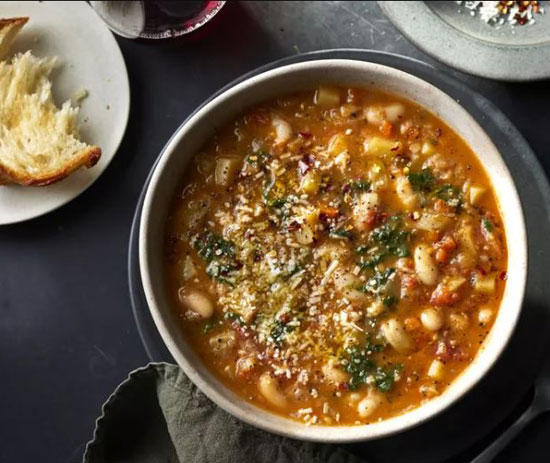
Ribollita (ree-bohl-LEE-tah) is an ancient dish from the Florentine tradition, a perfect comfort food for winter dinners. It is a classic Tuscan soup and is part of the cucina povera tradition of humble, thrifty dishes. The main ingredients of the Ribollita recipe are white beans, vegetables incuding cabbage and lacinato kale, and hearty day-old bread. The name Ribollita means “re-boiled” or “cooked twice” and comes from the fact that it’s usually prepared the day before and then cooked again before serving.
It originated as a way to use up leftovers, such as reheating vegetable soup from the previous day and adding stale bread to thicken it. The legend tells that the tradition of Ribollita started with a particular gift from the Noble people. In the Middle Ages, during the Lords feasts, it was common to serve roasted and grilled meats on flatbread, called trenchers, used as plates. The leftover bread was usually given to the servants, so they started to boil the bread along the vegetables available in their gardens and from wild foraging.
While there are many recipes for Ribollitta, typical ingredients include cannellini beans, cabbage, lacinato kale, and inexpensive vegetables like carrots, celery, onions, potatoes, and chard.
FMM: This recipe typically uses a Soffritto of celery, onion and carrot which should be finely minced.
Pellegrino Artusi recipe for Tuscan Ribollita (1891)
This is a Google translation of the Pellegrino Artusi recipe for Tuscan Ribollita included in his cookbook entitled "Science in the kitchen and the art of eating well" published in 1891 and is the first known recipe for Ribollita. Artusi calls this soup "Zuppa Toscana di Magro alla Contadina", a “lean peasant’s soup from Tuscany”.
Emiko Davies at https://www.emikodavies.com/ writes: "Pellegrino Artusi, the godfather of Italian cooking, calls it Zuppa Toscana di Magro alla Contadina, a “lean peasant’s soup from Tuscany,” and like most things that come from a peasant tradition, everyone’s grandmother knows this recipe by heart and probably does some variation on this. Artusi’s recipe is, more than 100 years later, still the way to do it:"
Google Translation:
Pellegrino Artusi describes his recipe, thus: "I am convinced that this soup, which, out of modesty, is called peasant, will be appreciated by everyone, even gentlemen, if made with due attention."
List of Ingredients:
"Stale brown bread, soft dough, 400 grams.
White beans, 300 grams.
Oil, 150 grams.
Water, two litres.
Cabbage or savoy, half a ball of medium size.
Black cabbage, just as much in volume and even more.
A bunch of chard and a little pepolino.
A potato.
Some carnesecca or ham rinds cut into strips."
Artusi did not list some ingredients that were in his recipe instructions:
[A large onion]
[Two cloves garlic]
[Two palm-long pieces of celery]
[A good pinch of parsley]
[Salt and pepper]
[tomato sauce or preserve (paste)]
"Put the beans on the fire with the aforementioned water, adding the rinds. You already know that the beans must be put in cold water and if they remain dry, hot water is added. While they are boiling, chop with a quarter of a large onion and two cloves of garlic, two palm-long pieces of celery and a good pinch of parsley. Chop it finely, put it on the heat with the above-mentioned oil and when it has browned, pour in the vegetables cut in bulk, first the cabbage, then the chard and the potato cut into chunks. Season them with salt and pepper and then add tomato sauce or preserves, and if they remain somewhat dry while boiling, add the bean broth. When these are cooked, throw a fourth part of them, left whole, among the vegetables, adding the rinds; pass the others through the sieve and dissolve them in the broth, pouring this too into the vase where the herbs are. Mix, boil a little more and pour everything into the tureen where you have already placed the bread cut into thin slices and cover it to serve after about twenty minutes.
"This quantity can be enough for six people; It's good hot and better cold."
Ribollita
from https://www.foodandwine.com/
FMM: This recipe is very similar to Artusi’s recipe from 1891, especially if you compare it to a lot of other recipes on the Internet. Those are more like a vegetable soup with some beans added.
Ribollita is a rustic Tuscan bread, bean, and greens soup with roots in Italian peasant cooking. Ribollita translates to reboiled; the soup was traditionally made by adding day-old bread to leftover soup. While it may have humble origins, this soup has become a comforting and delicious classic.
This bread along with the potatoes gives this recipe a creamy texture. Adding a Parmesan rind to the pot as it simmers deepens the savory flavors of the soup. Tomatoes brighten the flavor profile while Tuscan kale brings balance to the flavor and texture. This soup is delectable to eat on the day it’s prepared but gets even better the next day.
Food & Wine Editor-in-Chief Hunter Lewis explains his journey to find the perfect ribollita, and how he found this recipe:
I chased the flavor of a proper Tuscan ribollita for 17 years until I ate the genuine article again, finally, at now-closed Leonti, Adam Leonti's swanky Italian restaurant in New York City. Leonti's deeply savory version of the Tuscan bread and bean porridge was even better than the one I remember from a small hillside restaurant in Siena, Italy, so many years ago. . .
Leonti learned how to make ribollita from a restaurateur from Lunigiana, a three-hour drive northwest of Siena, paying close attention to the porridge's humble elements: grassy-green, peppery olive oil; earthy, rustic bread; small, thin-skinned white beans; and most importantly, sofrito, the finely chopped, slow-cooked mixture of carrots, onions, and celery that gives ribollita its extraordinary flavor. . .
1 cup extra-virgin olive oil, plus more for serving [use a lot less, 1/3 cup? just enough to cook the carrots, onion and celery and coat the greens a bit]
1 large yellow onion, finely chopped
1 large carrot, finely chopped
1 celery stalk, finely chopped
1 teaspoon kosher salt, plus more
8 garlic cloves, finely chopped (optional)
1/4 teaspoon crushed red pepper (optional)
1 1/2 cups crushed tomatoes (preferably San Marzano) (from 1 [15-ounce] can)
1 1/2 cups unoaked white wine
8 cups water or chicken stock
3 stale Tuscan-style bread (rustic country loaf or boule) slices, crusts removed, and bread cut into 1/2-inch pieces (about 3 1/2 ounces)
1 large bunch of kale, stemmed and thinly sliced into 1-inch pieces
1 (4-inch) Parmesan cheese rind (optional)
2 (12-ounce) Yukon Gold potatoes, peeled and diced
4 cups cooked cannellini beans (or other thin-skinned white beans) (from 2 [15-ounce] cans or homemade)
Freshly ground black pepper
Grated Parmesan cheese, for serving
Heat olive oil in a large, heavy pot or Dutch oven over medium-low. When oil shimmers, add onion, carrot, and celery; stir to coat with oil. Stir in salt to help draw out liquid from onions and season the foundation of the soup. Cook, stirring often and scraping bottom of pot with a flat-bottomed wooden spoon, reducing heat as necessary to maintain a gentle sizzle, until mixture is very soft and translucent, about 30 minutes. Increase heat to medium; cook, stirring often, until sofrito is caramelized, about 10 minutes.
Stir in the garlic and crushed red pepper, if using; cook, stirring constantly, about 1 minute. Stir in crushed tomatoes and wine, and stir, scraping up any browned bits on bottom of pot, until mixture is well combined. Increase heat to maintain a vigorous simmer (be careful of splattering tomato). Cook, stirring occasionally, until mixture is reduced to a jam-like consistency, about 20 minutes.
Add 8 cups water, bread, kale, and Parmesan rind, if using; stir, scraping bottom of pan to fully incorporate sofrito into liquid. Simmer until kale is tender and bread is dissolved, about 20 minutes. Stir in potatoes, and simmer until partially tender, about 15 minutes.
Meanwhile, puree 1 cup beans with 1 cup tap water or bean cooking liquid (if not using canned). Add bean puree and remaining 3 cups beans, and simmer until beans and potatoes are completely tender but not falling apart, about 25 minutes. Season with about 1 teaspoon more salt, or to taste, and a generous amount of black pepper.
Let soup cool to room temperature; cover and chill up to 3 days. Reheat soup gently before serving, and adjust seasonings as necessary. Divide among bowls, and top each with a drizzle of olive oil and freshly grated Parmesan cheese. Serve hot.
