Soffritto: Traditional Italian Flavor Base
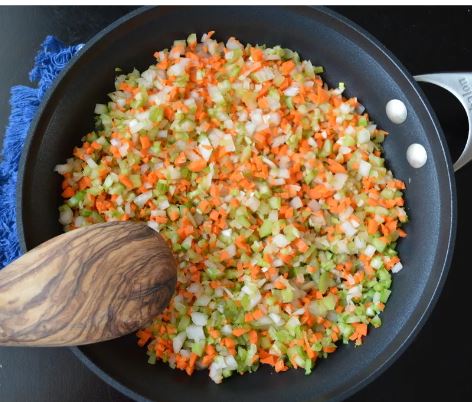
Soffritto (soh-free-toh) is to Italian cuisine as mirepoix (meer-pwah) is to French food. They are both culinary foundations, highly versatile and adaptive, and equally crucial to master if you want to create exceptional dishes from either cuisine. While some might argue that these base aromatic building blocks are interchangeable (both are made using onions, carrots and celery), there are subtle yet substantial differences.
The most obvious is that traditionally soffritto is made using olive oil, with butter added only in some regions of the country. Conversely, mirepoix is often cooked in butter or a mixture of butter and olive oil.
Other differences include the size of the vegetables, as mirepoix is often a small dice, whereas soffritto is a smaller mince-like size. Mirepoix vegetables are cooked low enough to become soft but do not pick up any color; this is also not the case for soffritto, which often takes on a golden, caramelized color if cooked for longer.
Soffritto versus Spanish Sofrito: Though these two words are pronounced in the same way and are spelled in a very similar manner, make no mistake, they're different and should be treated as such. Soffritto comes from Italian cuisine, while sofrito, spelled with just one 'f' and one 't,' is Spanish. Not only do spellings differ, but ingredients do too! The Italian soffritto combines carrot, onion, and celery, which have been finely minced and gently fried together in oil to create an aromatic base for many different dishes. Spanish sofrito, on the other hand, varies from region to region yet often combines onions, garlic, and tomato (regularly in the form of a paste). The results, you can imagine, are very different, as are their uses.
How Soffritto is made:
Soffritto is a mixture of minced onion, carrot, and celery, gently fried in olive oil until soft and fragrant. Soffritto means "fried slowly."Much like the cuisine, the Italian language often cuts straight to the point. Soffritto is also referred to as battuto, which means "to beat down." (While the base of most Italian soffritto is made up of onion, carrot, and celery, other aromatics can be added, often based on regional traditions or the intended dish.)
By slowly and gently frying the mixture of vegetables, the low heat and copious amounts of olive oil encourage each element to release its natural flavors, which are used then as a base from which to build even more depth of flavor. Soffrittos are often used as a base for slow-cooked dishes, including stews, soups, and sauces. It is sometimes referred to by chefs as the "holy trinity," a term that can apply to many different base flavor combinations across various cuisines.
Fundamentally, the ratio you'll want to consider to create a balanced mix of all three vegetables is two parts onion, one part carrot, and one part celery. Whatever size you intend to make, it is imperative to cut your vegetables into same-sized pieces; ideally, the smaller, the better for quicker cooking. This can be done with the press of a button in a food processor, by hand with a sharp knife, or by using a traditional Italian tool known as a mezzaluna. You may recognize this tool from its curved shape and double-sized handles, allowing for quick rocking-meets-chopping motion that can feel soothing once mastered.
Once cut to your desired size, it's time to fry. Using a heavy-bottomed pan or skillet and a generous amount of olive oil, gently heat the oil, then cook vegetables for as little as five minutes for a lighter-tasting mix or as long as 25 minutes for more depth of flavor. Whichever you choose, keep vegetables soft and caramelized rather than crispy. In some regions of Italy, a little bit of butter can also be added to the olive oil.
Recipes based on Soffritto
Minestrone
Tuscan Bean Soup
Ribollita (a Tuscan Bean Soup made with day old bread)
Pasta e Fagioli (bean soup w/ pasta)
Lentil soup
Bolognese Sauce
Naples' Genovese Sauce (onion & beef)
Pasta w/ Short Ribs
