Korean Cuisine
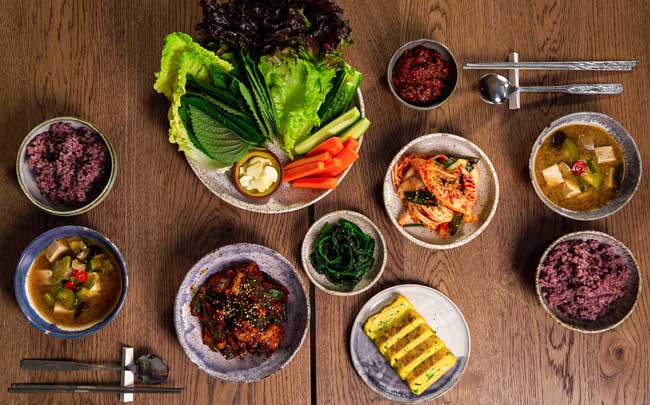
Much of the food that exists in Korea today and the customs surrounding it have come from royal cuisine and the complex customs of the ancient court. The food is a study in balance with careful consideration given to temperature, spiciness, colour and texture along with considered presentation.
The cornerstone of Korean food is rice, which forms the backbone of almost every meal, although is sometimes replaced with noodles. The meal usually starts with ritual bowls of rice and soup. Korean barbecue may get all the attention, but soups and stews really make up the backbone of the Korean diet. Historically, beef was a scarce commodity, so grilled galbi and bulgogi were reserved for special occasions. No matter what else is on the dinner (or breakfast) table, there's always soup or stew, sometimes serving as a palate cleanser between bites of heavier dishes.
Like everything else on the table, the soup or stew is meant to be eaten with rice, but how you choose to eat it is largely up to you. Some people will choose to tip a fair amount of rice into their soup, creating a kind of porridge-like consistency, whereas others will alternate sips of soup or bites of stew with mouthfuls of rice.
The main thing to be aware of is where you place your soup bowl in relation to your rice bowl. Etiquette dictates that the rice bowl should always be to the left of the soup/stew bowl. Putting the rice bowl to the right of the soup/stew bowl symbolizes death, and is typically only seen during meals in which Koreans are celebrating their deceased ancestors.
The rest of the meal is built around numerous shared side dishes selected to complement each other. The number of side dishes may vary from two to a dozen or more but everyday meals will include at least a few. All dishes are served at once to share, rather than in courses. A Korean banquet consists of many dishes cooked in various ways, including being steamed and simmered, pan-fried and stewed, fermented and raw.
Popular spices and sauces include: sesame and sesame oil, chilli pepper paste (kochujang), soybean paste (daenjang), garlic, ginger and chilli pepper flakes. Korean food tends to be intensely flavoured, spicy and pungent.
Meat Dishes
Having a protein-rich dish, whether it features meat, seafood, or tofu, isn’t a requirement, but it is increasingly common. Because Korea is a peninsula, seafood is also very popular. Traditional restaurants often feature charcoal grills in the middle of the table - a type of indoor barbecue. Paper-thin slices of marinated meat (bulgogi – literally "fire meat") or beef ribs (kalbi) are grilled, cut into pieces.
Hearty meat dishes are typically also accompanied by ssam, leafy vegetables like perilla leaves, cabbage, and lettuces that can be used to create small, delicious packages of meat, rice, and flavorful accoutrements, like raw sliced garlic, gochujang (chilli paste), doenjang (soybean paste), ssamjang (spicy dipping sauce).
It’s polite to keep your ssam-package small enough to be eaten in one bite as it's considered the height of rudeness to bite into a lettuce parcel. A corollary of that rule is you want to make sure the different elements you pack into a ssam are roughly proportionate, so you have a balanced bite. For example, if the pork you’re eating is highly seasoned, exercise a little restraint on the ssamjang; if you grab a small piece of pork, don’t overwhelm it with a large pile of rice; etc.
Banchan: Side Dishes
Anyone who’s had the pleasure of eating at a Korean barbecue restaurant will be familiar with banchan, the large collection of preparations that are plonked on the table as soon as you order. Banchan aren’t really meant to be treated like appetizers or condiments, though. Instead, they can be loosely described as "side dishes." The banchan category includes the whole class of pickled preparations that fall under the broad term of "kimchi," but it also can include everything from potato salad and stir-fried dried anchovies to namul, or simply dressed blanched vegetables, like bean sprouts or spinach.
The Koreans have perfected the art of preserving food, so many side dishes are picked, fermented or salted and many are spicy. Kimchi, Korea’s famous spicy cabbage, which has over a hundred varieties using different vegetables, is a constant of every meal. It is adored for its sour tangy crunch as well as being a digestive aid.
Banchan provide a fair amount of variety to every meal, they are meant both to serve as accompaniments to the rice and as relievers of palate fatigue—the rolled omelette is a perfect example, meant to offset the spicy pork, the savory stew, and the other more boldly flavored banchan. A full spread will typically have at least a few, balanced banchan, although more elaborate meals can be served with as many as 10, 15, or even 20 different banchan.
See Banchan
Cutlery
One of the first things you may notice upon sitting down to a Korean meal is the cutlery. Korean place settings will always have both chopsticks and a spoon. Unlike their Chinese or Japanese counterparts, Korean chopsticks are flat, not rounded or pointed, and are typically made from metal.
Koreans also tend to use the spoon instead of chopsticks for eating rice. Because of that, it’s considered rude to lift the rice bowl when eating from it, as is common in, for example, Japan, where lifting your rice bowl while using chopsticks to pick up the rice is incredibly common.
Lifting other plates off the table in order to eat from them is also considered impolite.
