The Flower of Wheat: Bread in the Middle Ages and Colonial Era
from http://www.engr.psu.edu/MTAH/articles/flower_of_wheat.htm
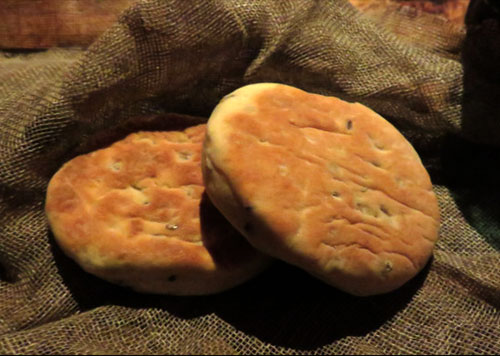
Early Middle Ages
After the "fall" of the Roman Empire, much of Western Europe was left at the mercy of various "barbarian" tribes. Britain, which was a grain powerhouse during the Roman occupation, had their agriculture virtually destroyed by invaders from the north. Rye, which had been an important grain in Roman Britain was "introduced later by the Saxon and Scandinavian conquerors who came from areas where rye had already for centuries been the predominating bread grain."
Even with the disorder that came after the departure of the Roman Empire, the desire for bread remained.
During the Middle Ages, Manorialism becomes the norm in rural parts of western Europe. During this time, most of the grain mills and bakeries came under the control of the lord of the manor. Lords “automatically owned the milling rights on grain grown by anyone living upon and tilling the land within his manorial domain.” Water mills, which were fairly common under the Romans, had again flourished after the early invasions and by the Norman conquest in 1066, there were almost 6,000 watermills serving 3,000 communities south of the Severn and the Trent.
As in earlier times, bread was usually not baked at the home. Ovens were far too dangerous to keep near the highly flammable dwellings so most “bread ovens were built well away from inhabited areas, usually near a river”. “In towns, ovens were owned by a lord or by a professional Fournier, or oven keeper; in the countryside they were the property of the lord or of a rural community. They were first and foremost for baking bread; they were not indispensable for pastries, which were sometimes cooked in containers placed on the floor of the fireplace surrounded by embers”. And even though bread can be cooked similarly in containers, it was far more convenient for the medieval cook to purchase the bread because of the massive quantities that would be consumed by the household.
Later Middle Ages
Bread was the essential food for all classes of society in the Middle Ages. The basic element, common to every table, was the pain de mayne, the hand-bread or table loaf, a round, bellied bread to be eaten plain, however else bread was incorporated with the meal. Recent historical studies have revealed surprising similarities in the statistics for bread consumption across class and geographic boundaries, confirming the centrality of this staple food in the medieval person's diet. Rather, differences of social status and era present themselves in the composition of that bread, as well as the source of its production.
Once bread or porridge was produced, its uses were virtually endless in medieval cooking. However, there are few recipes for the making of bread in medieval manuscripts; it was a separate and distinct professional craft, and therefore not included in cookbooks or domestic manuals. No recipes for porridge were given either, as the boiling of grains was assumed to be intuitive. Descriptions of common meals, menus and uses of bread and grains inform our views, though. The well-to-do often enjoyed a fine white bread bun for breakfast, sometimes with currants or raisins in it, resembling a brioche. Peasants, on the other hand, often ate their coarser black bread with raw apples or cheese for breakfast or a working lunch in the fields. [See Breughel unit.] The staple food for the broadest section of society at the main meal was a soup or stew — the French potage — made of beans and/or game. If not served in trencher bread, it was often poured directly over a hunk of coarse bread.
Early bread was made from mixtures including wheat, acorns, nuts, millet, barley, rye, oats, peas, beans and whatever weed seeds were harvested along with the grain. Since wheat is the best source of gluten making it most suitable for producing a light, risen loaf, its use soon predominated over that of other grains. Mediaeval European peasants also ate bread made from mixtures of grains, peas, acorns and weed seeds, but since Roman times, all 'refined' and 'civilised' people have preferred soft, white, wheaten bread. Although rye and barley were the chief bread grains in Britain until about AD 1700, coarse breads containing flours other than white wheat flour became very rare after that time.
Mediaeval bakers in many European countries developed a barm of flour, water, malt, and hops, which they left to get sour. They would then mix their bread in the same wooden bread trough each time, making use of the leavening culture which remained from the previous use.
Writing from Baghdad in the 10th century, Ibn Sayyar al-Warraq, gives his thoughts on the best kinds of bread to eat: "Wheat bread agrees with almost everybody, particular varieties made with a generous amount of yeast and salt and allowed to fully ferment and bake well. Such breads are lighter and digest faster. Jizmazaj (thin bread with tamarisk seeds) and ruqaq (very thin bread) are by comparison less nourishing and digest much faster. Bread baked in malla (pit with hot ashes and stones), tabaq (large flat pan) and any other similar varieties that do not ferment or bake well are hard to digest and cause stomach aches. Only people used to strenuous labor can eat them more often."
White Table Bread & Trenchers
Two main types of bread dominated the production of medieval bakeries, table bread and trenchers. In richer aristocratic and bourgeois kitchens, bread and cereals were not used so much as the center of the meal, as the essential matrix that held it together. The most common appearance was simply as the centerpiece of the table, the pain de mayne and the trencher bread that held the meat, gravies, purees and other dinner foods. The quality of that tough outer trencher crust was essential to the success of the feast.
This object receives frequent mention in literature, even idiomatic usage ("a good trencherman"), and occupies a position somewhere between tableware and food. The Menagier de Paris gives specifications for the desired size of a trencher: "half a foot long, by four fingers, by four fingers." These relatively small loaves would then be turned over and over in the oven until hard, flat crusts formed on both sides, so that, when cut horizontally, the soft bread remaining would dissolve to form a relatively sturdy pair of bowls. With trenchers, staleness was actually an asset, so the menagier tells his wife to demand four-day-old trencher bread from her baker, for the best dinner party.
Since structure was critical with trenchers, brown bread was ideal, but colour was quite a different matter with pain de mayne. Wheat had historically held the place of primacy among grains for purposes of bread baking because of its prevalence in the Mediterranean lands. It should be noted, though, that the term "wheat" was used somewhat generically by some writers, and sometimes encompassed a number of different related grains, including varieties as different as spelt, a hard wheat valued for its high nutritional capacity. Rye, on the other hand, was the grain most easily grown in the British Isles and northwestern Europe (Scandinavia, Germanic lands, Netherlands, much of France), and remained the most common cereal crop until the end of the eighteenth century. Oats and barley were also widely available, but were commonly used as animal fodder, so remain absent from medieval bread production.
Over time, the whiteness of wheat flour and the bread made from it became a sign of times of plenty and of high social status because of its relative scarcity in the medieval diet. It was not until the late 19th Century, and the introduction of new farming practices, when wheat was able to be grown all over the country, and also be imported from the rest of the world, that bread became commonly baked with only wheat in Britain. The standard of excellence, prized above all on the medieval dining table, was the pure white leavened bread, sometimes even called 'cake.' Medieval physicians even maintained that this bread had special curative properties, when, in fact, it actually had less nutritive value than the breads which left in more of the wholesome wheat bran, just as the good old Wonder Bread ads used to claim in the 1950s and '60s. Mixture of flours also acquired the mark of lower status, signifying the adulteration of the flour of pure wheat, and peasants became associated with black bread, the dark ryes and whole grain varieties, often made with whatever grains (sometimes with whatever plant materials, period) they could find and grind. The vast majority of the population fell in between, eating meslin or maslin bread (Fr. metail, or miscelin, meaning mixture), a mixture of wheat and rye flours that was most economical in the growing climate of Northern Europe.
American Colonies
Bread composition changed even further once it reached the shores of America, to reflect its new agricultural and economic environment. It appears that corn went into immediate use, ground into flour, thereby earning its place in the breadbaking mix. Cornmeal alone, however, yields the griddle-cooked "johnny cake" or "corn dodger," rather than a leavened loaf. Bread's ongoing prevalence lay in the colonists' continued reluctance to adopt the potato as an acceptable carbohydrate, on account of its membership in the nightshade family. Perceptions of healthiness of heavy vs. light breads appear to have been left behind as colonists crossed the Atlantic; the new environment, with its radically redefined notions of status and starvation, as well as a different growing environment, changed attitudes toward acceptability of bread products. While refined white wheat bread would still have status implications in the urban centers, much of the negative connotation associated with lesser admixtures fell by the wayside. Famed American journalist William Cobbett notes that, though Long Islanders are very prosperous, nine out of ten families rarely eat wheaten bread; instead they usually have rye.
The Poor
One might assume that the poor would receive less bread than the wealthy, as well as poorer quality bread, but recent studies of medieval and colonial bread consumption prove exactly the opposite. In fact, consumption figures for various countries are surprisingly similar as well. In the houses of late medieval English nobility, every individual is given a standard daily food ration of between two and three pounds of wheat bread and about a gallon of ale. What is even more striking is that the nearby castle garrisons are provisioned at almost exactly the same rations, as are the local hospital inmates. Crossing into the French provinces, the 3500 residents of Chambéry appear to have received approximately 24 litres of wheat per month, which likewise averages out to about a two-pound loaf of bread per day. These figures back up the notion that bread is the absolute staple of the medieval diet throughout Europe, at all levels of society. Remarkably, this amount appears again, virtually unchanged, in the everyday diets of the working residents of the American colonies. Social historians like Stephanie Grauman Wolf and Billy Smith have shown that the average colonial, living in Philadelphia between 1750 and 1800, also got by on "a pound and a half of grain in some form, usually bread," supplemented by small amounts of other food groups such as dairy and meat, just like his medieval counterparts.
Commercial Bakers & The Guilds
Who produced all the bread consumed by medieval people? Commercial bakers — and the best indication of the importance of their product and their profession in the medieval society was the amount of regulation placed on them. This regulation was both internal and external in origin. Bakers organized themselves into self-regulating commercial trade cooperatives known as guilds. These collectives functioned as a combination of trade union and market monopoly and regulatory body. Guilds compelled bakers to join their groups; no rogue enterprises were allowed in guild territory. Once you paid in, however, your business and your family enjoyed the protections associated with guild membership. As a master baker, you could take and train apprentices, without fear of having your proprietary recipes stolen and used to establish another profitable bakery under someone else's name. If anything happened to you or your business, the guild would pay out a kind of insurance money to your family. Since all bakers were guild bakers, the guild fixed prices on baked goods in the region, as well as overseeing the quality in guild bakeries and securing good prices on raw materials from other merchants and manufacturers. The guilds comprised a powerful force in medieval urban life, especially when they controlled the most important portion of the medieval diet.
So who protected the consumer against the guilds? Well, technically, that was where the state came in. But the state could not fight every battle on the common man's behalf, so only two foods were deemed important enough to legislate — beer and bread. The king's court came to oversee aspects of weight, quality and price on the most necessary foods.
Bakers were required to use what are called maker's marks. Very often bread was baked on top of a metal figure which pressed the baker's mark into the bottom of the loaf.
Throughout the medieval world there were regulations about how to make and sell bread. Because this food was so central the people’s lives, authorities needed to make sure that even the poor could afford to buy it. In some places, the government would make sure that the price of grain did not rise too much (although this might lead grain sellers to ship their merchandise elsewhere), while in England the Assize of Bread was created in the 13th century. These laws set up price controls for bakers, which would allow someone to buy at least some quantity of bread for a penny. Every year at least the size of this bread would be set according to the price of wheat and other grains – if the grain supply was expensive, your penny would only get you a small amount of bread; if grain was plentiful, than the size of the loaf would increase.
This system would last in England for over 500 years, although bakers occasionally tried to cheat by selling bread that did not meet regulations. In fourteenth-century London, for example, bakers were caught selling bread that had been mixed with dirt or chalk or even had an iron-bar inserted into it to make it weigh more. See this lecture by Barbara Hanawalt on Fraud among the Victualers in Medieval London, which included much about bad bakers.
From the Assize of Bread and Beer:
"Assisa Panis (Assize of Bread): When a Quarter of Wheat is sold for 12d., then Wastel Bread of a farthing shall weigh =A36 and 16s. But Bread Cocket of a farthing of the same grain and bultel, shall weigh more than Wastel by 2s. And Cocket Bread made of grain of lower price, shall weigh more than Wastel by 5s. Bread made into a Simnel shall weigh 2s. less than Wastel. Bread made of the whole Wheat shall weigh a Cocket and a half, so that a Cocket shall weigh more than a Wastel by 5s. Bread of Treet shall weigh 2 wastels. And bread of common wheat shall weigh two great cockets.
When a quarter of wheat is sold for 18d., then wastel bread of a farthing white and well-baked shall weigh =A34 10s. 8d...."
The Assize of Bread and Beer was first codified in the 12th Century and became fixed in its form in the 14th Century, although changes were made from time to time in regards the weights and costs. It remained in law until the 19th Century.
Types of Bread
There were a variety of different kinds of breads that were available to the public. Maria Dembinska, author of Food and Drink in Medieval Poland describes:
“Based on medieval baking regulations and the daily listings of bread in the royal registers, we know that there are nine broad categories of bread, no counting the many variant transitional forms…. Common rye bread (Siliginis) would equate to a modern whole meal rye. This type of bread was commonly used for trenchers…. Black rye bread (niger) was a fine-grained bread very dark in color…. This bread resembled a dense pudding like German pumpernickel…. Common white bread (albus) was made with farina triticea, farina alba, or a blend of the two…. Binavice (biscotum) is generally rendered into English as rusks, although the Polish term actually means ‘in a double way’. These breads are first baked, then sliced, and finally dried at a low temperature in the oven…. Often reconstituted by dipping in beer or some other beverage…. Wheat rolls or manchet breads (semellae) were of the finest sort of white bread…. Bagels or ring pretzels are called circuli in Polish Latin but bracellus or brachitum elsewhere in Europe…. Rogale or crescent rolls (called crostulli in Latin) are half-moon shaped rolls made of high-quality wheat flour…. The Polish term for flat cakes, plaki…covers a variety of forms without conveying a fixed meaning other than flat shape. Sometimes called a krepel or kreple when referred to in polish…. Tortae were dessert foods made with only the finest grade of bolted flour, since according to the royal accounts only farina alba cribrata was used”.
Maria Dembinska, Food and Drink in Medieval Poland, (Philadelphia: University of Pennsylvania Press, 1999), p. 114-7
Types of Bread from http://www.ladydespensersscribery.com/
You will see I’ve not included manchet bread here. That is because it comes along much later – the term first being used in the 16th century.
In medieval times, as today, bread was a staple food for people both rich and poor. However, like the class divides, bread also varied in its forms – from the posh whiter bread to the coarse peasant breads made from mixed grains and sometimes peas as well. As usual, I had intended this to be a quick and easy post – put down the medieval names for bread and explain what they were. However, when do any of my posts turn out to be quick and easy?
I looked at several online sources for medieval bread and found that they tended to parrot each other and contained generalisations – or just plain bad research! So I had to go back to basics, look at primary sources such as the Assize of Bread and Ale of 51 Henry III and then do the rounds of academic books to see if I could find better information. Well, I did – and I didn’t. Some of the types of bread are easy to describe but others seem to confound even historians as to what they actually might have looked/tasted like. The problem is, bread was such a common part of everyday life that it was not included in the recipe books we have from the medieval era. All we have to go on is the order of bread types and weights in the assize, and a fair bit of assumption.
But first things first… let’s look at the written record.
The Assize of Bread and Ale and Lucrum Pistoris, 51 Henry III (but without the ale bit!)
During the regnal year 51 (1266/7) of Henry III, a Statute was introduced pertinent to the trades of baking and ale making intended to standardise prices based on the price of wheat, type and size of bread. It was not at all popular among the bakers – for a start, it made it much harder to fleece the customers with underweight or poor quality goods. It probably also made it harder for them to make a good profit. The law was also enforced with the Lucrum Pistoris (Gain of the Baker – see below) which stipulated punishments of fines and a spell in the pillory for those not in compliance.
Here, then, is the text of the Assize of Bread, which I will initially work from.
When a Quarter of Wheat is sold for 12d., then Wastel Bread of a farthing shall weigh £6 and 16s. But Bread Cocket of a farthing of the same grain and bultel, shall weigh more than Wastel by 2s. And Cocket Bread made of grain of lower price, shall weigh more than Wastel by 5s. Bread made into a Simnel shall weigh 2s. less than Wastel. Bread made of the whole Wheat shall weigh a Cocket and a half, so that a Cocket shall weigh more than a Wastel by 5s. Bread of Treet shall weigh 2 wastels. And bread of common wheat shall weigh two great cockets. *
So, in order of size/weight, from lightest to heaviest:
Simnel: Simnel is one of the mystery breads, as it was lighter than the very fine wastel bread and yet is not often mentioned in other accounts. I can only assume that it was either leavened differently, or had a different crumb – and was perhaps sold as a smaller item… a bit like a bread roll. It doesn’t seem to have much in common with today’s Simnel cakes by the way.
Wastel Bread: Wastel, although mentioned quite a bit, is another mystery. It was described as a well-sieved white bread, although does not seem to be held in such high esteem as the pandemain (the bread of the elite and so not included in the Assize). However, it is placed above cocket, the ‘normal’ white bread in its quality. In the above Assize text, cocket (see below) is described as having ‘the same grain and bultel’ as wastel. In other words, it was made from the same quality of wheat, and had the same amount of sieving as the flour used for wastel bread. What may have made the difference, was the baking process. Wastel is often described as having a biscuit like texture, so it may have been baked either at a higher temperature, or for longer than cocket loaves. This does not mean however that it was a biscuit. My bet at the moment is that it may have had a scone like texture.
Cocket Bread: The most common of white breads sold, although it seems to have been sold in two grades, with one made from fairly good quality sieved flour and the other being made from grain that had not been sifted quite as well (and so still contained some of the bran, making it heavier and darker than its more expensive namesake).
Whole wheat: This was probably similar to the wholewheat bread we have today (although without all of the additives!). It is possible that this bread was also called ‘Cheat‘ in some other accounts. It was the best of the wholewheat breads.
Treet and Common wheat: Once again, this gets a bit confusing, as all the descriptions I have seen of Treet (or Tourte) was that it was similar to our granary loaves of today – a very coarse, heavy bread in which all the usually sifted out bits were left in. As such, it was the lowest form of wheaten bread available and fairly cheap and common. The term ‘common wheat’ kind of implies the same, but as they’re listed as two separate items in the Assize, there must have been some sort of differential – maybe, like cocket, treet had an inferior version – but that is just my supposition.
Four day old tourte was used to make trenchers. Cut in half with some of the middle hollowed out, it served as a plate for the main meal – usually in wealthy houses. It acted to mop up sauces and juices from the meal and, together with any leftovers, was gathered by the household’s almoner and given to the poor. In less wealthy houses without an almoner, these ‘plates’ would be given as food for the pigs.
Other Types of Bread Not Mentioned in the Assize:
Pandemain (paindemaigne, paynemaine): Literally, the lord’s bread – the highest quality of loaf made from the best wheat flour sifted about three times to get rid of as much bran as possible. Being of such high quality, it was reserved for the nobility and also for Communion bread. It did not appear in the Assize as it would have been baked in the ovens of large households and so would not have been on general sale to the public.
Maslin: A bread made from a mix of wheat and rye flour. It was generally made by peasants and was quite common.
Rye bread: Rye was the commonest crop grown by the peasant population and so was used often for baking bread as it was , in good harvest years anyway, readily available. It made a dark and dense loaf.
Oat cakes (havercakes, clapbread): Oat bread or oatcakes were more common in northern regions as oats grew better in a colder, wetter climate than many other crops. Conversely, oats did not thrive as readily in southern counties. These would more commonly have been baked on griddles or bakestones rather than in an oven.
Barley bread: Although less palatable a bread than wheat or rye, barley was also used in bread production, although not as often. It was a crop as widely grown as rye, but it tended to be used for producing ale rather than bread.
Horsebread: The poorest of all breads eaten only by horses or the poorest of people. Made from the flour of milled peas and beans mixed with bran and any other scrap of flour that could be obtained.
Leavening of Bread
Medieval people did not have the benefit of popping to the supermarket to buy a packet of active dried yeast and so had to make their own leavening. This would either have been a sourdough starter (a mix of water and flour left to stand and ferment with the wild yeasts that exist in the air), or, more usually, an ale barm. This is the frothy stuff that can be skimmed from the top of fermenting ale. As the brewing of ale and the baking of bread tended to occur side by side and on an almost daily basis, it would have been simple for bakers to obtain it.
Stale Bread Uses
The home kitchen also recycled all stale table bread — drying, grilling, or even charring it, to make crumbs for incorporation into sauces. Once broken down, bread could be soaked in broth, vinegar or verjuice; it would be sieved, then set aside for last-minute incorporation in a sauce as a thickener. Other crumbs, the paler ones, would be crushed and made into a panade, then sieved and added to the sauce at the boiling point. At that moment, it would break down, losing its own texture and making the sauce smooth, shiny, translucent, and creamy. If added to milk or stewed fruit over gentle heat, then cooled, it could even become a flan or custard. With knowledgeable use, the staple of the medieval diet could create a symphony of textures and flavours in the medieval kitchen.
What do we know of medieval bread recipes?
Recipes
The only recipe that purports to come from a 14th century source, although this source is now unknown, is a recipe for Manchet. It states that the flour is "ground and bolted through the finest cloth," then put into a kneading tub. It states that a hollow is made in the flour into which you put ale barm; "three pints to a bushel of meal (flour)" and salt. Warm water is then added and the dough is kneaded "through a brake"—a type of dough hook commonly used in bread kneading. The dough is then risen for an hour then formed into "manchets"—small loaves that are rounded on top and flat on the bottom. The loaves are then scored "about the waist" and pricked on top, then baked at a gentle heat.
The Form of Cury includes a bread recipe as a part of a recipe for Rastons, a dish of fried bread. That recipe says to mix good flour, egg white, a little egg yolk and mix together. Add warm barm and work them together, then add in some sugar and let it rise, then bake. That book also advises bakers to use a finely sifted flour and salted water. Then you mix in the leaven (yeast) and rise it in a damp place. We are told that too much leaven will make it sour, but not enough will make it too heavy.
Platina (recipe c. 1431) tells us that bread is best made of finely ground flour sieved to remove the bran. He notes that buns may be flavored with fennel seeds and have fat added from lard, butter, or oil. They may also be formed around fresh cheese or even small birds. There are references to barley bread being most commonly used in monasteries, especially those that did their own brewing. The barley is mixed with wheat to make the flour. Barley bread dates back to Biblical times, and it became more common in the 15th century due to an increase in barley production, probably because of its higher yield than wheats. Also mentioned is "Household Bread," usually given to servants. This was a mixed grain bread that could include wheat, rye, barley, and legumes. A bread made mostly of legumes was fed to horses.
What are the 16th century bread recipes like? Most bread recipes and references are from Elizabethan English sources. The highest quality bread was manchet, made entirely of white flour. One recipe for it is found in The English Hus-wife by Gervase Markham. "French Bread" was similar to manchet but with the addition of egg whites and milk. "Fine Cheate Bread" was a sourdough of mostly white flour, considered second to manchet in quality. "Temmes Rye Bread" was made with rye flour and wheat flour containing some germ and bran. "Meslin Rye Bread" was a half rye half wheat sourdough bread. "Cheate Bread" was whole wheat bread, also sometimes called "coarse cheat." "Brown Bread" was a sourdough whole grain bread considerd inferior and suitable only for servants, slaves, and peasants. "Jannocks," an oat bread, was also considered inferior. Sourdough barley bread was usually baked in very large flat loaves for servants. At the other end of quality was dessert spiced bread. It was a manchet containing butter, sugar, spices, and dried currants.
What do we know about Middle-Eastern Breads? As early as the 9th century, there were bread recipes in Arab cookbooks, but like their European counterparts, these recipes tended to be for special breads, as opposed to the ones people ate every day. "Khushknanaj" was a dessert bread stuffed with almond paste, spices, and rosewater. A 14th century cookbook described baking techniques as well as complex recipes for stuffed breads and breads with elaborate coatings or toppings of seeds, spices, nuts, and cheese. Both wheat and barley bread and mentioned. Most bread seemed to have included eggs, yogurt, and/or butter, making them brioche type breads. Late 15th century Arab food writers describe "nān," "pūrī," and "balloon bread;" a bread that apparently puffs up when fried similar to pita bread.
