Frumenty
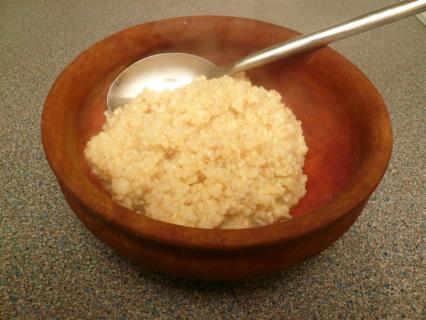
Plain Frumenty
Sweet Frumenty
Frumenty (sometimes frumentee, furmity, fromity, or fermenty) was a popular dish in Western European medieval cuisine. It was made primarily from boiled, cracked wheat - hence its name, which derives from the Latin word frumentum, "grain". Different recipes added milk, eggs or broth. Other recipes include almonds, currants, sugar, saffron and orange flower water. Frumenty was served with meat as a potage, traditionally with venison or occasionally porpoise (considered a "fish" and therefore appropriate for Lent). It was also frequently used as a subtlety. You can think of this as a wealthy noble's version of pottage.
For several centuries, frumenty was part of the traditional Celtic Christmas meal. Frumentee was served with venison at a banquet in the mid-14th century as depicted in the North Midlands poem Wynnere and Wastoure: "Venyson with the frumentee, and fesanttes full riche / Baken mete therby one the burde sett."
In the 1600s, frumenty was commonly served as part of the Mothering Sunday meal in the United Kingdom. The holiday falls on the Sunday between Pancake Day, also known as Mardi Gras, and Easter. For this tradition, the son or daughter would typically bring a bouquet of primroses or violets, as well as a small gift, for the mother. In return, the mother would often provide a bowl of frumenty, a glass of ale and a blessing for the child. The use of eggs would have been a brief respite from the Lenten fast.
By the 19th century, frumenty had become a staple during Christmas Eve dinners. It was typically served alongside cheese, apple pie and yule cake. This dinner was also part of the yule log ritual. Before dinner, the yule log was placed on a fire, and a yule candle was lit and set on the table, not to be snuffed out. The wife of the household would save a piece of the yule log until the next Christmas. This action was believed to protect the house from fire during the year.
Curye on Inglysch, 15th c.
To make frumente. Tak clene whete & braye yt wel in a morter tyl the holes gon of; sethe it til it breste in water. Nym it up & lat it cole. Tak good broth & sweet mylk of kyn or of almand & tempere it therwith. Nym yelkys of eyren rawe & saffroun & cast therto; salt it; lat it naught boyle after the eyren ben cast therinne. Messe it forth with venesoun or with fat motoun [mutton] fresch.
The Modern Version:
10 oz kibbled (cracked) wheat, bulgur may be substituted if necessary
5 cups water
1/3 cup beef stock
1/3 cup milk (or almond milk, see below)
2 egg yolks, beaten
pinch of dried saffron threads
salt to tasteBoil the kibbled wheat in the water until softened, about 15 minutes. Remove from the heat and allow to stand for another 15 minutes or until the water is abosrbed. Add the stock and milk (or almond milk) and bring back to a boil. Reduce heat to low and stir mixture for about 5 minutes. Stir in egg yolks and saffron and continue stirring until the egg starts to thicken. Do not let the mixture boil. Remove from the heat and allow to stand for 5 minutes before serving. The mixture will continue to thicken during this period.
To make almond milk, grind 4 oz of blanched almonds in a mortar or blender with a Tbsp or two of ice water. Put in a bowl and add 1 cup of boiling water. Allow to stand for 15 minutes and strain through a metal sieve. Will last, refridgerated, about 3 days.
Frumente yn lentyn
PERIOD: England, 15th century | SOURCE: An Ordinance of Pottage | CLASS: Authentic
DESCRIPTION: Wheat cooked in Almond Milk
ORIGINAL RECEIPT:
16. Frumente yn lentyn. Take clene pykyd whete. Bray hit yn a morter, and fanne it clene, & seth hit tyl hit be brokyn. Than grynd blanchid almondys yn a morter; draw therof a mylke. Do hit togedyr & boyle hit tyl hit be resonabull thykke: than loke thy whete be tendyr. Colour hit up with safferyn. Lech thy purpas when hit ys sodyn, than ley hit on disches by hitsylfe, and serve hit forth with frumente.
- Hieatt, Constance B. An Ordinance of Pottage. An Edition of the Fifteenth Century Culinary Recipes in Yale University's MS Beinecke 163. London: Prospect Books Ltd, 1988.
GODE COOKERY TRANSLATION:
Frumenty in Lent. Take clean picked wheat. Pound it in a morter, and remove the hull, & boil it until it cracks. Then grind blanched almonds in a morter; make an almond milk. Add the wheat to the almond milk & boil until reasonably thick; make sure the wheat is tender. Color it with saffron. Cut your porpoise after it's boiled, then set it in dishes with nothing else, and serve it with frumenty.
MODERN RECIPE:
- 1 cup cooked cracked or bulgur wheat
- 3 cups Almond Milk
- 1 pinch saffron
- 1/4 tsp. salt
Stir together all the ingredients. Bring to a soft boil, stirring occasionally to prevent sticking, then reduce heat to low, cover and cook for approx. 45 minutes, or until the mixture becomes thick. Be careful not to scorch. Serve as a soup or as a sauce for meat.
Frumenty was one the most popular foods of the Middle Ages, used as an accompaniment to roast meat, venison being particularly favored. However, this particular recipe was intended for Lent and was meant to be served with boiled porpoise! Frumenty recipes appear throughout surviving period cookbooks & manuscripts, proving that its preparation was wide-spread and common. Apparently, any cook worth his or her salt could prepare this dish.
This translation, along with notes, has been published as a related reading in the Glencoe Literature Series (Glencoe/McGraw-Hill) edition of The Mayor of Casterbridge (Thomas Hardy).
Other Recipes
Forme of Cury, S. Pegge (ed.), 1390
I - FOR TO MAKE FURMENTY. Nym clene Wete and bray it in a morter wel that the holys gon al of and seyt yt til it breste and nym yt up. and lat it kele and nym fayre fresch broth and swete mylk of Almandys or swete mylk of kyne and temper yt al. and nym the yolkys of eyryn. boyle it a lityl and set yt adoun and messe yt forthe wyth fat venyson and fresh moton.
Le Viandier de Taillevent, J. Prescott (trans.), 1395
Frumenty. Take wheat, prepare it, wash it very well, and cook it in water. When it is cooked, drain it. Take cow's milk boiled for an instant, add the wheat, and boil it for an instant. Move it to the back of the fire, stir often, and thread in plenty of egg yolks. Some add spices, saffron and venison stock. It should be yellowish and well thickened.
Liber cure cocorum, R. Morris (ed.), 1430
Furmente. Take wete, and pyke hit fayre [and clene - Added by Richard Morris] And do hit in a morter shene. Bray hit a lytelle, with water hit spryng Tyl hit hulle, with-oute lesyng. Þen wyndo hit wele, nede þou mot. Wasshe hit fayre, put hit in pot. Boyle hit tylle hit brest, þen Let hit doun, as I þe kenne. Take know mylke, and play hit up To hit be thykkerede to sup. Lye hit up with 3olkes of eyren, And kepe hit wele, lest hit berne. Coloure hit with safron and salt hit wele, And servyd hit forthe, Syr, at þe mele. With sugur candy, þou may hit dowce, If hit be served in grete lordys howce. Take black sugur for mener menne. Be ware þer with, for hit wylle brenne.
7. Frumenty
Take wheat, and pick it fair [and clean - Added by Richard Morris]. And put it in a shining mortar; Pound it a little, sprinkle it with water Till it [casts off its] husks, without picking. Then winnow it well, needs you must; Wash it fair, put it in [a] pot; Boil it till it bursts, then Let it down, as I teach you. Take cow's milk, and boil it up Till it is thickened [enough] to sup. Mix it up with yolks of eggs, And keep it well, lest it burn. Color it with saffron and salt it well, And serve it forth, Sir, at the meal; With sugar candy, you may sweeten it, If it is served in [a] great lord's house. Take black sugar for meaner men; Beware therewith, for it will burn.
Libro di cucina / Libro per cuoco, L. Smithson (trans.)
XXIV - Maize dish (Frumenty) good and perfectly useful. If you want to make a frumenty, take the wheat and beat it well to when it leaves the shell / husk, then wash it well, then put it to boil not much, then throw away the water, then put into it that fat of the meat that you choose, and it needs to be not too much, and mix spices sweet and strong and saffron, and if you do not have wheat take rice; it will be good.
Two fifteenth-century cookery-books, (ab. 1430 A.D.) - Furmenty recipe for Venyson in Broth. Also Furmenty with purpaysse (porpoise) for fish days.
.viij. Venyson with Furmenty.—Take whete and pyke it clene, and do it in a morter, an caste a lytel water þer-on; an stampe with a pestel tyl it hole*. [Hull, lose the husks. ]; þan fan owt þe holys,*. [Hulls; husks. ] an put it in a potte, an let sethe tyl it breke; þan set yt douun, an sone after set it ouer þe fyre, an stere it wyl; an whan þow hast sothyn it wyl, put þer-inne swete mylke, an seþe it y-fere, an stere it wyl; and whan it is y-now, coloure it wyth safron, an salt it euene, and dresse it forth, & þin venyson in a-nother dyshe with fayre hot water.
See Venyson in Broth for recipe for venyson
