Medieval Tarts and Pies
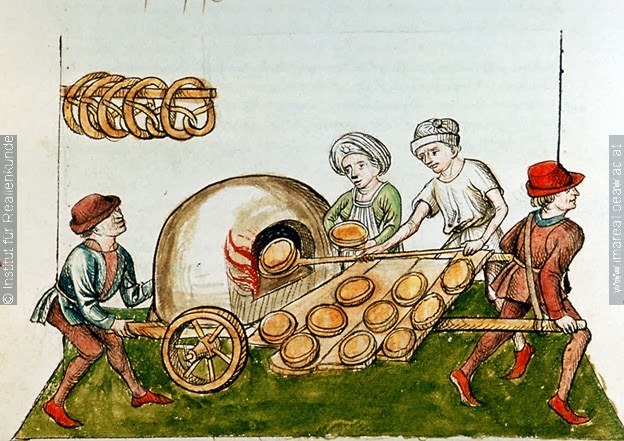
15th century German illustration of roving bakers
How do you differentiate between a tart and a pie? There is no universally agreed correct answer to this – it depends on your own culinary and linguistic heritage. The definition of a 'tart' (and 'pie', for that matter), has never been crystal clear. Both words have been around since at least the thirteenth century, and some cookbook authors use the words interchangeably. Even the Oxford English Dictionary is unclear. It suggests that for a pie, that it is the top crust that is essential, (except in America where a top is not necessary to call a pastry a pie), and it then defines a 'tart' as 'nearly the same as a pie'. The OED prefers the idea that it is related to 'tourte' and 'torta', which originally meant a sort of round flat disc of bread. The OED traces the first use of the word “pie” to 1303, and they were well-known and popular by 1362.
The discussion about the number and location of crusts that define a tart probably misses the point. The original difference may have been to do with the depth of the dish – tarts being shallow compared to pies. 'Pies,' at their most elemental consisted simply of lumps of meat and other ingredients wrapped in dough and baked. The development of mouldable dough (we don't know for sure when this happened) such as the well-known 'hot water crust,' enabled free-standing coffins to be made, and these functioned like casserole dishes do today. See recipe for Raising Pies (from 1870s) and Pastry dough for shaped pies (from 1553). These pies were referred to as bake metes. These are the great free-standing meat pies of the Middle Ages. Soft fruits and custards, which required only short times in the oven, could be made in shallow coffins; the contents then being scooped out from the shell by the lucky diner.
We don't know for sure when the first deliciously edible pastry was developed. The first known detailed instructions for fine pastry appear in an English cookbook of 1545, A Propre new booke of Cokery, but it was certainly around for a long time before that. It is likely that pastry- making (of the buttery, 'short' kind) was raised to an art form by the Italians during the Renaissance, and spread to the rest of Europe from there. Fine pastry such as this could not support large quantities of filling, but did allow the cooking of 'wetter' ingredients such as custards which cooked quickly, and were intended to be eaten within a short time.
By the end of the sixteenth century, cookbooks gave many recipes for tarts. In one book published in 1591, called A Book of Cookrye, there are several recipes for tarts. The fruit tarts are often given in two versions – with and without a 'cover', suggesting that the number and location of crusts was not the defining issue. One poster in the Internet suggested that early types of sweet pie did exist in medieval England, but they were distinguished from the meat based pies, which were more popular, by the name “tarts.” Here is a list of some of the pies and tarts you will find in the medieval period and later.
The whole pie-tart debate which was the topic of yesterday’s story was not likely to have been an issue for our medieval ancestors. Their culinary language was rich with words to describe pastry dishes with fillings - which is clearly a reflection of the range of offerings at the tables of the wealthy at the time.
Here are some of the medieval variations on a pie or tart theme:
A florendine (several spellings) was a covered pie (or tart!). Florendines were shallow pies filled with various kinds of meat or fish.
A talmouse was a sort of cheesecake, often made in a triangular shape.
Custard Tarts
The development of custard is so intimately connected with the custard tart or pie that the word itself comes from the old French croustade, meaning a kind of pie. Some other names for varieties of custard tarts in the Middle Ages were doucettes and darioles. In 1399, the coronation banquet prepared for Henry IV included "doucettys".
Medieval recipes generally included a shortcrust and puff pastry case filled with a mixture of cream, milk, or broth with eggs, sweeteners such as sugar or honey, and sometimes spices. Recipes existed as early as the fourteenth century that would still be recognisable as custard tarts today. Tarts could also be prepared with almond milk during times of fasting such as Lent, though this was rather expensive and would have been popular only with the comparatively wealthy. Often, savoury ingredients such as minced pork or beef marrow were also added (the combining of sweet and savoury ingredients was more common in medieval England), but unlike a modern quiche the custard filling itself was invariably sweet.
14th century recipes
Flampoyne (or flampoint or flaumpeyn etc.), 14th - 15th century
The OED defines this as "a pie or tart ornamented with pointed pieces of pastry," and suggests that the name comes from 'flame point' or flan pointé. Flaumpeyns is a meat pie, but part of the pastry is to be fried before the remainder is made into a coffin. The fried pastry is used to decorate the pie. They are shallow tarts (an inch deep) filled with minced pork and cheese.
Mylates of Pork - pork pies with cheese and pine nuts
Pynite
Pynite is also a sweet dish, this one filled with honey, sugar, wine, gingerbread, and pine nuts.
Pety peruaunt
Pety peruaunt is tart of egg, marrow, raisin, and spices, all very rich ingredients; it’s possible that the egg yolks in place of water are to yield a richer and more tender pastry.
Tardpolane, 14th century
Tardpolane is a sweet custard tart made with fresh cheese, eggs, and dried fruits and nuts.
Two Anglo-Norman Culinary Collections Edited from British Library Manuscripts Additional 32085 and Royal 12.C.xii", Speculum 61/4 (1986) 859-882. Both are from BL Additional 32085, described in the article as an early 14th century small quarto vellum volume.
Tardpolane (custard tarts with fruit)
11. Tardpolane. E une autre viaunde, ke ad a noun tardpolane. Pernex flur e socre e metez ensemble, e ke le past seit tempre' oue let de alemaundes; a festes de cest past coffyns de hautesce de deus deis; e puys pernez peires e dates e alemaundes e figes e reysins, e metez liqur, des especes, e braez les ensemble, e jetez la moel de l'oef dedenz, e une pece de bon formage tendre, no mye trop vieuz, e de oefs asez; e pus metez au fu e oignez les desus del moel de l'oef, e pus dressex.
11. Tardpolene [custard tarts with fruit]. Here is another dish, which is called tardpolene. Take and combine flour and sugar, and mix into pastry with almond milk; make cases of this pastry two fingers in height: then take pears, dates, almonds, figs, and raisins, and put in liquid and spices and grind together; add egg yolk and a piece of good, soft cheese, not too old, and plenty of whole eggs; then put them [the pastry cases filled with the above mixture] to cook; brush the tops with egg yolk; then serve.
Comments:
Reasonably straighforward. I'm not certain that I would translate coffins as "cases", or past as "pastry". (The latter is a general term for a wide variety of doughs and batters, ranging from noodles of various kinds to pie crust. It is the same term that is used to describe the noodles of raviele [recipe 8; cheese ravioli] and cressee (crossed noodles), and for fritters, and for what amount to funnel cakes, and ....)
15th century recipes
Crustade
Two Fifteenth Century Cookery-Books, p. 50/63
Take veal, and smite in little pieces into a pot, and wash it fair; then take fair water, and let it boil together with parsley, sage, savory, and hyssop small enough and hew; and when it is on boiling, take powder pepper, canel, cloves, maces, saffron, and let them boil together, and a good deal of wine therewith. When the flesh is y-boiled, take it from the broth all clean, and let the broth cool; and when it is cold, take eyroun, the white and the yolks, and cast through a strainer, and put them into the broth, so many that the broth be stiff enough; then make fair coffins, and couch 3 pieces or 4 of the flesh in a coffin; then take dates, and cut them, and cast thereto; then take powder ginger, and a little verjuice, and put into the broth and salt; and than put the broth on the coffins, bake a little with the flesh ere thou put thyne liquor thereon, and let all bake together till it be enough; then take it out, and serve them forth.
This is a nice fifteenth century recipe for a tart filled with minced or finely-chopped pork, fruit and spices reminiscent of a genuine mincemeat pie, but with herbs added. It is cooked in a pastry shell which has been partially pre-cooked in the oven.
16th century
Recipes for custards, containing meat or fish and fruit, and baked in pastry are referred to as Crustardes of flessh and Crustade in the 14th-century cookbook The Forme of Cury and in 15th-century cookbooks as well. (Pegge, 1780) (Austin, 1888) This continued into the 18th century as shown by a recipe from Beauvilliers’ 1827 cookbook, The Art of French Cooking.
To make a Tarte of Prunes [Plums].
Take Prunes and wash them, then boile them with faire water, cut in halfe a penny loaf of white bread, and take them out and straine them with Claret wine, season it with sinamon, Ginger and Sugar, and a little Rosewater, make the paste as fine as you can, and dry it, and fill it, and let it drie in the oven, take it out and cast on it Biskets and Carawaies.
A Book of Cookrye, Originally published 1584
To make a Tart of Cream.
Take Creame and Egs and stir them, togither, and put them into a strainer till the whay be come out, then strain it that it may be thick, season it with Ginger, Sugar, and a little Saffron, and then make your paste with flower, and dry your paste in the Oven, and then fill it, and set it into the Oven to dry, and then take it out, and cast Sugar on it, and so serve it forth.
A Book of Cookrye, Originally published 1584
Vaunts (16th century)
The Oxford English Dictionary says a vaunt is "a kind of fruit pie" and admits that the word is of obscure origin. In the recipes given however, the thin omelet-like sheets of egg which form part of the construction are themselves referred to as vaunts, and in at least one French-language cookery book of the era (Ouverture de Cuisine, 1604) they are called votes. Take note, OED. In these recipes the thinly fried eggs themselves seem to take the place of the pastry; it's almost like a filled omelet. A flaune, or flawn seems to be linguistically related to the modern ‘flan.’
