Sawse Camelyne / Sauce Cameline (Cinnamon Sauce)
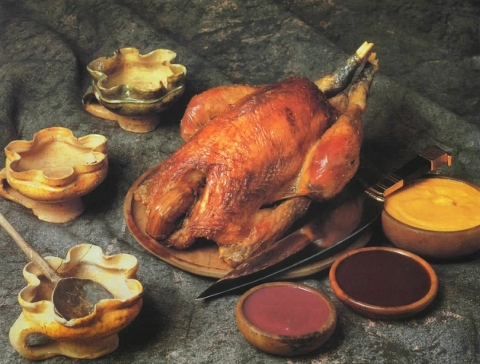
A roasted bird served with various sauces
(Photo from the book "Fêtes gourmandes au Moyen Age")
Cameline was one of the most common sauces used in the Middle Ages. It was so common that it could be purchased pre-made from vendors in late 14th century Paris. When the Ménagier was instructing his new wife about shopping he wrote, "At the sauce-maker's, three half-pints of cameline for dinner and supper and a quart of sorrel verjuice."
It would appear that the ingredients and methods of cooking Cameline sauce tended to vary. In winter it could be boiled up and served hot, in summer the same sauce could be served cold (see Le Menagier de Paris below). As to which spices were included, that would appear to be pretty much up to the cook making it, however Cinnamon is almost always the base spice around which the sauce is constructed. But not always, as a Garlic Cameline recipe suggests in Le Menagier de Paris.
Vinegar (or verjuice) and bread are always added, the vinegar to add sharpness and the bread as a thickening agent. In some recipes wine replaces vinegar but I dare say that in the medieval period, even more so than today there wasn’t much difference between cooking wine and vinegar anyway and it served the same purpose. No quantities of ingredients are given in any of the recipes, which is the norm. The cook would have decided on quantities based on a combination of experience, personal taste and I dare say availability of ingredients at time of cooking.
Cameline sauce seems to have been served with a wide range of foods, especially fish. Pike, Shad, Trout, Lamprey, Red Gurnard, Red mullet, Grey gurnard, Stock fish, Dogfish, Salmon, Mackerel, Garfish, etc . It was also popular with Veal, Mutton, Kid, Lamb, Rabbit, and Heron. But for some reason only lazy people ate it with stuffed piglet? From Le Viandier de Taillevent:
36. Stuffed piglet or pig.
Scald it, wash it well, and put it on the spit. The stuffing is made of pork pluck, cooked pork meat, some egg yolks, harvest cheese, cooked peeled chestnuts and good Spice Powder. Put everything in the piglet's belly, stitch up the slit, and put it to roast. Baste it with a spoon, while turning the roast, with vinegar and good boiling drippings. Eat it hot with Yellow Pepper [Sauce]. Some lazy persons eat it with Cameline [Sauce].
Le Viandier de Taillevent (French, between 1380 - 1395)
155. Cameline: To Make Cameline Sauce. Grind ginger, a great deal of cinnamon, cloves, grains of paradise, mace, and if you wish, long pepper; strain bread that has been moistened in vinegar, strain everything together and salt as necessary.
Forme of Cury (1390)
Take raysouns of coraunce & kyrnels of notys & crustes of brede & powdour of gynger, clowes, flour of canel; bray it wel togyder and do (th)erto salt. Temper it up with vyneger, and serve it forth.
Le Menagier de Paris (French, 1393)
230. Cameline. Note that at Tournais, to make cameline, they grind together ginger, cinnamon and saffron and half a nutmeg: soak in wine, then take out of the mortar; then have white bread crumbs, not toasted, moistened with cold water and grind in the mortar, soak in wine and strain, then boil it all, and lastly add red sugar: and this is winter cameline. And in summer they make it the same way, but it is not boiled.
And in truth, for my taste, the winter sort is good, but the following is much better: grind a little ginger with lots of cinnamon, then take it out, and have lots of toasted bread or bread-crumbs in vinegar, ground and strained.
Ashmole MS. 1439. Sauces (circa 1430-40)
6 Sauce camelyne. Take faire brede, and cut it, and toste it; and take vynegre and wyne, and stepe hit (th)er-in, and draw it (th)urwe a straynour wi(th) poudre canel, and draw it .ij. or .iij. tymes, til it be smothe. And (th)anne take poudre ginger, sugre, and poudre of clowes, & by sugre; and (th)anne put (th)er-to a litil safroune, and salt, and serue hit for(th) (th)ike y-nowe.
Frati, Ludovico, editor, Libro di cucina del secolo XI
This book is also known as The Anonymous Venetian Cookbook
48. Excellent cameline sauce. To make an excellent cameline sauce, take skinned almonds and pound and strain them; take raisins, cinnamon, cloves, and a little crumb of bread and pound everything together, and moisten with verjuice; and it is done.
Beinecke 163
"Sauce camelyn for qualys & othir maner of foules and fysch.
Take white bred and draw hit in the manner of a sauce gynger, with venyger; & put therto poudyr of canell, a grete dele, & poudyr of gynger & poudyr lumbard. & draw hit ayen, & yf thu wilt, draw a lytyll mustard therewith, & sesyn hit up with sygure that hit be doucete. Salt hit & colour hit with safron."
A Noble Boke off Cookry (ca 1468 R. Napier (ed.))
To mak sauce camelyne for quaile, tak whyt bred and drawe it in the sauce in the manner of guinger sauce with venyger put ther to pouder of guinger
canelle and pouder-lombard a goodelle and ye may draw alitille mustard ther with and sesson it up with mustard that it be douce salt it and colour it with
saffron and serue it.
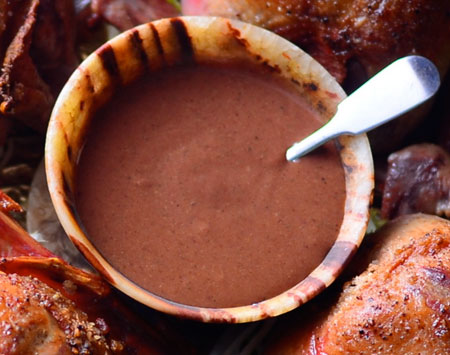
Cameline Sauce
As advised by Mistress Rowenna de Ronçesvalles based on her research of many different recipes for this sauce.
2 cup diluted white or red wine vinegar, extra wine vinegar to thin sauce (see Notes below)
2 cup white or red wine
2 to 1 teaspoon cinnamon
1 cup toasted breadcrumbs
2 teaspoon ginger
¼ teaspoon pepper
¼ t cardamom
pinch mace
pinch clove
salt
Combine vinegar, wine and cinnamon. Add breadcrumbs and soak until liquid is absorbed. Pass through a sieve two or three times (three is better), until very smooth. Add remaining spices. Taste and adjust seasoning. Cameline sauce should be spreadable (like mustard); if it's too thick, thin with more wine or vinegar.
Notes:
• Modern vinegar is much stronger than medieval vinegar (approximately three times stronger) and should be diluted for medieval recipes.
• You may use 1 cup diluted wine vinegar instead of 2 cup each wine and wine vinegar.
• Some of the original recipes have all the additional spices, some have two or three. Adjust the spices to suit your tastes.
• This sauce is much better prepared in advance.
• Consider adding Cameline Sauce to your gravy or pan drippings for roasted meats.
Texture
We’ll use a food processor to prepare the Cameline Sauce, Green Sauce, Pink Garlic Sauce and Sharp Pepper Sauce. While the food processor is fast – and the results are quite good – the texture isn’t quite right.
When you prepare these on your own, please do take the time to press the Cameline, Pink Garlic and Sharp Pepper sauces through a sieve several times, or use a manual food mill. Try preparing the Green Sauce in a blender, or use a mortar and pestle, instead of the food processor – blenders cut with four blades, most food processors cut with two.
Vinegar
Mistress Rowenna de Roncesvalles in her Year-Long Culinary Ithra class advised that modern vinegars are stronger than the vinegars available to medieval cooks. Please remember to dilute your vinegar 3 to 1 with water.
Breadcrumbs
If the recipe doesn’t specify toasted breadcrumbs, please use fresh breadcrumbs (or as fresh as possible). If the breadcrumbs are very dry, they will soak up too much liquid and can change the taste of the sauce if that liquid is other than water.
