Antojitos mexicanos, the corn and tortilla-based dishes
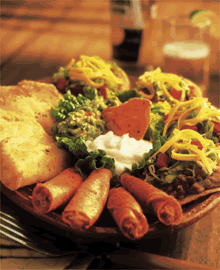
Botana Platter: miniature Flautitas, Cheese
Quesadillas and Chalupitas, served with
guacamole and sour cream
Antojitos, meaning something close to little cravings (antojito means “little whim” in Spanish), are generally made from corn dough, but there are of course exceptions. For instance, to make a proper sincronizada or gringa, wheat flour tortillas are the standard, and tortas require those marvelous French-style Mexican crusty rolls called bolillos or teleras.
In the United States and Mexico, a few antojitos, like enchiladas, have evolved into something more substantial, like a plate lunch served with sides of rice and beans. Also becoming popular are botana (appetizer) plates or platters which often consist of several types of antojitos. The platter in the picture to the left is an assortment of miniature Flautitas, Cheese Quesadillas and Chalupitas, served with guacamole and sour cream.
Most antojitos are corn-based. Corn is quite literally the staff of life in Mexico, and has been for 5,000 years.
- Burritos - Burritos consist of a filling, usually shredded or dried meat, often mixed with a chile sauce, wrapped in a large, thin flour tortilla. They are a specialty of the State of Sonora where they are often packed into saddlebags.
- Cazuelitas - These are a specialty of Chilapa in the state of Guerrero. They are made by pressing a thin layer of tortilla dough around the outside of a small mold and then deep frying it to produce a crisp shallow corn cup. They are filled with shredded meat and other taco fillings.
- Chalupas - These are made by pressing tortilla dough into an elongated shape with a ridge around the edge, resembling the chalupas or canoes from which they take their name. They are cooked on a comal, and sometimes fried as well, then topped with shredded meat, cheese and similar fillings.
- Chilaquiles - Chilaquiles are made with totopos, the crisp fried tortilla quarters that are so familiar as complimentary appetizers in Mexican restaurants. The fried chips are mixed with either a red, green or tomatillo-based chile sauce and heated, often with chicken and cheese as well, and served at breakfast.
- Chimichangas - Deep fried burritos.
- Enchiladas - Enchiladas consist of a corn tortilla that has been "softened" in hot oil and often dipped in a chile sauce, wrapped around a filling of either meat or cheese, then garnished with a little more sauce and cheese. Sonora style enchiladas are made by covering a very thick corn tortilla with heated chile sauce and cheese. (In Mexican-American cooking enchiladas are often made without the initial dipping in sauce and are heated after being topped with a large quantity of chile sauce and cheese, and sometimes sour cream, as well).
- Enchiladas rojas have a distinctive red sauce.
- Enchiladas verdes have a green tomatillo (a small green tomato with a papery husk) sauce
- Enchiladas suizas (“Swiss enchiladas”) are filled with chicken or cheese and topped with a creamy sauce.
- Enfrijoladas are much less common on tourist menus; in this dish the tortillas are covered in a black bean sauce rather than a chile-based sauce.
- Entomatadas are covered in a mild, tomato-based sauce.
- Enfrijoladas - Enfrijoladas are similar to enchiladas except that they are covered with thinned, refried beans, rather than a chile sauce, and the softened tortillas are often folded in half twice into a triangle shape.
- Entomatadas - Enchiladas made by dipping the tortillas to be wrapped around the filling in a sauce, usually of tomato and chiles in the south and more often of tomatillos and chile in the north.
- Envueltos - Another name for tacos that are filled and fried.
- Flautas - Flautas are made by rolling a large corn tortilla around a filling, usually shredded meat, and then deep frying it to a crisp golden brown. Also see taquitos.
- Garnachas - Another member of the gordita family from the Yucatan, often made with the masa shaped into little "plates" with raised edges, then fried.
- Gorditas - Gorditas are made with tortilla dough (occasionally with the addition of other ingredients such as wheat flour or potato) which is patted into circles of 2 - 3 inches then cooked on a comal and sometimes deep fried as well. The filling, often beans or shredded meat and cheese is placed in the pocket formed when a small layer or skin of dough puffs up from the top and can be peeled open.
- Huarache: Literally means “sandal” it is a giant, foot-shaped version of
- Molotes - Corn masa for tortillas, sometimes with a little wheat flour added, is mixed with some lard, rolled into small oblongs, filled and pressed into oblong shaped little packages which are then fried until golden and crisp.
- Pambazo - From the pharase pan bazo, which means literally, brown bread. Originally this term referred to the crudest, most inferior bread. Now it is most often used in connection with two different antojitos: one made with unleavened wheat flour dough that is filled, rolled into an oblong shape and fried. The other consists of a small torta made with a small version of either a bolillo or telera
- Panuchos - This specialty from the Yucatan is made by peeling back the thin skin that puffs from the tortilla as it cooks, filling it, sandwich style, with fried black beans and shredded meat, then frying it to a golden brown. It is then topped with shredded meat.
- Papadzules - These are the enchiladas or soft tacos from the Yucatan that are filled with hardboiled egg and topped with both tomato and pumpkin seed sauces.
- Pellizcadas - A type of gordita or chalupa that is made by pinching (pellizcar means "to pinch") up the dough around the edges to create a raised border to help contain the filling.
- Picada - Another regional name for gordita.
- Quesadillas - Quesadillas are tortillas, usually corn but also flour, that are folded over a filling of cheese, sometimes with the addition of an epazote leaf, squash blossom or other ingredient, and cooked on a greased or ungreased griddle until the cheese is melted and the tortilla begins to become crisp. In some areas an uncooked corn tortilla is folded over the cheese and sealed like a turnover, then fried in oil until crisp
- Salbutes - Tortilla masa, often with flour added, is formed into a small, fairly thick tortilla, fried until crisp and light, then topped with shredded meat and vegetables. A specialty of the Yucatan
- Sopes - Another name for gorditas
- Tacos - Tacos are basically tortillas wrapped around a filling. They are usually defined by either the type of filling, the type of tortilla (corn or flour) and whether the taco is fried or not.
- Tacos al pastor - These tacos are filled with thin slices of marinated pork cooked on vertical spits set beside charcoal, gas or electric heat sources.
- Tacos al carbón - This specialty of northern Mexico refers to tacos filled with charbroiled meats.
- Tacos al vapor - Tacos whose meat filling, often from a cow or goat's head is steamed.
- Tacos de barbacoa - Tacos made from barbacoa.
- Tacos de carnitas - Tacos made from carnitas.
- Tacos de papas: A lucky vegetarian might stumble across a potato taco.
- Tacos de pescado: fish tacos; the fish may be grilled or battered and deep-fried.
- Tacos de cazuela - This refers to tacos filled with ingredients, usually a stew of some sort, cooked in a cazuela.
- Tacos a la plancha - Tacos made from meats cooked on a comal or griddle.
- Tacos dorados - The name of these tacos comes from the golden crisp-fried corn tortilla which encloses them. Usually the filling is of shredded meat.
- Tacos sudados o de canasta - "Sweated or basket" tacos get their name from the fact that they are prepared, often with a stewed, shredded filling, then placed between towels in a basket to keep them warm until they are consumed.
- Tacos de maíz o harina - Tacos de maíz are tacos made with corn tortillas and tacos de harina with flour tortillas.
- Tamales - The original pre-Hispanic tamales were made by placing some uncooked masa (tortilla dough) on a fresh or dried and rehydrated corn husk, adding a filling of meat, seafood, insects, vegetables or fruit, wrapping the husk into a package and steaming it. Following the introduction of lard by the Spanish, this fat was added to the dough which makes it much lighter, and more savory. Tamales are also made with fresh ground corn. In Esplendor y grandeza de la cocina mexicana, Sebastián Verti describes well over a hundred regional varieties made with almost every imaginable ingredient.
Every Mexican region has its own, the most famous being the Oaxacan-style tamales with mole and wrapped in banana leaves, the Mexico City tamales with chicken and green tomatillo sauce wrapped in corn husks, and the Yucatecan style, made with chicken marinated in achiote (annatto paste) and wrapped in banana leaves. - Taquitos - Taquitos are essentially the same as flautas but are theoretically made with smaller tortillas.
- Tlacoyos - This is one of the oldest antojitos of all. Tlacoyos are made by patting tortilla dough around a filling, often of squash blossoms, huitlacoche or mushrooms, until fully enclosed into an elongated shape, which is then cooked on a comal
- Tlayuda - From Oaxaca, this extra-large corn tortilla is cooked until leathery and then piled with condiments like a tostada.
- Tortas compuestas - This is the famous Mexican version of the sandwich. Fillings, including various meats or stews and sometimes whole tamales are placed inside a roll, often a telera, from which some of the crumbs have been removed. Often tortas are named for the country of origin of the filling such as Torta Italia which may contain mortadella.
- Tostadas - Tostadas (literally “toasted”) are made by piling beans, meat, or chicken on a crispy corn tortilla. In Mexico, the classic tostada might have just a smudge of beans, a sprinkling of dry white cheese, a little chopped cabbage and onion, and a delicious salsa. Tourist-oriented restaurants pile on mounds of grated lettuce, yellow cheese, and often guacamole (avocado dip) or sour cream.
