Mexican Ingredients
from jmarquez1976, "Understanding Mexican Cuisine" at http://www.bigsoccer.com/forum/showthread.php?t=291205
Mexican Cheeses
I am going to begin with Mexican Cheeses, because it always turns into a point of contention when discussing the authenticity of the cuisine here. Now, lets be clear about something....Mexicans eat cheese, we eat a fair amount of it...in some regions Mexicans eat more cheese per capita than most European countries. It is integral in many dishes.
However, I am sure that I have confused some people here...you have heard us complain about the Melted Cheese that goes over every dish in Faux Mexicaine. More than anything we object to the cheeses used & how they are used or not used.Mexico has a dozen or so different mainstream cheeses.
Cotija is an aged cheese, more like a Pecorino Romano.....you can crumble it over chilaquiles....I just like it as a slice sitting in the piping hot chilaquil sauce...it wont melt...but it just softens a bit & combines great with the tangy sauce. Good stuff if you like those types of cheeses.
In addition, to these cheeses...there is also a more recent trend of using quality European cheeses in fusion dishes.
> Dutch Edam has been popular in the Yucatan since the early 1900s
> Brie, Blue/Green Cheeses, & Chevre are stars in the Nueva Cocina dishes
> Mexican dairy processors make acceptable imitations of European cheeses.
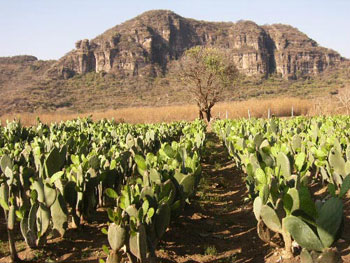
Nopan Field
Nopal Cactus
The Nopal is one of Mexico's sacred vegetables, as it is found & consumed just about anywhere & everywhere in the country. It is a very hardy plant in very harsh climates, and is a good analogy of the Mexican people....extremely resilient, a little thorny on the outside, and a great treat for those who know how to unlock its gifts.
The Nopal is so inherently part of Mexican cuisine that any restaurant that doesn't have it on the menu is incomplete...and this goes for High End establishments as well as Casual sit down places. This takes us back to why I am unsatisfied with L.A.'s Mexican dining situation....the plant grows all around the Southwest, you can buy it fresh at Whole Foods, Farmers Markets, Ethnic Markets & even some mainstream supermarket chains...yet for some fuct up reason...it is nearly impossible to find restaurants that serve it.....and when they do, they are often from a can.
How to eat Nopal? The most common recipe in the Mexican repertoire is the Cactus Salad (chilled steamed tender cactus strips with fresh diced tomato, onions, cilantro, avocado & a little bit of good salt).The Nopal has a slightly green, crisp flavor that is echoed in Silver Tequilas...and it melds with other flavors quite easily. Further, the Cactus Salad plays right in to the Mexican culinary scheme. Earlier, I mentioned that Rice & Beans as sides where a cop out...a shortcut, taken by cheap Mexican restaurants. The thing to understand about Mexican Culinary philosophy is that it is important to balance Cold & Hot foods (e.g., topping Pozole with crisp Cabbage) & to balance Cooked & Uncooked foods. In the traditional Comida scheme, you might eat something like:
> Soup (obviously Hot & Cooked)
> Saucy Pot Roast with a Side of Cactus Salad
> Fresh Fruit for Desert
Mexican cuisine is not just about spicy & bold flavors...its about balance & health as well.
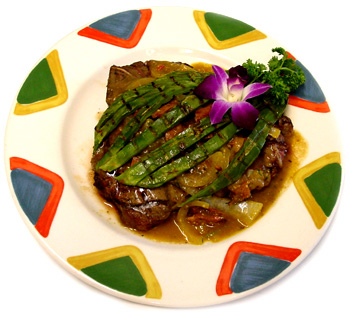
Grilled Steak w/ Salsa & NopalOther than Cactus Salad...the Nopal is often Grilled or Griddled & served in Sauce. In high end Mexican restaurants you might get a Filet Mignon served on Griddled Nopal that is swimming in a Tomato-Chipotle sauce. A forkful, of steak, nopal & seared salsa is certainly something memorable.
On the vegetarian front (there is tons of vegetarian food in Mexico...mostly because people can't afford to eat meat every meal...not out of choice...although the average Mexican meal probably contains 3 to 4 ounces of meat used mostly to flavor the sauce, vegetables & tortillas rather than as a protagonist) the Nopal is often served in rich sauce, like say a Mole, and accompanied with a nice wedge of Cheese or hard boiled eggs.
The Nopal is also used in Soups, and Sauteed with Eggs and/or Chorizo for breakfast.
Eggs
Eggs are and have always been crucial in Mexico. In Contemporary Mexico, they play a vital role as the least expensive complete protein (along with milk & cheese). In this role, Eggs can be eaten at any time of day...and frequently subsitute Meats directly in many classic recipes.
In Ancient Mexico, Eggs (Bird, Turkey, Duck, Turtle etc.,) played a dual role.
> As just another protein source in the diverse pre-hispanic diet. (Eggs were not as easy to obtain as today)
> As part of the Ancient Haute cuisine. Early Spanish writings tell us that the Aztecs used Eggs (& Avocado) in a similar role that Cheese plays in Contemporary Mexican cuisine. They were used to contrast spicy sauces...and for textural layers. As an example, one Moctezuma's favorite dishes was a folded over Enchilada stuffed with Shredded Turkey & topped with slices of hardboiled Eggs. Incidentally, a similar dish is still very common in the Yucatan and referred to as Papadzules (Tortilla stuffed with Chopped Hard Boiled Eggs & Smothered in Pumpkin Seed Sauce).Eggs are very common as a breakfast food. Most preparations aren't particularly exciting (Eggs scrambled with Chorizo or Salsa, Omelettes with cheeses & vegetables etc.,)...but there are couple of notable Mexican egg dishes:
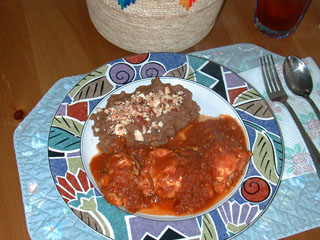
Huevos Ahogados (Drowned Eggs)Huevos Ahogados (Drowned Eggs)...these are typically Eggs that are poached directly in a thin salsa (your favorite salsa...that is slightly diluted with a combination water & chicken/veggie broth). These are great because salsas add lots of flavor without adding much calories, sugar or fat...and because you don't lose any of the egg as you do when you poach in a water/butter solution.
One of the essential things to know about Mexico...is that its cuisine is very, very seasonal....and whenever something is in season...we find a way to sneak it into almost everything we eat. As such, the salsas are often used to cooked a bit of greens or mushrooms before the eggs are added. This is notable, because in a typical day in Mexico...you can easily eat 10 fruits & vegetables without even noticing.
In addition to Poaching in Diluted Salsa...Mexicans also poach Eggs & Serrano Chiles in a Bean Broth (I love Black Bean Broth myself). The Eggs are served with the Poaching broth in a bowl and then topped with a little bit of chopped onion & herbs for an unforgettably delicious, light yet satisfying breakfast.Another great little touch to Eggs...is "Blistering." Basically you fry a couple of eggs in good quality Lard (pork fat that is leftover from frying bacon or carnitas....not the refined, tasteless crap in a box)....and you take spoonfuls of the hot lard and pour over the top of the eggs a few seconds after you crack them into the pan. It creates an interesting texture...and adds a little more of the lard flavor.
As far as lunch or dinner uses of eggs...people frequently serve fried or hard boiled eggs and fresco cheese in their favorite salsa or mole. Also, eggs (with mushrooms) are used to extend a little bit of meat. For example, you make take some leftover shreeded beef, a bunch of meaty mushrooms, onions & poblano chiles...and then sautee them with a couple of eggs...and everything served in a cooked salsa, to be eaten family style with a bunch of beans & corn tortillas.
And to round up the Eggs discussion, I forgot to mention the most important non-breakfast; non-dessert Egg application.......... Souffle Batter.
In the States, the best know Mexican dish that uses the Souffle Batter is known rather loosely as the Chille Relleno, its a Roasted Poblano Pepper, stuffed with Cheese, then dipped in frothy egg batter rolled with a little flour or cornmeal....and panfried to a golden brown.
But the Poblano is not the only food that gets this treatment: Stuffed Pumpkin Blossoms, Native Mexican Greens.
Peppers
Leading off the Souffle Batter post.....lets discuss the Chile Relleno. It is one of the most loved, & common dishes in all of Mexico. Most restaurants have some kind of Chile Relleno on the menu as a testament to its inseperable relationship with Mexican cuisine.
Of course, when the Official National Dish is a stuffed Poblano....what else can you expect? The Chile en Nogada was literally created for the first anniversay of independence from Spain.....drawing from fresh ingredients readily availabe in mid September:The stuffed Poblano (far superior to the Bell Pepper as a stuffing chile) comes in many variations. They can be souffle-fried or just roasted, served dry or with a thin sauce (usually an herby tomato sauce), they are stuffed with melting cheese, moist cheese, dry cheese, brie....meats, seafood, foie gras.....you can imagine people like to give it their own twists. My favorite Poblanos are the:
> Semi hard cheese, souffle battered, tomatoe-epazote sauce Poblanos that are common in Oaxacan restaurants.
> Roasted Poblano stuffed with Chicken Tinga (shredded chicken & carmelized onions in a chipotle-tomatoe sauce)Further, our Chile stuffing predilection does not end with the Poblano. The fascinatingly complex Ancho (a dried Poblano pepper that turns maroon as it dries) is rehydrated & stuffed with the classic combination of Chorizo & Potato.
And one of my favorites....the stuffed Jalapeno that is so common & beloved in the state of Veracruz (the Jalapeno derives its name from the town of Jalapa / Xalapa in Veracruz). The Jalapeno is also stuffed with cheese & paired with tomatoe sauces....but its better application is as a great little canvas for small plates:
> Fresh Crab Meat
> Creamed Tuna (tuna blended with cream cheese)
> Tuna Tartare
> Beef Ceviche (raw ground beef marinated in lime juice)
> Goat CheeseIts time to get a little deeper into the soul & crux of Mexican Cuisine. Lets start by discussing the omnipresent Chile. The Chile (Capsicum) is a extremely low calorie nutrient dense fruit that adds flavor & life to just about anything.
The Chile originated somewhere in Mesoamerica many moons ago, and was spread throughout the new world by migratory birds....findings its greatest diversity and culinary expression in Mexico where it is revered. The Chile which is culinarily labeled as a condiment or spice, is the world's MOST consumed & most traded spice. Most Chiles consumed around the world are variants of Contemporary Mexican chiles...while most chiles consumed in Europe are variants of Contemporary Andean chiles (such as the bell pepper & paprika).
In Mexico, the Chile is analogous to the Wine Group. There are dozens of Chiles in the Mexican pantry and they all have their own flavor profiles and culinarly purspose. Further, Chiles are processed in various ways (Sun Drying, Smoking, Grilling, etc.) to enhance their specific qualities.
I am not going to discuss every Chile....but the point that I wanted to make is that there are dozens of types (close to 100), that they come in a surprisingly large range, and that they are key in understanding the cuisine. See...people in Mexico talk about Chiles like the French talk about Wine....they know their varietals, they relish in their nuances, they discriminate regional variances and can tell you what 5 different types of Chiles you used in your Mole within a couple of seconds.
The Ancho Chile is a Sun Dried Poblano. Its mild, meaty, tangy flesh is reminiscent of Plumbs, Tamarind & Cherries.
The Guajillo is medium hot to hot, direct pepper with raspberry & woodsy notes.
There are two types of Chipotle:
Dried (Morita)
Smoked (Ahumado or Meco)They are both used interchangeably....but do have some different characteristics. The Morita (Red Chipotle) is a Sun Dried Jalapeno with deep wood, smoke & berry flavors. The Ahumado or Meco is a smoked Jalapeno. It is hotter than the morita, smokier, "darker" & earthier.
The Pasilla or Negro, is a dried Chilaca. It has similar heat as a Guajillo...has a great elegant, black color with a very brash...less nuanced flavor that makes it a great workhorse that combines perfectly with other chiles as well as roasted garlic etc.
The Chile de Arbol is very, very hot...and direct. Its flavor is most similar to the red pepper flakes you get at Pizza places.
The Serrano combines heat with a pleasant grassy flavor & burnt bacon. It is the Raw chile you can have...whether taking a bite out of it, chopping into to a salsa or marinating it with Ceviche.
The Chile de Agua, is a favorite in Oaxaca, that resembles a Jalapeno in flavor & appearance. However, it is fairly mild....so it makes a great, great Chile that you slice paper thin and top your favorite foods. I particularly like it in Salads.
The Jalapeno, of course, is the preferred Chile for pickling.
Chocolate and Vanilla
Before I continue with the analysis of Salsas & Sauces...I wanted to take a quick break to provide you guys with some relief from the Winter Blues.
As you may know, both Chocolate and Vanilla are native to Mexico. Just as with the Chile pepper, they became wildly successful around the world during the Colonial area. In fact, today Chocolate & Vanilla are considered the World's most popular flavors.
Chocolate (from the Nahuatl Xocolatl which means bitter drink) in Pre-Hispanic Mexico, and to some degree in Contemporary Mexico, had two purposes:
> Major caffeinated beverage for the blessed. In fact, Mayan priests imbibed Hot Chocolate on the long nights when they observed the stars...and on nights when they transformed into their alter egos (Jaguars, Eagles etc.,) in rituals.
> Savory condiment. Xocolatl contributes to Mole and other Chile based sauces & marinades. In fact, in Contemporary Mexican cuisine....Ground Chocolate is used as a dry rub on Filets & other fine cuts of meat.
Vanilla, which originated in Eastern Mexico (Veracruz & Tabasco) with Mexico's earliest civilizations (Olmecs)...and is still very commonly used in the traditional cuisines of those states. In addition to its sweet uses, Vanilla also features in savory cuisine...particularly as a floral addition to seafood specially shrimp & scallops.As I type...I am enjoying a Mexican Hot Chocolate.
If you are ever in Mexico, you have to try one made completely from scratch (Chocolate & Vanilla beans ground in a volcanic metate etc.,). But for now you can make this at home, quite easily, from Dark Chocolate Chips (its best if the first ingredient is Chocolate Liquor rather than sugar)....I make it from Trader Joe's Belgium 72% Dark Chocolate (you get more than a pound for $4):
6 Squares of Chocolate (2.6 to 3.0 ounces)
3 Cups of Water
6 Tablespoons of Sugar (or Honey)
1 Teaspoon Real Vanilla
1/2 Teaspoon Cinnamon
Sprinkle of Chile Powder (like Cayenne, Arbol or Ancho)(1) Combine all ingredients in a sauce pot (make sure you leave plenty of room) and bring to a boil over high hot
(2) At some point it will start to foam & boil over....let the foam almost get to the top...then remove from heat until the foam recedes. Repeat this 2 more times.....taste & make final adjustments.Notes:
If you want to make this really specially you can start with Cinammon Sticks & Water....to make a Cinnamon tea before adding the remaining ingredients. It will make your house smell better and give you a more delecate melding of flavors.
Mexican Vanilla was the world standard prior to trade disruptions in the 20th century, and corruption via Vanillin. Now it's back, and has regained its status as the world's best (it has a sweeter, more floral character than Tahitan & others).
