What Is Mole?
from http://en.wikipedia.org
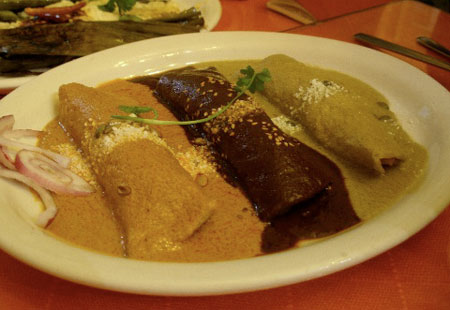
From La Casita Mexicana, a Mexican restaurant in L.A. owned by Jaime
Martin del Campo and Ramiro Arvizu: Three Moles Enchiladas filled with
chicken or cheese and topped with three different signature moles:
pepian rojo, mole Poblano, and pepian verde. Jaime and Ramiro won a
Chile Relleno “Throwdown” against Iron Chef Bobby Flay.
Perhaps the most famous Mexican chile dishes are the moles. The word mole, from the Náhuatl molli, means "concoction" or "mixture," as in guacamole, a mixture of vegetables (guaca). Some sources say that the word is taken from the Spanish verb moler, meaning to grind. Whatever its precise origin, the word refers to a vast number of sauces utilizing every imaginable combination of meats, vegetables, spices, and flavorings - sometimes up to three dozen different ingredients, as well the dishes based on these sauces, such as Mole Poblano de Guajolote (Turkey Mole).
Mole can be best defined as a very thick, homogeneous sauce with complex flavors. This distinguishes it from most Mexican salsas which have a thinner consistency, often raw, and contain fewer ingredients (usually nothing more than tomato, onion, garlic and chili pepper) in still-identifiable chunks.
Outside of Mexico, mole often refers to a specific sauce which is known in Spanish by the more specific name Mole Poblano. This is the mole found on menus in the United States. In contemporary Mexico, the term is used for a number of sauces, some quite dissimilar to one another, including black, red, yellow, colorado, green, almendrado, and pipián. The most popular kinds come from the Mexican states of Puebla and Oaxaca.
The earliest moles were simple compared with what was to come after the Spanish invasion. Ana M. de Benítez, who reconstructed pre-Columbian dishes based on de Sahagún's descriptions, used four different chiles (ancho, mulato, pasilla, and chipotle), plus tomatoes, garlic, pumpkins, tomatillos, and chayote as the basis of her moles. The addition of Eastern Hemisphere ingredients such as almonds, raisins, garlic, cinnamon, and cloves would eventually transform the basic mole of the Aztecs into a true delicacy.
In Mexico today, cooks who specialize in moles are termed moleros, and they even have their own competition, the National Mole Fair (Feria Nacional del Mole) held every year in October at the town of San Pedro Atocpan, just south of Mexico City. At the fair, thousands of people sample hundreds of different moles created by restaurateurs and mole wholesalers. This fair is the Mexican equivalent of chili con carne cookoffs in the United States; the moleros take great pride in their fiery creations and consider each mole a work of art in the same way that chili cookoff chefs regard their chili con carne. Often the preparation of a family mole recipe takes as long as three days. Their recipes are family secrets not to be revealed to others under any circumstances; indeed, they are passed down from generation to generation.
Chiles Used in Moles
The color of a particular mole depends mostly upon the varieties of chiles utilized. A green mole consists mostly of poblano chiles (and tomatillos rather than tomatoes) while a red mole could contain three or four different varieties of dried red chiles, such as chiles de árbol, or cascabels. The brown and black moles owe their color to pasillas and anchos, both of which are sometimes called "chile negro" because of their dark hues when dried. The dark color of mole negro can also be the result of roasting the chiles until they are almost black, as is the custom in Oaxaca.
Other than chiles, there are literally dozens of other ingredients added to the various moles, including almonds, anise, bananas, chocolate, cinnamon, cilantro, cloves, coconut, garlic, onions, peanuts, peppercorns, piñons, pumpkin seeds, raisins, sesame seeds, toasted bread, tomatillos, tomatoes, tortillas, and walnuts. Undoubtedly, some moleros add coriander, cumin, epazote, oregano, thyme, and other spices to their moles.
Every ingredient here earns its place in the final dish. Toasted nuts and sesame seeds add layers of distinct nutty flair and body and a soft savoriness that helps tame the sauce's more bitter elements. A base of fried tortillas, bread, and ripe plantain lends thickness and subtle earthiness, while raisins and other fruits echo the fruit-forward notes in the chiles. A tablet of Mexican chocolate, melted into the mole at the end, rounds out the bitterness and adds a silky sheen.
Mole Poblano, classic mole from Puebla
Mole Poblano, originally called mole de olores ("fragrant mole"), is the sauce traditionally served on special occasions such as Christmas that combines chiles and chocolate, a popular and revered food of the Aztecs. Moctezuma's court consumed fifty jugs of chile-laced hot chocolate a day, and warriors drank it to soothe their nerves before going into battle. However, the story of how chocolate was combined with chile sauces does not involve warriors, but rather nuns.
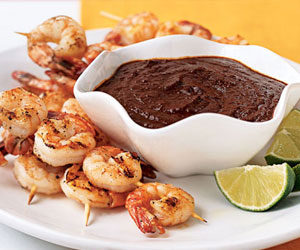
Shrimp with Mole Poblano
Legend holds that mole poblano was invented in the sixteenth century by the nuns of the convent of Santa Rosa in the city of Puebla. It seems that the archbishop was coming to visit, and the nuns were worried because they had no food elegant enough to serve someone of his eminence. So, they prayed for guidance and one of the nuns had a vision. She directed that everyone in the convent should begin chopping and grinding everything edible they could find in the kitchen. Into a pot went chiles, tomatoes, nuts, sugar, tortillas, bananas, raisins, garlic, avocados, and dozens of herbs and spices. The final ingredient was the magic one: chocolate. The chocolate, they reasoned, would smooth the flavor of the sauce by slightly cutting its heat. Then the nuns slaughtered their only turkey and served it with the mole sauce to the archbishop, who declared it the finest dish he had ever tasted.
This is a great legend, but a more likely scenario holds that the basic mole of the Aztecs was gradually transformed by a collision of cuisines. Regarding the use of chocolate, since that delicacy was reserved for Aztec royalty, the military nobility, and religious officials, perhaps Aztec serving girls at the convent gave a royal recipe to the nuns so they could honor their royalty, the archbishop. At any rate, the recipe for mole poblano was rescued from oblivion and became a holiday favorite. De Benítez noted: "In the book on Puebla cooking, published in Puebla in 1877, we find recipes for making forty-four kinds of mole; there are also sixteen kinds of manchamanteles (tablecloth stainers) which are dishes with different kinds of chiles."
Moles of Oaxaca
But Puebla is not the only state in Mexico with a reputation for moles. Oaxaca, in the south, lays claim to seven unique moles--and dozens and dozens of variations. In Tradiciones Gastronómicas Oaxaqueñas, the author, Ana Maria Guzmán de Vasquez Colmenares, noted: "There must be something magical in the number seven, for the number of Oaxacan moles coincides with the wonders of the world, the theological virtues, the wise men of Athens--and for their wisdom which elected the number seven to represent justice."
"There may be seven moles," say the locals, "but thousands and thousands of cooks each has their own private version of all of the moles, so how many does that make?" One magazine writer suggested: "Oaxaca should be the land of 200 moles!"
For the record, the seven moles are:
- Mole Negro (best known of Oaxaca moles)
- Mole Coloradito
- Mole Verde - always made fresh with herbs native to the region
- Mole Amarillo
- Mole Rojo (Red Mole)
- Manchas Manteles ("Tablecloth Stainer")
- Mole Chichilo
They are all descendants of Clemole, believed to be the original mole of Oaxaca. It was quite simple, being composed of ancho and pasilla chiles, garlic, cloves, cinnamon, and coriander.
The Oaxacan moles are characterized by unusual chiles that are unique to the region. There are sixty chiles grown only in the state of Oaxaca and nowhere else in Mexico. Some of these unusual chiles include chiles de agua, which grow erect and are pointed at the end. The chiles chilhuacle, which are short and fat, come in two varieties, black and red. The red variety is called "the saffron of the poor" because a small amount of ground chilhuacle rojo gives are similar coloring to foods. Other unique chiles are the red-orange chiles onzas, the yellow costeño, and the pasilla Oaxaqueña (sometimes called pasilla Mexicana),
There is an easy way to make moles. Instead of tediously grinding all the ingredients on a metate, cooks go to the Benito Juárez market, buy all their chiles, nuts, and seeds, and have them custom-ground in the special molinos, or mills in another section of the market. The result is a dark paste which is later converted into a mole sauce.
Susana Trilling, of Season of My Heart Cooking School outside of Oaxaca, describes the more tedious process: "The chiles are toasted black, soaked and ground, and blended with fried tomatoes, tomatillos, and roasted garlic and onions. Then come nuts and seeds--some toasted, some fried. Almonds, peanuts, pecans, chile seeds, and sesame seeds. There are almost always more sesame seeds than any other seed or nut. They have to be fried slowly and carefully, with lots of love and attention." Hence the affectionate Mexican dicho (saying): "You are the sesame seed of my mole."
There are other special ingredients which characterize the different Oaxacan moles. Avocado leaves, difficult to find in the U.S. and Canada, are used in mole negro. Fresh green herbs such as epazote and parsley are the source of the green color of mole verde. Pineapple and banana are added to manchas manteles, while string beans, chayote and chiles costeños are ingredients in mole amarillo.
Many different meats are added to moles, from chicken to beef to fish, but by far the most common meat served is turkey. In fact, turkey is so important in mole negro, that Mexican writer Manuel Toussaint noted that the turkey in the mole was as important as the eagle in the Mexican flag, and another writer suggested that to refuse to eat mole negro was a crime of treason against the homeland!
Types of Mole
Mole Amarillo uses Ancho, Costeño, and Guajillo chiles, green tomatoes and tomatillos, onion, garlic, clove, cumin, black pepper, cilantro, chilcoxle, and hoja santa or pitiona, depending on the type of mole vessel.
Mole de Cacahuate, or "Peanut Mole", made of ground peanuts and chiles, is typically served with chicken.
Mole Chichilo is also one of the less common moles, with an odd ashy flavor. It has Chilguacle Negro, Mulato, and Pasilla chiles, tomatillos and tomatoes, cloves, black pepper, and corn dough. Avocado leaves add a hint of anise flavor.
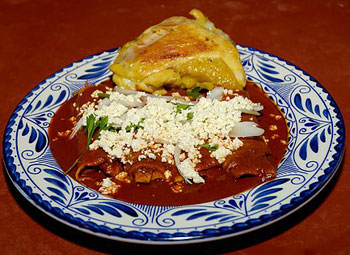
Chicken Mole Coloradito with Enchiladas
Mole Coloradito
Mole Coloradito has a brick red color and a simple taste. It uses Ancho and Pasilla or Guajillo chiles, almonds, sesame seeds, tomatoes, garlic, oregano, cinnamon, banana, pumpkin seeds, crackers, and sugar.
Recipe for Mole Colorado
Mole Mancha Manteles is characterized by its sweet, tart, and spicy notes. It's made with a blend of ancho and pasilla chilies, fruits like pineapple and apple, and spices like cinnamon and cloves. This sauce is commonly used in Mexican cuisine to complement meats like pork, but also pairs well with shrimp and vegetables.
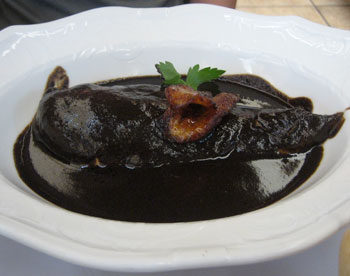
Mole Negro
Mole Negro, black mole, is the most difficult to prepare. Traditionally, black mole has six different kinds of chile peppers, Chilguacle Negro, Mulatto, Pasilla, Ancho, Guajillo, and Chipotle, although many sauces that carry the name contain fewer. The ingredient list is very long, featuring many seeds, nuts, spices, herbs, and chocolate.
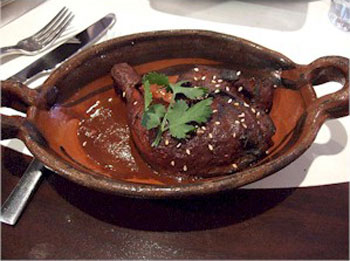
Mole Poblano
Mole Poblano, whose name comes from the Mexican state of Puebla, is a popular sauce in Mexican cuisine and is the mole that most people in the U.S. think of when they think of mole.
Mole poblano is prepared with dried chili peppers (commonly ancho, pasilla negro, guajillo or mulato and chipotle), ground nuts and/or seeds (almonds, indigenous peanuts, and/or sesame seeds), spices, Mexican chocolate (cacao ground with sugar and cinnamon and occasionally nuts), salt, and a variety of other ingredients including charred avocado leaves, onions, and garlic. Dried seasonings such as ground oregano are also used.
In order to provide a rich thickness to the sauce, bread crumbs or crackers are added to the mix. Because of the labor-intensive nature of Mole Poblano, when prepared at home it is most often made in large batches on special occasions, such as religious holidays, birthdays or weddings.
Recipe for Mole Poblano (the mole I have always made)
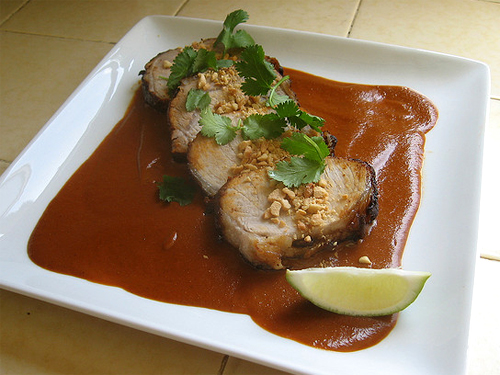
Puerco En Mole Rojo
(Chipotle-marinated Roasted Pork with Red Mole Sauce)
Mole Rojo is lighter red and spicier than Coloradito. It uses Ancho and Guajillo chiles, onion, tomatoes, pecans, peanuts, sesame, garlic, oregano, chocolate.
Recipe for Classic Red Mole (Mole Rojo Clasico)
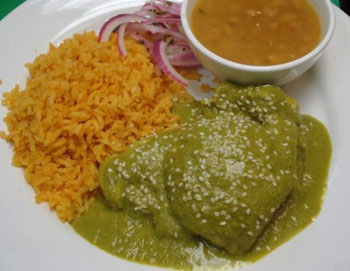
Mole Verde
Mole Verde (also "tomate verde" or "miltomate" in Spanish) achieves its distinctive green color from the toasted pumpkin seeds that form the sauce's base, as well as using ingredients such as Romaine Lettuce, cilantro, epazote, and tomatillos.
Diana Kennedy's Mole Verde.
