Middle Eastern Phyllo Pastries
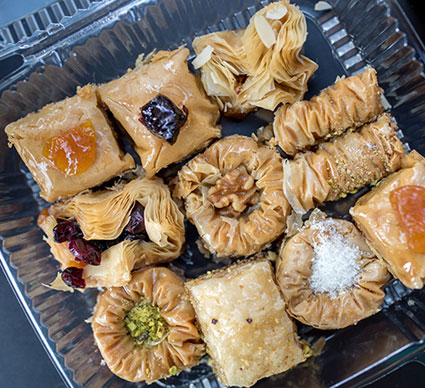
Baklava is a rich, sweet pastry made of layers of filo filled with chopped nuts and sweetened and held together with syrup or honey. Baklava is a traditional dessert in countries that were part of the former Ottoman empire. Early recipes for baklava date to the fourteenth century. There are several variations of this pastry often made with phyllo sheets, but kataifi, a shredded phyllo dough, is also becoming popular.
Although the history of baklava is not well documented, its current form was probably developed in the imperial kitchens of the Topkapı Palace in Istanbul. The Sultan presented trays of baklava to the Janissaries every 15th of the month of Ramadan in a ceremonial procession called the Baklava Alayı.
Baklava is normally prepared in large pans. Many layers of filo dough, separated with melted butter and vegetable oil, are laid in the pan. A layer of chopped nuts—typically walnuts or pistachios, but hazelnuts are also sometimes used—is placed on top, then more layers of filo. Most recipes have multiple layers of filo and nuts, though some have only top and bottom pastry.
Before baking (180 °C, 356 °F, 30 minutes), the dough is cut into regular pieces, often parallelograms (lozenge-shaped), triangles, diamonds or rectangles. When the baklava is fresh out of the oven and still hot, a sweet syrup—a honey syrup in Greece, and an orange-blossom or rose-water scented sugar syrup in Lebanon and parts of the Middle East—is poured over the top of the dessert, which is then left to soak for several hours. The syrup marries with the filo layers and nuts in a glorious sticky union.
Baklava is usually served at room temperature, often garnished with ground nuts.
Pastry shops have come up with many different variations as can be seen below. Besides the flat sheets of phyllo dough, there is a dough called Kataef or Kataifi, which is basically phyllo dough that has been shredded. Bunches of these strands are treated much like the sheets in that they are brushed with butter and soaked with a syrup after baking.
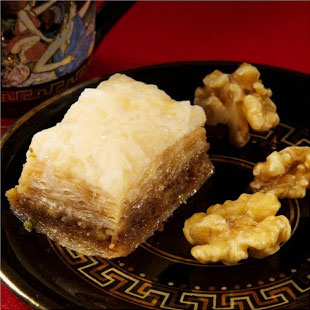
Baklava
Baklava - made with finely chopped walnuts. This is the traditional baklava; what you normally get if you order baklava at a restaurant or pastry shop. This picture shows the Turkish version which layers the nuts in the middle between layers of phyllo on the bottom and top. Greek and other versions contain several layers of nuts and phyllo dough.
It's common to find baklava made with rosewater in Syria, or honey and cinnamon in Greece, but Turkey maintains certain purist baklava standards, no matter how you fill it, wrap it, or slice it. "It is important that baklava is never made with honey, but with a simple sugar syrup," explains culinary travel expert Selin Rozanes of Turkish Flavours.
Recipe for Greek Baklava (made with cinnamon, cloves and honey)
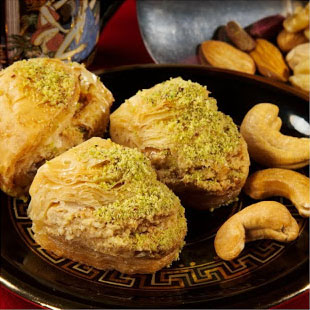
Kol w shkor
Kol w shkor, or Kulwuskur - made with cashew nuts.
For the cashew lover, a delightfully crispy pastry shell stuffed with smooth, crumbly ground cashews. Translated from the Arabic Kol w shkor, it means “taste and be thankful”.
The phyllo dough is folded over to make a pouch of crispy layers of phyllo and cashews.
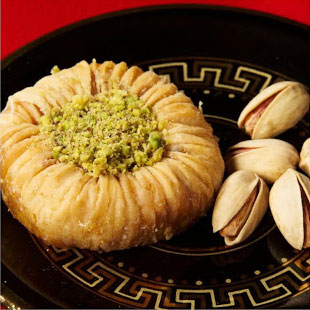
Swar
Swar - made with pistachios.
Swar, also called Turkish Nightingale’s Nests, is created by wrapping phyllo around a thin Turkish rolling pin, called oklava, and delicately working it to resemble a pretty bracelet. The end of the phyllo sheets are not rolled up, but are used to form the center of the pastry.
Recipe for Turkish Nightingale’s Nests including instructions on forming the shape.
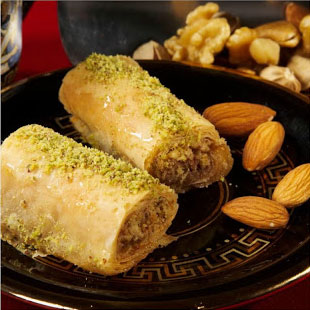
Assabeh
Assabeh, also called Assabee - made with almonds.
This is baklava made into a log shape. Instead of walnuts, almonds are traditional.
Recipe for Almond Baklava Fingers
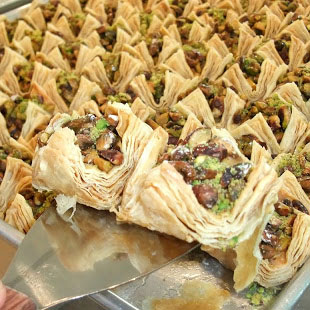
Wardeh
Wardeh - made with pistachios.
Wardeh is made by shaping the phyllo into pretty petals and filling it with whole and crushed pistachios.
I've also seen these called Bukaj or Boukage. The Palestinian word «bukjah» refers to an old fashion way of making a suitcase from a large piece of fabric. Personal items would be placed in the middle of a large square piece of fabric which is then pulled from its four corners to enclose the items.
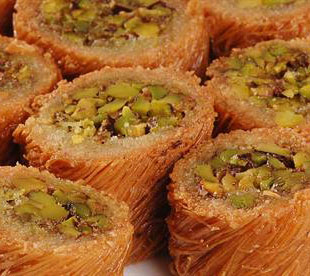
Borma (golden bird's nest roll)
Another variation of baklava is made with shredded Kataef or Kataifi (shredded phyllo dough) resembling vermicelli rice noodles. The shredded dough is treated the same a regular phyllo dough. It is brushed with butter and baked to a golden crispy brown.
Borma, sometimes written Burma, comes from the Palestinian word for «Rounded». It got its name from its unique rounded shape.
Recipe for Greek Nut and Honey Pastry Rolls. This recipe has you roll individual bird's nests, but some recipes tell you to roll lengths of dough with pistachio nut filling, then cut into portion-size lengths that are baked as in the picture.
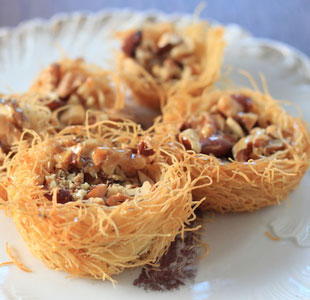
Osh El Bulbul (Bird's Nest Pastry)
There are other inventive recipes that have you fill small muffin tins with kataifi to form a nest, bake them, then fill with toasted nuts and drizzle with the honey, or other flavored, syrup. Other recipes free-form the bird's nests.
I've seen these called Osh El Bulbul, which means "Bird's Nest" in Arabic.
The pictures below are from Damas Sweets. Cute little "Sparrow's Nests" that hold only a few nuts. These would be nice to place here and there on a Middle Eastern appetizer table or tray. They would also be good made with whole almonds, Brazil nuts, or any other favorite nut.
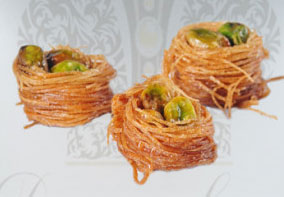
Sparrow's Nest Pistachio
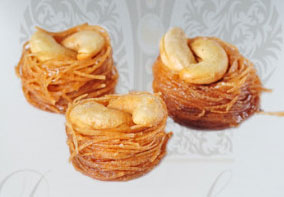
Sparrow's Nest Cashew
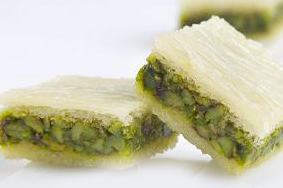
Ballooriyeh (white bird's nest squares)
Also spelled Ballourie or Ballorieh.
Ballooriyeh, pronounced [bal-law-ri-yeh], is sweet with a rich pistachio filling and is covered with a delicious stringy Kataifi dough (shredded dough) crust on top and bottom.
It gets its characteristically white glowing color from the fact that it is very lightly baked and its dough is kept almost raw. The added sugar syrup gives it its shiny look. It is the only piece among all assorted Baklava types that is kept almost raw. In fact, it is baked for only about few minutes. Its thick and rich pistachio filling makes it the preferred piece for pistachio lovers.
The Turkish also make a coconut ballorieh.
Recipe for Ballourie or Ballorieh Baklava
